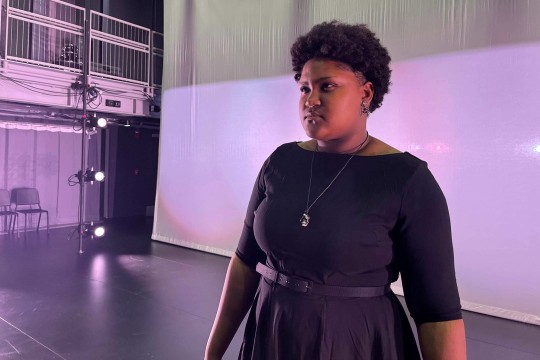
Ryan Underbakke Headshot

Ryan Underbakke

Visiting Assistant Professor, Performing Arts

School of Performing Arts
College of Liberal Arts

Ryan Underbakke

Visiting Assistant Professor, Performing Arts

School of Performing Arts
College of Liberal Arts

Currently Teaching

PRFL-130
3 Credits
An introduction to theatre as a performing art. Students develop skills in reading, analysis and evaluation through an examination of theatre’s forms, constituent elements, and its cultural, stylistic and historical development.
PRFL-222
3 Credits
This course is an in-depth and hands-on study of improvised storytelling. Students will investigate the creative process by exploring the primary tools and techniques for creating improvised scenes, progressing from basic to advanced to theatrical compositions. Students will engage in various long-form improv structures to create compelling and crafted performances that explore themes, situations, and references situated in a modern cultural context. Major topics include foundations of physical storytelling, character creation and role playing, developing unscripted work, and extemporaneous presentation. The course highlights interpersonal communication through ensemble-based creation and collaboration.
PRFL-230
3 Credits
Devising theatre is a collaborative process in which a group of individuals produce a wholly new or adapted piece of theatre. This course is a hands-on exploration of that collaborative process and places students at the center of their own artistic expression. Through a series of class discussions and lectures, readings, writing assignments, creative exercises, brainstorming sessions, and acting workshops, students will learn about the history and theories of devised theatre as a tool for social change, while also generating their own theatrical pieces for individual and group presentation. Above all, this course fosters an ensemble-building atmosphere and imparts to students the importance of teamwork and communication in working toward a shared goal.
PRFL-288
0-1 Credits
This course involves rehearsing and performing in small performance groups in music, theatre and dance. Groups may include flute choir, saxophone quartet, horn ensemble, woodwind or brass ensembles, theatre groups engaged in devised or classical theatre, dance groups, or mixed instrument or vocal groups. Ideas about as well as the application of collaboration and/or improvisation will be emphasized. Students will be led by a faculty member and will rehearse weekly. Collaborative practice in rehearsals and performances will also be discussed and applied within the context of the students’ major(s). Instructor approval required.
PRFL-319
3 Credits
Themes in Theatre Studies is a variable topics course that offers students a deep dive into a specific subject of theatre theory and history. Topics and methods vary from term to term, though each offering features an introduction to a theme, concept, methodology, or other subfield of study within theatre history and play analysis. The course offers the opportunity to build knowledge and evaluate the artistic expression of specific events, issues, and opportunities unique to theatre, dramatic theory, and performance studies. Possible subjects range from the history of mask-work on stage, witches depicted through dramatic literature, and theories of theatrical space in site-specific performance. Students develop theoretical and experiential knowledge of the topic under investigation while fostering opportunities to respond to recent events and to interpret the societal and cultural frameworks in which the concepts emerge. Students, acting as investigators, delve deeply into their topics, conducting research and exploration to create deliverables appropriate to their experience. These may include presentations, projects, and performances, all of which reflect their investigative process and findings. The topic will be announced prior to the course offering.
PRFL-334
3 Credits
This course will continue to develop concepts introduced in PRFL 221: Fundamentals of Acting and PRFL 333: Auditioning Techniques and will focus on scene study. Through scenes from a variety of play texts such as contemporary, American classic, European Realism, Shakespearean, as well as tv/film scripts, students will hone their skills of text reading, script analysis, character development with a critical eye, personalization, memorization, collaboration, teamwork, improvisation, and confidence in presenting their work. Students can expect a course that is highly experiential, but supported by readings, lecture, and discussion. By the end of the semester, students will have gained experience and understanding of the acting styles and conventions related to several major theatrical periods. The skills built in this course can be applied to most other careers and disciplines.

In the News