New York State Pollution Prevention Institute selects 14 awardees for 2025-2026 Community Grants Program
Initiative has supported 179 projects totaling $2.9 million to date
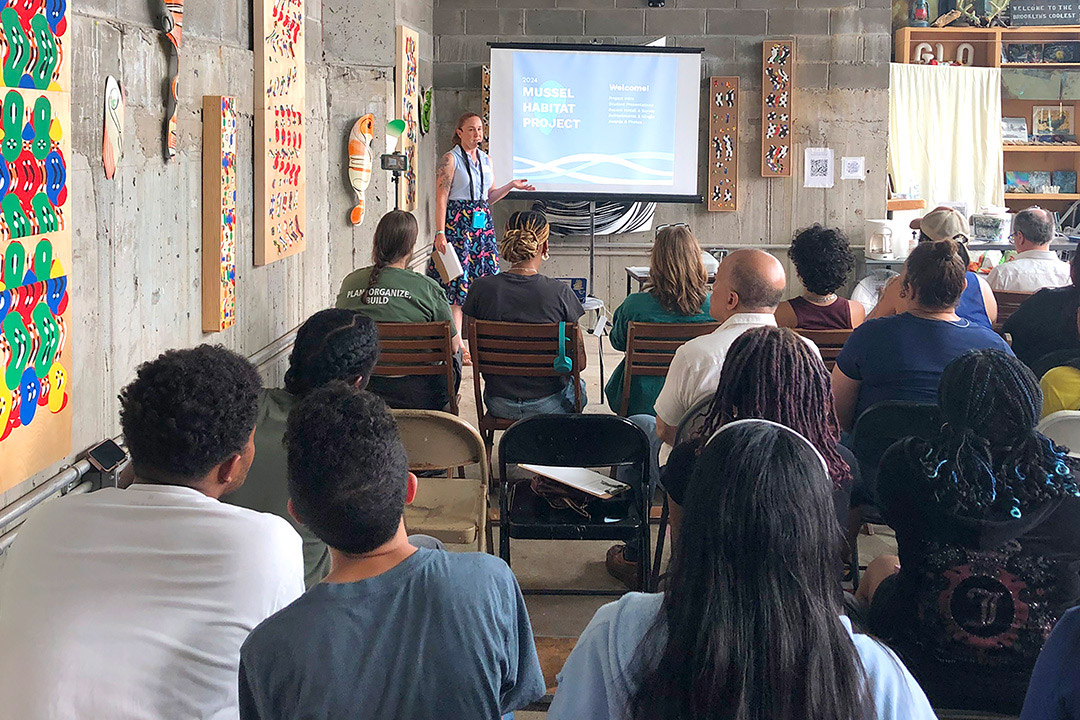
Sherri Hamilton/RIT
Jennifer Kepler, Education Program Senior Manager at Gowanus Canal Conservancy—a previously funded recipient of the NYSP2I Community Grants Program.
The New York State Pollution Prevention Institute (NYSP2I) has announced selections for its 2025-2026 Community Grants Program as part of the organization’s ongoing efforts to continue improving the health and environmental quality of New York state.
NYSP2I, sponsored by the New York State Department of Environmental Conservation (DEC) through the Environmental Protection Fund and led by Rochester Institute of Technology’s Golisano Institute for Sustainability (GIS), has selected 14 projects following the completion of a competitive review process.
Ultimate awarding of funds to selected projects is subject to standard conditions such as contract fulfillment and availability of funding. The Community Grants Program provides nonprofit organizations, academic institutions, and local governments both financial and technical assistance for projects that promote and implement pollution-prevention practices at the community level.
“We are very pleased with this year’s grant recipients, whose impactful community projects, outreach efforts, and educational initiatives address key aspects of pollution prevention,” said Roy Green, NYSP2I’s director. “These collaborative projects cover a wide range of topics, showcasing the diverse approaches needed to protect our environment and advance our mission of providing a comprehensive, statewide program to tackle complex environmental challenges. Congratulations to all of this year’s selected awardees.”
The selected proposals include:
- Adirondack North Country Association
Project Title: Compost for Good
The project will entail partnering with soil health experts, four farms, and a network of farm and soil advocates to establish on-farm compost demonstration sites that support the integration of compost practices into daily farming operations. Several workshops will be hosted across the North County region, each demonstrating a unique aspect of compost generation technology, applications, or feedstock.
- Billion Oyster Project, Inc.
Project Title: Shell Recycling Program
The project will expand Billion Oyster Project’s current shell recycling program by diverting oyster, clam, and scallop shells produced by New York City restaurants from landfills. It will improve the efficiency of shell collection operations through relationship building and educational programming for front- and back-of-house restaurant staff. The collected shells will be repurposed as a valuable resource for oyster reef restoration—an effort vital to harbor health—as the shells will be used to create habitats that support biodiversity and to help protect shorelines.
- Bronx River Alliance, Inc.
Project Title: On-River Microplastics Pollution Prevention Community Education Series
The project will address pollution prevention in the Bronx River by combining hands-on trash removal with community-driven environmental education that empowers Bronx residents to reduce their use of single-use plastics—a primary source of microplastic pollution in the river. Through the organization’s Paddle & Pickup and Community Paddle programs, the Bronx River Alliance will engage participants in experiential learning that deepens their connection to the river, raises awareness of the environmental and health impacts of plastic pollution, and inspires long-term stewardship to prevent pollution at its source.
- Children's Environmental Literacy Foundation (CELF)
Project Title: Harvesting Change: Fighting Food Waste in New Rochelle Schools
The project aims to build on CELF's Civic Science program by developing a food systems pathway. This pathway will support under-resourced schools and help reduce school food waste. Students will engage in hands-on activities such as sorting cafeteria food waste and visiting a county compost facility to learn how food waste can be better segregated to rescue and share uneaten food. They will also research contributing factors like menu design, student choice, and food presentation. In addition, students will participate in peer education and conduct outreach to community, municipal, and county partners.
- Finger Lakes GrassRoots Festival of Music & Dance
Project Title: Bringing Sustainability to the Party
The project will expand current waste reduction efforts to include festival food vendors and identify future sustainability-related infrastructure needs. These efforts aim to reduce garbage generation, reduce fossil fuel demands, and convert waste byproducts into resources. The project also seeks to build on and demonstrate to a wider audience how to design and implement circular economy solutions for organic waste generated at large-scale events. This will be achieved through the expansion of a reusable dish program.
- Finger Lakes ReUse, Inc.
Project Title: Reuse Material Donation Platform
The project will pilot Donify New York (DNY)—an online platform designed to organize and expand the donation of reusable materials across New York state. The project goals are to divert resources from landfills, create a steady stream of reusable materials for nonprofit organizations, and generate measurable environmental benefits. Reuse activities will also create local economic opportunities, including job creation and revenue generation, and will help strengthen community resilience in the Hudson Valley.
- Grassroots Garden of Western NY
Project Title: Preventing Pollution with Integrated Pest Management
The project will entail a series of workshops and educational events for Western New York communities to raise awareness about pesticide pollution issues. This awareness will be fostered through foundational education and the promotion of integrated pest management practices, with a focus on utilizing native plants to control harmful insects. Additionally, 200 native plants will be added to community gardens to support local ecosystems and promote sustainable pest management.
- House of Mercy
Project Title: Beyond Plastic: A Sustainable Pantry Initiative
The project aims to eliminate the distribution of single-use plastic bags at the House of Mercy’s Food Pantry by introducing reusable, branded bags and providing education on pollution prevention and sustainable practices. The primary beneficiaries are low-income individuals and families in Rochester, N.Y., who depend on the pantry for food assistance. Beyond reducing plastic waste, the project seeks to foster collaboration among emergency food providers throughout Rochester by promoting mutual recognition of reusable bags. This collective effort will help amplify the initiative’s impact across the city.
- Lake Champlain- Lake George Regional Planning Board
Project Title: Stormwater Education and MS4 Lite Program
The project will address educational gaps in stormwater management best practices across a five-county region within the Lake Champlain and Upper Hudson River Watersheds. This initiative will enhance public and developer awareness by creating and updating educational materials to support the region’s seven Municipal Separate Storm Sewer System (MS4) communities and assist with MS4 permit implementation. Additionally, recognizing that urban communities outside the MS4 designation also face significant stormwater challenges, the project will establish an “MS4 Lite” program to provide resources for municipalities not currently regulated under the MS4 program.
- Mohawk Valley Economic Development District, Inc.
Project Title: Homesteading Workshops 2.0
The project will offer a series of engaging, hands-on workshops designed to empower individuals to reduce waste, minimize chemical exposure, and adopt sustainable practices in everyday life. These workshops will be held across the Mohawk Valley region and will cover a range of topics that support eco-friendly skills and habits easily practiced within the boundaries of one’s home and property, making sustainable living more accessible and achievable for all. MVEDD will partner with local artists, colleges, community organizations, and businesses to maximize the impact and reach of these events.
- Open Buffalo, Inc.
Project Title: "Rooted in Buffalo" Sustainability project (RBSP)
The project aims to reduce food waste and prevent pollution in East and West Buffalo by promoting circular economy principles through hands-on composting education and sustainable waste management practices. Through interactive workshops, the installation of community composting stations, and the launch of a community compost tote program, residents will gain practical tools and knowledge to minimize food waste and adopt environmentally responsible habits.
- Outstanding Renewal Enterprises, Inc. DBA LES Ecology Center
Project Title: Repair & Reimagine Workshops in the Lower East Side
The project aims to empower communities across New York City’s Lower East Side with practical, creative skills to extend the life of everyday items and reduce environmental impact. Through workshops on visible mending, natural dyeing, food preservation, electronic repairs, and zero-waste cooking, participants will learn how to creatively repurpose materials and reduce waste at its source.
- Starflower Experiences
Project Title: Community Composting--Good Earth Gardens II
The project aims to reduce food waste in the towns of Huntington and Babylon by turning food scraps into valuable compost. In-person and virtual workshops will educate residents on what materials can and cannot be composted, and why proper composting matters. To support community participation, two organic waste drop-off sites will be established, and a limited amount of compost tumblers will be provided to encourage at-home composting.
- The Tool Library
Project Title: Dare to Repair Café
The project aims to prevent pollution in Western New York by reducing waste and promoting the circular economy through the repair and reuse of household items. With the slogan “Fix It! Don’t Ditch It!,” Dare to Repair Café (D2R) events will help normalize repair and reuse as alternatives to consumer culture and the enormous waste and environmental degradation it causes. D2R events will be held throughout the Buffalo and Niagara Falls metro areas.
NYSP2I’s Community Grants Program has supported 179 projects throughout New York state with grants totaling $2.9 million to date. Past projects have included food waste diversion and community composting initiatives, educational workshops on repair and reuse, and efforts to reduce the use of plastic and single-use food service items. Many of these projects benefited underserved populations in environmental justice communities.
The next Community Grants Program request application will be announced in late spring of 2026. Go to the website for information.
About the New York State Pollution Prevention Institute
The New York State Pollution Prevention Institute (NYSP2I) is a partnership between the New York State Department of Environmental Conservation, Rochester Institute of Technology, and the university’s Golisano Institute for Sustainability, Binghamton University, Clarkson University, Cornell University, and Rensselaer Polytechnic Institute, with a statewide reach. NYSP2I also works with the state’s Manufacturing Extension Partnership to help disseminate data and strategy.
NYSP2I’s goal is to make the state more sustainable for workers, the public, the environment, and the economy through pollution prevention. Pollution prevention is reducing or eliminating waste at the source by modifying production processes, promoting the use of non-toxic or less-toxic substances, implementing conservation techniques, and reusing materials rather than putting them into the waste stream.
Funding provided by the Environmental Protection Fund as administered by the New York State Department of Environmental Conservation. The opinions, results, findings and/or interpretations of data contained herein are the responsibility of Rochester Institute of Technology and do not necessarily represent the opinions, interpretations or policy of New York State.