Sustainability Ph.D.

RIT’s Ph.D. in sustainability solves real-world challenges and optimizes sustainable systems across tech, business, energy, and more.
Overview for Sustainability Ph.D.
Our approach to sustainability means working in the broader context of environmental assessment, economics, and policy. Each faculty member in the Golisano Institute for Sustainability sponsors a select number of students for specific research projects, with the scope varying from fundamental science to applied engineering to corporate sustainability applications. On acceptance into a sponsored research project, you will receive a fully-funded education, a stipend to help with living expenses, your own office space, and the time to develop your technical expertise in sub-areas dependent on your research.
In the sustainability Ph.D. program, you’ll have the opportunity to learn from areas across the entire university to develop your own innovative approach to the field, building off of methodologies such as life cycle assessment, environmental risk and impact assessment, design for the environment, pollution prevention, closed-loop supply chain management, and product life assessment. Moreover, you’ll work side-by-side with our world-renowned faculty who are avid researchers in diverse areas including biofuels, transportation, energy policy, resource recovery, smart products and systems, and more.
The sustainability Ph.D. helps you think innovatively about how sustainability can positively impact systems all over the world through big-picture solutions, from training future business leaders to maximizing natural resources. You don’t need a background in sustainability to apply to this program; you just need a desire to create positive change in the world. We bring in students of all ages, from all backgrounds—from biotechnology to business—and from all over the world. You’ll also find a wide range of experience—many of the program’s students have more than 10 years of career experience and/or education.
The faculty are well-known scholars and active researchers who not only bring their knowledge into the classroom but also directly involve students in their scholarship. This work includes a wealth of hands-on experience in our impressive research facilities, including a 75,000-sq.-ft., LEED Platinum certified research building with over nine labs and six technology testbeds. With this level of experience, you’ll be prepared for diverse academic and industry jobs where you can make an impact on the way the world views and utilizes sustainable practices, from the macro to the micro.
RIT's Sustainability Ph.D.
With the sustainability Ph.D.'s integrative curriculum, you will develop a deep foundation in sustainability science, sustainable systems, risk analysis, and more. You can also choose several electives from across RIT's colleges—from Computational Modeling and Simulation to Principles of Statistical Data Mining—to tailor your degree and create interdisciplinary relationships throughout the university.
Through your sponsored research project, you’ll have the opportunity to make novel and impactful contributions to the development and understanding of sustainable technologies. Recent dissertation examples include:
- Implications of Consumer Lifestyle Changes and Behavioral Heterogeneity on U.S. Energy Consumption and Policy
- Criticality of Byproduct Materials: Assessing Supply Risk, Environmental Impact, and Strategic Policy Response for Tellurium
- Development of an Integrated Reformer and Fuel Cell System for Portable Power Applications
Sustainability Research
Sustainable Energy
- Fuel cells
- Photovoltaics
- Energy supply/demand models
- Energy policy
Circular Economy
- Life cycle assessment
- Electronic waste and battery recycling
- Waste-to-energy processes
- Food waste management
- Remanufacturing
Sustainable Urban Systems
- Smart Cities
- Transportation systems analysis
- Food Waste Management
- Food-Energy-Water Nexus
Sustainability Resources: RIT Advances Global Sustainability
Partnering locally and internationally with the communities in which we are engaged, RIT is continuing to advance sustainability efforts and build resiliency at home and around the world. Rochester, NY, is a hub for sustainability professionals and home to rich natural resources, such as fertile farmland and the nearby Finger Lakes. Many of our students share their passion for sustainability with the local community by volunteering on projects connected to K-12 education, community gardens, farmer’s markets, and more. In addition, you will connect with the global sustainability community by attending and presenting at professional conferences all over the world.
Featured Work and Profiles
-

Does energy storage make the U.S. electric grid cleaner?
Dr. Eric Williams In brief: Project: “How much wind and solar are needed to realize emissions benefits from storage?”
Read More about Does energy storage make the U.S. electric grid cleaner? -

Can paper waste be used to make black ink?
Dr. Thomas A. Trabold In brief: Project: “Waste Paper Derived Biochar for Sustainable Printing Products”
Read More about Can paper waste be used to make black ink? -

Nanomaterials: To use or not to use
Dr. Elizabeth Moore ’19 The following learning module was created by Dr. Elizabeth Moore '19 as a student for public teaching use.
Read More about Nanomaterials: To use or not to use -

From Personal Battle to Planetary Impact: Ph.D. Student Tackles Agricultural Plastics
Backed by a $15 million NSF grant, Katie Malarkey ’04 (physics), a sustainability Ph.D. student, quantifies the volume of plastics and tackles their end-of-life issues.
Read More about From Personal Battle to Planetary Impact: Ph.D. Student Tackles Agricultural Plastics -

How can forecasting changes in electronic waste inform circular-economy planning?
Dr. Callie Babbitt In brief: Project: “Forecasting electronic waste flows for effective circular economy planning”
Read More about How can forecasting changes in electronic waste inform circular-economy planning? -

How to Cut Food Waste at Home: Researching food waste collection services in Rochester, NY
Jessica Peterson The following content was created by Jessica Peterson in November 2018 as an educational sustainability blog post.
Read More about How to Cut Food Waste at Home: Researching food waste collection services in Rochester, NY
Curriculum for 2026-2027 for Sustainability Ph.D.
Current Students: See Curriculum Requirements
Admissions and Financial Aid
This program is available on-campus only.
| Offered | Admit Term(s) | Application Deadline | STEM-OPT Visa Eligible |
|---|---|---|---|
| Full‑time | Fall | January 15 priority deadline | Yes |
Full-time study is 9+ semester credit hours. International students requiring a visa to study at the RIT Rochester campus must study full‑time.
Application Details
To be considered for admission to the Sustainability Ph.D. program, candidates must fulfill the following requirements:
- Learn tips to apply for a doctoral program and then complete a graduate application.
- Submit copies of official transcript(s) (in English) of all previously completed undergraduate and graduate course work, including any transfer credit earned.
- Hold a baccalaureate degree (or US equivalent) from an accredited university or college. A minimum cumulative GPA of 3.0 (or equivalent) is recommended.
- Satisfy prerequisite requirements and/or complete bridge courses prior to starting program coursework.
- Submit a current resume or curriculum vitae.
- Submit a statement of purpose for research which will allow the Admissions Committee to learn the most about you as a prospective researcher.
- Submit two letters of recommendation.
- Entrance exam requirements: None
- Submit one writing sample, of your own work, in which you are the only author. This can be a report or paper from previous academic or professional work that reflects your critical thinking and writing abilities.
- Submit English language test scores (TOEFL, IELTS, PTE Academic, etc.), if required. Details are below.
English Language Test Scores
International applicants whose native language is not English must submit one of the following official English language test scores. Some international applicants may be considered for an English test requirement waiver.
Duolingo (DET): 140
IELTS: 7.5
LanguageCert Academic: 84
PTE Academic: 76
TOEFL: 100/5.5
International students below the minimum requirement may be considered for conditional admission. Deaf and hard-of-hearing test takers with significant hearing loss do not need to take the listening and speaking sections for the TOEFL and IELTS. Each program requires balanced sub-scores when determining an applicant’s need for additional English language courses.
How to Apply Start or Manage Your Application
Cost and Financial Aid
An RIT graduate degree is an investment with lifelong returns. Graduate tuition varies by degree, the number of credits taken per semester, and delivery method. View the general cost of attendance or estimate the cost of your graduate degree.
A combination of sources can help fund your graduate degree. Learn how to fund your degree
Additional Information
Prerequisites
The Sustainability Ph.D. program requires that students gain mastery of key sustainability concepts and methods, several of which are quantitative in nature. Due to this, we require incoming students to have taken university-level calculus, statistics, and two courses in physical sciences (such as chemistry or physics).


Related News
-
November 4, 2025
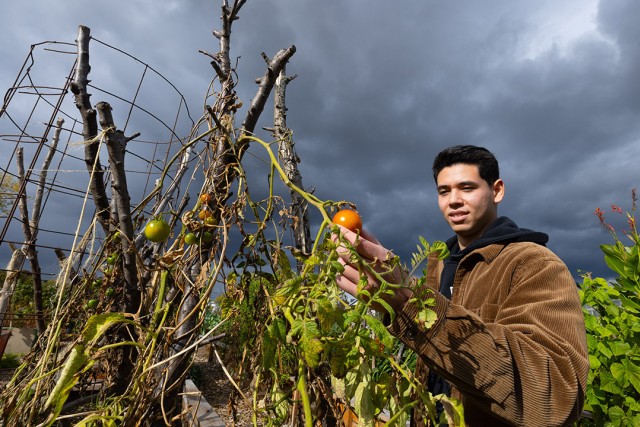
Students take the lead in growing sustainability program
The Climate and Sustainability Leadership Program brings together students across all majors to learn through campus discussions and hands-on experiences with Rochester-area partners. The goal is to create leaders in sustainability.
-
September 3, 2025

Sustainability Ph.D. student earns Quad Fellowship
Sherralyn Sneezer, a Ph.D. candidate at RIT’s Golisano Institute for Sustainability, has been selected as a 2025 Quad Fellow. She joins a cohort of 37 students focused on applying science and technology to pressing global problems.
-
May 1, 2025

Sustainability Ph.D. candidate finds purpose at RIT
Tunmise Raji came to RIT with a vision to harness technology for global good. He’s leaving prepared to advance energy solutions for underserved communities.
