Sustainable Systems Master of Science Degree

Solve global challenges using sustainability science in energy, food, health, and more.
Overview for Sustainable Systems MS
The sustainable systems MS degree accepts students from any academic background and encompasses a wide range of interdisciplinary studies in sustainability science. Here, you won’t be restricted to one sustainability topic or methodology. You will comprehensively learn and experience the methods that lead to environmental, social, technological, and business success, working one-on-one with a faculty advisor to tailor the degree to your sustainability interests.
RIT's Sustainable Degree
In our sustainable master's program, you will start with a broad foundation of knowledge in environmental life cycle assessment, sustainable decision making, economic and policy strategies, and more. Then, you will have the opportunity to customize your degree in areas that suit your interests and career goals—such as renewable energy or mobility—as well as get the hands-on experience that employers are seeking. In as little as one year of study, you will be prepared to make sustainability decisions that you can apply to any career.
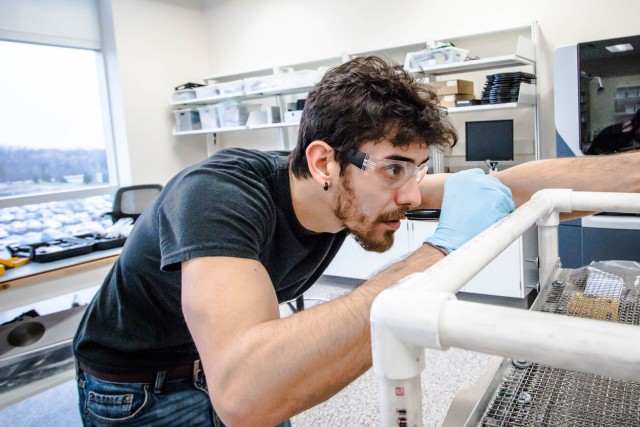
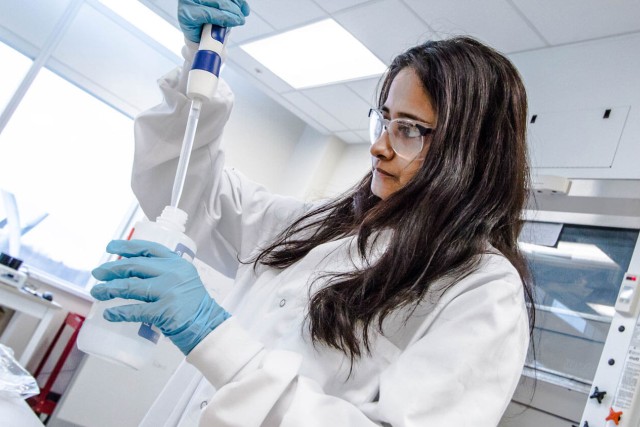
Not only will you be able to focus on an area that interests you, but you will be able to get hands-on in your projects with the use of one of our many labs or through design modeling tools. This degree allows you the flexibility to adapt your career over time and in response to the ever-changing developments in sustainability. The Golisano Institute for Sustainability is dedicated to groundbreaking sustainability research and its business applications. Our research facilities are second to none, and include a number of green buildings including Sustainability Institute Hall, a 75,000-square-foot, LEED Platinum-certified research building and multiple state-of-the-art research centers.
You don’t need a background in sustainability to apply to this program; just a desire to create positive change in the world. We accept applicants of all ages, from all backgrounds—from mechanical engineering to political science—and from all over the world. This ensures your learning experience comes from the classroom as well as from the perspectives of students with diverse experiences.
Sustainability Curriculum
Through a flexible and interdisciplinary curriculum, you’ll begin your degree in sustainable systems with core courses in industrial ecology, risk assessment, the economics of sustainability, and more. Several electives from across the university–in areas as diverse as from sustainable craft brewing and distilling to corporate social responsibility–allow you to tailor your degree around your talents and career goals.
Your degree culminates with a research thesis or a capstone project. Recent thesis examples include:
- Techno-Environmental Analysis of Generating Animal Feed from Wasted Food Products
- Fabrication and life cycle assessment of organic photovoltaics
- Characterizing adaptive capacity to climate change in developing countries: a case study on Peru
Sustainability Topics / Tracks
Sustainable Energy
- Sustainable Energy Systems
- Food-Energy-Water Nexus
- Energy Policy
Example research project: Inspection of wind turbine blades with unmanned aerial vehicles (UAVs)
Circular Economy
- Introduction to Geographic Information Systems (GIS)
- Data Analysis for Sustainability
- Innovation Policy
- Corporate Social Responsibility (CSR)
Example research project: Assessing a baseline case for reaching carbon neutrality in Monroe County by 2027
Sustainable Urban Systems
- Sustainable Mobility Systems
- Graduate Sustainable Communities
- Sustainable Building Metrics
Example research project: Evaluating strategies for sustainable renovation of RIT campus buildings
Careers in Sustainability
Graduates of the sustainable systems MS have a 100 percent placement rate, in part because of RIT’s dedication to career counseling and ongoing relationships with employers. This means that all of our graduates gain employment or choose to further their education shortly after graduating. And If you’re interested in pursuing a career more focused on academia or research, the master’s degree is also an excellent stepping stone to a doctoral program, such as RIT’s Ph.D. in sustainability, if you take the route of completing a thesis while here.
Sustainability Resources: RIT Advances Global Sustainability
Partnering locally and internationally with the communities in which we are engaged, RIT is continuing to advance sustainability efforts and build resiliency at home and around the world. Rochester, NY, is a hub for sustainability professionals and home to rich natural resources, such as fertile farmland and the nearby Finger Lakes. Many of our students share their passion for sustainability with the local community by volunteering on projects connected to K-12 education, community gardens, farmer’s markets, and more. In addition, you will connect with the global sustainability community by attending and presenting at professional conferences all over the world.
Careers and Salary Info
Typical Job Titles
| Associate Engineer - Energy Efficiency | Clean Power and Industrial Efficiency Project Engineer | Energy and Sustainability Engineer |
| Health Care Information Analyst | Solutions Engineer | Sustainability Analyst |
| US Power Analyst |
Curriculum for 2026-2027 for Sustainable Systems MS
Current Students: See Curriculum Requirements
Admissions and Financial Aid
This program is available on-campus only.
| Offered | Admit Term(s) | Application Deadline | STEM-OPT Visa Eligible |
|---|---|---|---|
| Full‑time | Fall or Spring | Rolling | Yes |
| Part‑time | Fall or Spring | Rolling | No |
Full-time study is 9+ semester credit hours. Part-time study is 1‑8 semester credit hours. International students requiring a visa to study at the RIT Rochester campus must study full‑time.
Application Details
To be considered for admission to the Sustainable Systems MS program, candidates must fulfill the following requirements:
- Complete an online graduate application.
- Submit copies of official transcript(s) (in English) of all previously completed undergraduate and graduate course work, including any transfer credit earned.
- Hold a baccalaureate degree (or US equivalent) from an accredited university or college. A minimum cumulative GPA of 3.0 (or equivalent) is recommended.
- Satisfy prerequisite requirements and/or complete bridge courses prior to starting program coursework.
- Submit a current resume or curriculum vitae.
- Submit a personal statement of educational objectives.
- Submit two letters of recommendation.
- Entrance exam requirements: None
- Submit one writing sample, of your own work, in which you are the only author. This can be a report or paper from previous academic or professional work that reflects your critical thinking and writing abilities.
- Submit English language test scores (TOEFL, IELTS, PTE Academic, etc.), if required. Details are below.
English Language Test Scores
International applicants whose native language is not English must submit one of the following official English language test scores. Some international applicants may be considered for an English test requirement waiver.
Duolingo (DET): 130
IELTS: 6.5
LanguageCert Academic: 74
PTE Academic: 60
TOEFL: 88/4.5
International students below the minimum requirement may be considered for conditional admission. Deaf and hard-of-hearing test takers with significant hearing loss do not need to take the listening and speaking sections for the TOEFL and IELTS. Each program requires balanced sub-scores when determining an applicant’s need for additional English language courses.
How to Apply Start or Manage Your Application
Cost and Financial Aid
An RIT graduate degree is an investment with lifelong returns. Graduate tuition varies by degree, the number of credits taken per semester, and delivery method. View the general cost of attendance or estimate the cost of your graduate degree.
A combination of sources can help fund your graduate degree. Learn how to fund your degree
Additional Information
Prerequisites
The Sustainable Systems MS program requires that students gain mastery of key sustainability concepts and methods, several of which are quantitative in nature. Due to this, we require incoming students to have taken university-level calculus, statistics, and two courses in physical sciences (such as chemistry or physics).
MS/MBA Option
Students are eligible to earn an MBA in just one year after completing the Sustainable Systems MS. This combination of graduate degrees allows students to learn business, policy, engineering, and science behind our world's systems to gain knowledge to solve any sustainability problem. Admission to the MBA is automatic upon successful completion of the MS, with scholarship guaranteed. Students admitted to the program graduate as dual-degree holders—with both a Master of Science and an MBA—in just two years. For more details on this accelerated pathway, visit: Sustainable Systems MS & MBA.