Political Science Bachelor of Science Degree

Overview for Political Science BS
Why Study Political Science at RIT?
Four Dynamic Tracks: Target your political science studies. Select a track option: digital politics; government, economics, and public policy; international and global security; politics, ecology, and the life sciences.
Interdisciplinary Senior Project: A capstone course where you’ll apply the knowledge and skills you’ve acquired to solve a real-world problem or issue.
Real-World Experience: Completing an optional cooperative education or internship means you’ll gain hands-on, full-time, paid work experience in industry.
Teaching Partnership Program Available: 4+1 or 3+2 programs enable you to earn your bachelor’s degree at RIT and a master’s degree in education at one of our partner universities.
Accelerated Bachelor’s/Master’s Available: Earn both your bachelor’s and your master’s in less time and with a cost savings, giving you a competitive advantage in your field.
The Political Science Curriculum
In the political science BS, your political science undergraduate courses begin with core courses designed to introduce you to the general themes of political science. You will be required to take political science electives in American politics/Constitutional studies and international relations/comparative politics.
In addition, you’ll choose a track in:
- Digital politics: The influence, impacts, and implementation of technology in politics.
- Government, economics, and public policy: Applied politics, humanitarianism, economics, and the study of power in our society as studied through the lens of behavioral science and institutional interactions.
- International and global security: The study of world power interaction and the role played by the state in both traditional and non-traditional ways, including human, cyber, and global security.
- Politics, ecology, and the life sciences: An in-depth study on the political impact of modern biology, biotechnology, and environmental changes, and their influence on how we understand ourselves as human beings and citizens.
The political science major culminates in a capstone course, which ties together the themes of the major through a seminar and a significant writing project.
Double Major Pathways
Double majoring in a discipline that complements your political science studies lets you further explore a secondary area of study and can give you an advantage in the job market.
Double Major in Cybersecurity and Political Science: With this double major pathway, your RIT education can prepare you for a career in cyberpolitics or cybersecurity, both highly specialized and in-demand career paths. According to the U.S. Bureau of Labor Statistics, cybersecurity jobs are among the fastest-growing career fields nationally, with a projected job growth of 31 percent through 2029. That’s more than seven times faster than the national average. Double majoring in cybersecurity and political science can put you on a fast track for success in a high-growth industry that is crucial to the safety and security of countries and organizations.
Furthering Your Career in Political Science
Pre-Law Advising Program
Law schools welcome applications from students majoring in a wide range of academic programs. RIT’s pre-law advising program will help you navigate the admission process for law school, explore a range of legal careers, and guide you through course selection to ensure you build the skills and competencies required of competitive law school applicants. The program is open to students in all majors who are interested in pursuing a career in law.
Majoring in Political Science for Law School Preparation
Because a political science major includes an in-depth study of the context of law, the systems that surround it, and leadership within public service, it is an ideal major for law school. RIT’s political science faculty bring specialized law and politics expertise to the classroom for both theoretical and practical fields.
Further Your Education in Political Science
Combined Accelerated Bachelor's/Master's Degrees
Today’s careers require advanced degrees grounded in real-world experience. RIT’s Combined Accelerated Bachelor’s/Master’s Degrees enable you to earn both a bachelor’s and a master’s degree in as little as five years of study, all while gaining the valuable hands-on experience that comes from co-ops, internships, research, study abroad, and more.
- Political Science BS/Sustainable Systems MS: An accelerated dual degree that builds a foundational understanding of the political and economic forces at play nationally and globally and prepares grads to make informed decisions when applying sustainability science principles to address the world’s most challenging issues — from peacekeeping and pollution to food scarcity and fast emerging technology issues.
- Political Science BS/Science, Technology and Public Policy MS: The accelerated dual‑degree provides an integrated pathway that blends a foundation in politics—in both theory and practice, and from the domestic to the international—with advanced coursework in science and technology policy—preparing graduates for impactful roles in government, NGOs, consulting, or tech-driven policy spheres.
- +1 MBA: Students who enroll in a qualifying undergraduate degree have the opportunity to add an MBA to their bachelor’s degree after their first year of study, depending on their program. Learn how the +1 MBA can accelerate your learning and position you for success.
3+3 Accelerated BS/JD Programs
RIT has partnered with Syracuse University’s College of Law and University at Buffalo School of Law to offer accelerated 3+3 BS/JD options for highly capable students. These programs provide a fast track to law school where you can earn a bachelor’s degree at RIT and a Juris Doctorate degree at Syracuse University or University at Buffalo in six years. Interested students may apply to the option directly, with successful applicants offered admission to RIT and conditional acceptance into either Syracuse University’s College of Law or University at Buffalo School of Law.
RIT’s political science undergraduate degree is one of the approved majors for the 3+3 option. Learn more about Accelerated Law 3+3 Programs.
RIT’s Teaching Partnership Programs
Whether your goal is to go into early childhood or elementary education, become a secondary education teacher with a content area specialty at the middle or high school level, or work in the higher education or counseling fields, RIT’s partnership programs with local universities provide a guided pathway to a career in teaching.
These 4+1 or 3+2 programs enable you to earn your bachelor’s degree at RIT and a master’s degree in education at one of our partner universities. As you progress, you’ll benefit from focused academic advising, career exploration opportunities, and resources for research, learning, and skill development.
RIT’s political science degree is eligible for RIT’s Teaching Partnership Program. Learn more about RIT’s Teaching Partnership Programs.
Careers and Experiential Learning
Typical Job Titles
| Attorney/Lawyer | Business and Management Analyst | Campaign Manager |
| Economist | Intelligence Analyst | Legislative Aide |
| Lobbyist | Market Research Analyst | Mediator |
| Policy Analyst | Political Campaign Staff | Political Consultant |
| Public Relations Manager | Research Analyst | Urban Planner |
Graduates work primarily in the Government (Local, State, Federal) industry.
Cooperative Education and Internships
What’s different about an RIT education? It’s the career experience you gain by completing cooperative education and internships with top companies in every single industry. You’ll earn more than a degree. You’ll gain real-world career experience that sets you apart. It’s exposure–early and often–to a variety of professional work environments, career paths, and industries.
Co-ops and internships take your knowledge and turn it into know-how. A liberal arts co-op provides hands-on experience that enables you to apply your knowledge in professional settings while you make valuable connections between coursework and real-world applications.
Co-ops and Internships for Political Science Majors
Students in the political science major are encouraged to complete a cooperative education, internship, or study abroad experience.
Working closely with political science faculty advisors and tapping into networks unique to RIT, you can tailor your co-op or internship experiences to meet your career aspirations. Opportunities in local lawmakers’ offices; local political party liaisons; state and federal institutes; and summer co-op and internships in Washington, DC, are just a few of the possibilities the political science faculty advisors can help you pursue.
International internships are also possible for political science majors.
Study Abroad Opportunities
Study Abroad Programs: RIT offers more than 600 study abroad programs in 60 different countries—rich opportunities to enhance your understanding of global politics and culture by studying full-time at a host school.
The College of Liberal Arts’ Frederick C. Cuny Peace and Conflict Summer Program: A premier international leadership and peace-building seminar taught by renowned practitioners and academics who have hands-on experience in the United Nations; national governments and militaries; humanitarian organizations; and the private sector.
RIT’s Global Campuses: Spend a semester studying at one of RIT’s global campuses: RIT Croatia, RIT Dubai, or RIT Kosovo.
Featured Work and Profiles
-

Zoe Gray finds confidence, connection, and purpose across disciplines at RIT
Zoe Gray is reflecting on a college experience defined by ambition, curiosity, and a willingness to embrace every opportunity that came her way.
Read More about Zoe Gray finds confidence, connection, and purpose across disciplines at RIT -

Co-op & Internship Spotlight: First-hand Experience in Government and Policy
Through her internship at the U.S. House of Representatives, Kaitlin Sommer experienced the inner workings of national government up close. Working alongside Representative Joe Morelle’s team, she...
Read More about Co-op & Internship Spotlight: First-hand Experience in Government and Policy -

Meet Afnaan Qureshi, May 2025 Philosophy and Political Science Grad
He had always been an inquisitive and driven person, but at RIT, Afnaan Qureshi discovered that the study of philosophy ignited a special fascination and fueled his thinking in ways other disciplines...
Read More about Meet Afnaan Qureshi, May 2025 Philosophy and Political Science Grad -

RIT Alumna Takes on Top National Security Challenges
Brianna Alverson addresses national security challenges at the Johns Hopkins Applied Physics Laboratory. Her work on cyber threats and emergency preparedness help secure the nation.
Read More about RIT Alumna Takes on Top National Security Challenges -

Tech-Driven Liberal Arts Education Sparks Political Career
Luke Rydelek RIT graduate Luke Rydelek reflects on how his tech-driven liberal arts education fueled his political journey, blending technology and advocacy for career success.
Read More about Tech-Driven Liberal Arts Education Sparks Political Career -

Internship Puts Student Closer to Goals of Advocacy and Change
Kaitlin Sommer, a dedicated political science student at RIT, gains invaluable experience interning with U.S. Rep. Joseph Morelle in Washington, D.C., where she combines her personal advocacy with...
Read More about Internship Puts Student Closer to Goals of Advocacy and Change
Curriculum for 2026-2027 for Political Science BS
Current Students: See Curriculum Requirements
Admissions and Financial Aid
First-Year Admission
First-year applicants are expected to demonstrate a strong academic background that includes:
- 4 years of English with a strong performance is expected.
- 3 years of social studies and/or history with a strong performance is expected.
- 3 years of math is required and must include algebra, geometry, and algebra 2/trigonometry.
- 2-3 years of science.
Transfer Admission
Transfer applicants should meet these minimum degree-specific requirements:
- A minimum of college algebra is required.
Financial Aid and Scholarships
100% of all incoming first-year and transfer students receive aid.
RIT’s personalized and comprehensive financial aid program includes scholarships, grants, loans, and campus employment programs. When all these are put to work, your actual cost may be much lower than the published estimated cost of attendance.
Learn more about financial aid and scholarships


Related News
-
April 20, 2026

Trump sidelined Congress’ authority over war on Iran – and lawmakers allowed it, extending a 75 year trend
The Conversation features an analysis from Sarah Burns, associate professor of political science, examining Congress’ limited oversight of U.S. military action in Iran, highlighting historical patterns of presidential power in war-making.
-
March 20, 2026
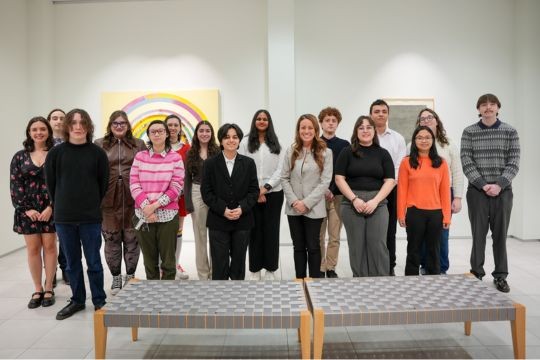
Students Honored for Writing Excellence
Eighteen students from across campus were honored this year by the Rochester Institute of Technology College of Liberal Arts 46th annual Student Writing Awards presentation on March 20, 2026.
-
March 17, 2026

Congress Once Fought to Limit a President’s War Powers − Now, Its Successors Are Less Willing
Highbrow Magazine publishes a column by Sarah Burns, associate professor of political science, examining congressional war powers and how Congress’s response to recent conflicts compares to its assertion of authority during the Vietnam War.
