RIT researchers build funding momentum
Grant funding, paired with institutional support, leads researchers to ‘millionaire’ status
Carlos Ortiz/RIT
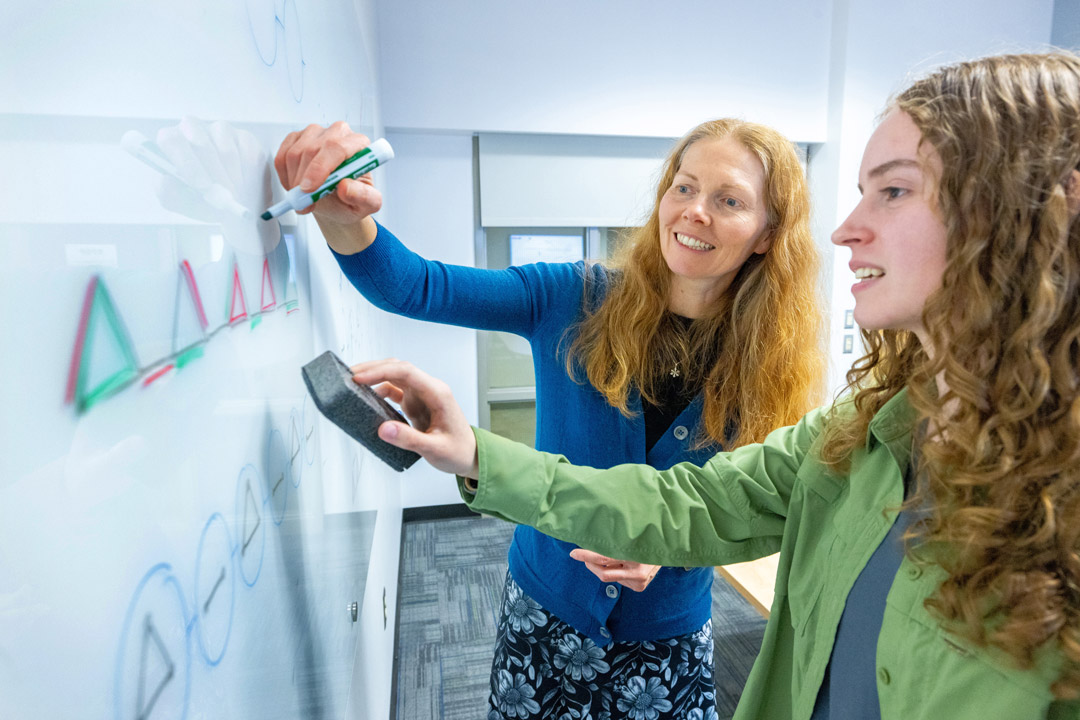
Professor Ivona Bezáková, left, works with Sherry Robinson, a fifth-year BS/MS computer science student. Bezáková’s research helps undergraduate students better understand the theoretical foundations of computer science using an automated feedback tool.
Ivona Bezáková, professor of computer science, leads a team that is building an automated tool that allows educators to provide immediate feedback to students on computational model constructions. The input helps students understand why their answers are incorrect.
Xudong Zheng, professor of mechanical engineering, is using high-fidelity computer simulations to study how fluids like air and water move through complex environments. By studying the airflow and motion of vocal folds during speech, his work may help improve the diagnosis and treatment of voice disorders.
Bezáková and Zheng are part of the newest members of a growing cohort of researchers who have reached or exceeded $1 million in sponsored funding and were recognized alongside new researchers and faculty who have completed the university’s grant writers bootcamp to win internal seed funding. They represent how RIT continues to grow its research ecosystem.
The university, which celebrated receiving a record $105 million in sponsored research funding in fiscal year 2025, also reached a new record for National Science Foundation awards at more than $21 million and a record-setting 30 National Science Foundation CAREER Award submissions from RIT faculty. So far this year, RIT is on track for a record for proposals submitted, with more than 500 since July 1.
Ryne Raffaelle, vice president for Research, said RIT is intentional in its mission to help faculty secure funding for their projects. Through Sponsored Research Services, the university offers a robust suite of proposal‑development workshops and administers several seed‑funding programs that help researchers generate preliminary results and strengthen future proposals.
“RIT is continuing on a path of significant growth by building foundations for the next wave of groundbreaking research,” said Raffaelle. “By providing our faculty with the support and tools they need to successfully advance their cutting-edge research, work alongside top students, and team with experts in their fields, RIT is demonstrating its commitment to solving real-world problems that will move the world forward.”
Bezáková utilized other internal programs like RIT’s Faculty Education and Development Grants program, which provided time to focus on research despite a heavy teaching load. Additional seed funding through the Golisano College of Computing and Information Sciences allowed her to test new ideas, some of which evolved into externally funded projects. These resources helped her write, win, and conduct multiple research awards.
Zheng quickly built momentum with external funding, including support from the National Institutes of Health. Before coming to RIT, he earned an NSF CAREER award to study how muscles, tissue motion, and airflow interact to produce sound. At RIT, early financial support helped launch a second line of research inspired by studying seal whiskers and developing a similar hydrodynamic sensing system for underwater disturbances. This research has led to additional funding from the Department of Defense’s Office of Naval Research.
“Few research projects work out the way they were intended or hoped for, and having the ability and support to test an idea before developing a full proposal for external funding has been extremely helpful,” said Bezáková. “While not every seed funding award I received immediately turned into a proposal for external funding, I learned a lot during the process of working on those projects. These experiences eventually led to research progress on other projects and other grant proposals.”
Research continues to grow across the university. In December, RIT opened its new Research Building, with 19 labs and space designed to enhance its position as a leading research university. With the renovation of Brown Hall, additional freed-up spaces as a result of the SHED, and the construction of the new Research Building, 55 new labs and nearly 60,000 square feet of additional research space were created in just three years.
As a result of RIT’s thriving research environment, 94 current researchers have achieved $1 million or more in funding since 2000, and 16 faculty members have received NSF CAREER awards since 2014. Recently, RIT launched its Strategic Framework, which places conducting world-changing research high on the list of priorities.
Funding routes and the experiences of the researchers vastly differ. Bezáková’s funding represents years of persistence—testing ideas, refining approaches, and building a research program piece by piece. For Zheng, funding milestones reflect rapid growth fueled by early support, collaboration, and innovative thinking.
“Reaching this funding milestone at RIT is very exciting and meaningful for me and my research group,” said Zheng. “It reflects the collaborative efforts of my students, colleagues, and the support from the university.”
Recent funding achievements
RIT researchers who have recently reached or exceeded $1 million in sponsored funding are Jane Amstey, senior director, K-12 University Center; Ivona Bezáková, professor of computer science; Jason Kolodziej, associate professor of mechanical engineering; Kathleen Lamkin-Kennard, associate professor of mechanical engineering; Rui Li, associate professor of computing and information sciences; Rui Liu, assistant professor of mechanical engineering; Cory Merkel, associate professor of computer engineering; Alireza Vahid, Gleason Memorial Professor, Department of Electrical and Microelectronic Engineering; and Xudong Zheng, professor of mechanical engineering.