RIT professor brings nutrition expertise to international collaboration
Brenda Abu is a Carnegie African Diaspora fellow
Provided
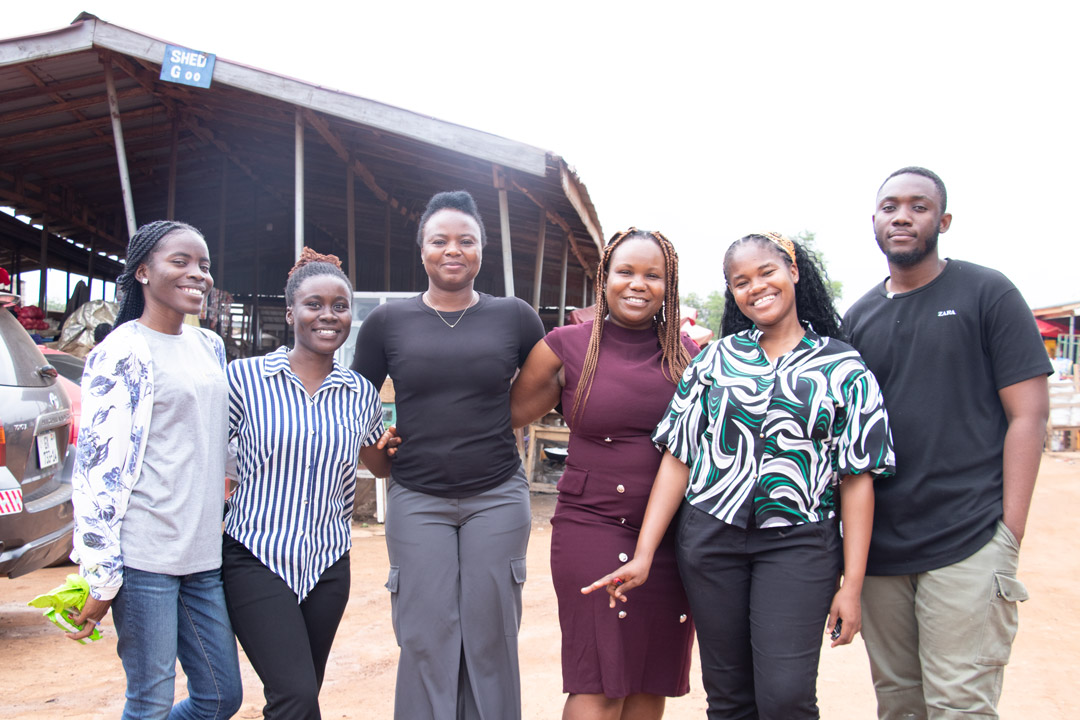
RIT researcher Brenda Abu, third from left, is a Carnegie African Diaspora fellow. She conducted research in Ghana with Ensign Global University faculty Sandra Kushitor, dressed in plum, and a team of graduate students including, from left to right, Josephine Bempong, Judith William, Manuela Dodzi, and Edmund Amoabeng. Credit: Michael Blay/Ensign Global University
A remote networking session Associate Professor Brenda Abu attended for academics from African countries has led to a promising collaboration that extends her scholarship and the influence of RIT’s Wegmans School of Health and Nutrition to communities in Ghana.
Abu, director of RIT’s nutritional sciences BS program, and Sandra Boatemaa Kushitor, senior lecturer in the master’s program in public health nutrition at Ensign Global University in Kpong, Ghana, are working on a nutrition-and-lifestyle needs assessment in an urban slum community in the country’s capital, Accra.
The Carnegie African Diaspora Fellowship Program funded Abu and Kushitor’s pilot study this past summer. Their findings will serve as preliminary data for an intervention study on lifestyle and non-communicable diseases—such as diabetes and hypertension or the effects of high blood pressure.
Carnegie Corporation of New York funds the fellowship program to support higher education in African countries through collaborations between host universities and African-born academics. Abu, who grew up in Ghana, is a two-time award recipient.
Her current project with Kushitor will assess the rate of diabetes and hypertension in the population, with attention given to how individuals manage these conditions, their comfort level with using health apps or wearable health trackers, and support provided by their family and social network.
“Our goal is to come up with a technology-interfacing platform that can be useful to patients living with chronic diseases,” Abu said. “We are looking to address issues around nutrition and lifestyle, and taking a 360-degree perspective to holistically look at how their family life can be harnessed to prevent generational patterns of these diseases.”
Abu’s primary research centers on women and children with iron-deficiency anemia in Ghana and in Rochester, N.Y., and lifestyle management and disease prevention. Abu and Kushitor found academic comradery in the use of technology to manage, track, and improve health outcomes when they met at the online symposium, organized by Loughborough University, on lifestyle management and disease prevention.
Their complementary research interests create new possibilities for both scholars. “A priority for me was to make sure we have an ongoing relationship that can lead to cross learning and co-creating projects and ideas,” Abu said.
To that end, the fellowship has enabled her to review Ensign Global College’s nutrition curriculum, mentor the graduate students building the pilot survey instruments and conducting interviews, and provide feedback on graduate thesis proposals. Abu and Kushitor are co-mentoring a graduate student currently analyzing data collected during the summer for her graduate thesis.
Another aspect of the pilot study engages community health workers and nurses who treat people living in the urban slums and across the country. The research team also held separate focus-group discussions with the patients to gain a deeper understanding of their needs.
When Abu was in Ghana, her research assistant, Ayla Laro, a student in RIT’s dietetics and nutrition MS program, supported the project from Rochester. Since then, Laro has helped Abu prepare and disseminate online surveys to the health care workers participating in the study. The surveys are ongoing and represent the final data component.
“We, ourselves, are dealing with non-communicable diseases here in Rochester, but also in the rest of the United States,” Abu said. “From this work, we will see if there are any lessons that we can learn or share based on what we have done so far.”

