Dietetics and Nutrition Master of Science Degree

Explore advanced nutritional science and dietetics in our MS program. Gain skills to become a Registered Dietitian Nutritionist (RDN) and make an impact on people’s health.
Overview for Dietetics and Nutrition MS
Registered dietitian nutritionists (RDN) engage people of all ages, cultures, health concerns, and socioeconomic levels to address a range of nutritional needs. RDNs are skilled health care professionals who apply the art and science of food and nutrition at individual, institutional, organizational, community, and population levels.
RIT’s Master of Science in Dietetics and Nutrition
This program, housed in the Wegmans School of Health and Nutrition, has a dynamic curriculum addressing new connections between technology and health. In addition to meeting all competencies for entry-level practice as an RDN by the Accreditation Council for Education in Nutrition and Dietetics (ACEND)–the accreditation body for programs in nutrition and dietetics–graduates demonstrate research expertise through the completion of a thesis that includes technology as an aspect of nutrition and dietetics practice.
Program faculty hold doctorates and are Registered Dietitian Nutritionists with professional expertise in a wide range of topics. Following graduation, you will be prepared to practice in a variety of settings including hospitals, clinics, universities, research facilities, food and pharmaceutical companies, public health organizations, government agencies, communication and marketing firms, professional sports organizations, commercial food service operations, and corporate well-being units. Completion of the MS degree in dietetics and nutrition meets the course work and supervised experiential learning requirements to sit for the Registered Dietitian/Nutritionist examination.
Becoming a Registered Dietitian Nutritionist (RDN)
Multiple pathways exist to pursue the RD/RDN credential. The RIT graduate program in dietetics and nutrition fulfills the GP pathway as described by CDR. Graduates of RIT’s program are issued a GP Verification Statement which is required for eligibility certification to take the CDR examination for dietitians, which must be passed to become an RD/RDN. Effective January 1, 2024, the CDR requires a minimum of a master’s degree to be eligible to take the credentialing exam to become an RDN. In addition, CDR requires that individuals complete coursework and supervised practice in program(s) accredited by the Accreditation Council for Education in Nutrition and Dietetics (ACEND).
In most states, graduates also must obtain licensure or certification to practice. While state interpretations of statutes may vary, it is ACEND's considered opinion that the program meets the educational requirements for dietetics licensure and certification in all states. However, completing an ACEND accredited academic program alone does not qualify an individual for licensure or certification as a dietitian in any state. Individuals should review their state's licensing statutes and regulations to understand the specific requirements, including supervised practice and examinations, needed to obtain a dietetics license. More information about state licensure and certification can be found on the CDR's State Licensure webpage.
New York State (NYS) has certification of dietitians and nutritionists. Some NY employers may require dietitian/nutritionist certification. The RIT GP meets NYS requirements for planned work experience in dietetics-nutrition and graduates are eligible to seek certification in NYS.
Visit the Academy of Nutrition and Dietetics for more information about educational pathways to become an RDN.
Additional Information and Program Policies
Additional information, including the program calendar, graduation and program completion requirements, guidance about distance education components including technology requirements, estimated annual costs, and program policies, is available in the Dietetics and Nutrition Program Handbook.
Learn more about the program's mission, goals, and objectives.
-
Affordable Now. Valuable for Life.
Earn your master’s degree without the full price tag. With Master Up you can receive a 30% tuition scholarship for an RIT master’s degree.
-

Discover how graduate study at RIT can help further your career objectives.
Virtual Admissions Webinars | Recordings available
Virtual Academic Sessions | October 20 - October 29
On-Campus Open House | November 20
Careers and Experiential Learning
Careers in Nutrition
Changes in the health care landscape are helping to make dietetics and nutrition professionals highly sought after for excellent career opportunities. Now, more than ever, RDN’s practice in a wide range of settings, including:
- Hospitals
- Clinics
- Universities
- Government Agencies
- Research Facilities
- Food and Pharmaceutical Companies
- Public Health Organizations
- Journalism
- Marketing
- Sports Nutrition
- Commercial Food Service Operations
- Corporate Well-Being Units
Supervised Experiential Learning
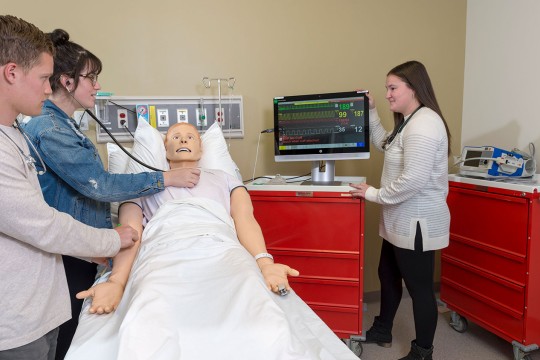
Students complete three Supervised Experiential Learning (SEL) courses providing practical, hands-on learning in culinary and food service operations, community, and clinical settings. SEL course activities are integrated with concurrent classroom-based courses to translate knowledge into practice, preparing graduates to pass the RDN credentialling exam and start careers in dietetics and nutrition.
Featured Work and Profiles
-

No, You Can’t Live Off Protein Shakes; RIT Student Teaches Healthy Eating
RIT dietetics and nutrition student Madison Degenfelder (BS/MS) simplifies nutrition through Tiger Nutrition, a free wellness program for RIT students.
Read More about No, You Can’t Live Off Protein Shakes; RIT Student Teaches Healthy Eating -

RIT Dietetics Students Tackle Key Health Issues at Graduate Showcase
Two graduate students in dietetics and nutrition focused their research on the nutritional needs of student athletes and challenges facing people with food allergies who eat in RIT dining halls.
Read More about RIT Dietetics Students Tackle Key Health Issues at Graduate Showcase -

Student Research Experiences
Undergraduate and graduate students in the Wegmans School of Health and Nutrition gain valuable, hands-on research experience through classroom and community-based opportunities.
Read More about Student Research Experiences -
Nutrition Guide Fuels RIT Athletes
The Performance Nutrition guide, a collaborative effort between the Wegmans School of Health and Nutrition and RIT Athletics, is a resource for student-athletes to support their performance through...
Read More about Nutrition Guide Fuels RIT Athletes -

Prepared for a Career in Research
Kristie O’Connor, MLA, RDN ‘08 Kristie O’Connor is an RIT employee and alumna of the dietetics and nutrition program. She is a research coordinator on a national randomized-control clinical trial. “One of the things that is so...
Read More about Prepared for a Career in Research
Curriculum for 2026-2027 for Dietetics and Nutrition MS
Current Students: See Curriculum Requirements
Students are also interested in
Admissions and Financial Aid
This program is available on-campus only.
| Offered | Admit Term(s) | Application Deadline | STEM-OPT Visa Eligible |
|---|---|---|---|
| Full‑time | Fall | Full-time: October 15 priority deadline, February 15 standard deadline, rolling thereafter | No |
Full-time study is 9+ semester credit hours. International students requiring a visa to study at the RIT Rochester campus must study full‑time.
Application Details
To be considered for admission to the Dietetics and Nutrition MS program, candidates must fulfill the following requirements:
- Complete an online graduate application through the Dietetics Inclusive Centralized Application Service (DICAS).
- Submit copies of official transcript(s) (in English) of all previously completed undergraduate and graduate course work, including any transfer credit earned.
- Hold a baccalaureate degree (or US equivalent) from an accredited university or college. A minimum cumulative GPA of 3.0 (or equivalent) is recommended.
- Satisfy prerequisite requirements and/or complete bridge courses prior to starting program coursework.
- Submit a current resume or curriculum vitae.
- Submit a personal statement of educational objectives.
- Submit two letters of recommendation.
- Entrance exam requirements: None
- Submit English language test scores (TOEFL, IELTS, PTE Academic, etc.), if required. Details are below.
English Language Test Scores
International applicants whose native language is not English must submit one of the following official English language test scores. Some international applicants may be considered for an English test requirement waiver.
Duolingo (DET): 120
IELTS: 6.5
LanguageCert Academic: 70
PTE Academic: 56
TOEFL: 79/4.5
International students below the minimum requirement may be considered for conditional admission. Deaf and hard-of-hearing test takers with significant hearing loss do not need to take the listening and speaking sections for the TOEFL and IELTS. Each program requires balanced sub-scores when determining an applicant’s need for additional English language courses.
How to Apply Start or Manage Your Application
Cost and Financial Aid
An RIT graduate degree is an investment with lifelong returns. Graduate tuition varies by degree, the number of credits taken per semester, and delivery method. View the general cost of attendance or estimate the cost of your graduate degree. A complete breakdown of program cost can be accessed in the Dietetics and Nutrition Program Handbook.
A combination of sources can help fund your graduate degree. Learn how to fund your degree
Additional Information
Students must demonstrate proficiency in all ACEND-defined competencies through ongoing evaluations during their SEL rotations and course work. Failure to meet any competency may delay graduation or require additional supervised practice/remediation until all competencies are satisfactorily achieved.
Credit for Prior Learning
The graduate program in dietetics and nutrition follows the RIT policy for credit for prior learning as outlined in the Middle States Commission on Higher Education. RIT allows up to 6 credits provided for prior learning. No more than 3 credits can be applied to supervised experiential learning. A request for consideration of prior learning will be reviewed by the program director in consultation with the school head and, as appropriate, a preceptor representing the area of request. The decision of the program director will be relayed to the student in writing within 30 days of the request. The review will include evaluation of transcripts, performance evaluations, letters of support, business records, as well as other documents. Student disagreement with the decision for credit for prior learning may ask for a review by the graduate school and/or dean of the college or follow grievance procedures outlined for students at RIT.
Prerequisites
Applicants must show evidence of prerequisite coursework prior to starting the program.
Prerequisites include concepts in nutrition, community nutrition, nutrition education, food production and service, general biology, chemistry, organic chemistry, biochemistry, microbiology, and human anatomy and physiology.
Applicants holding a Verification Statement from an ACEND-accredited program in didactics are considered to have met these requirements. Students interested in the program who still need to complete prerequisite coursework are encouraged to meet with the program director before registering for courses to ensure they are taking the appropriate prerequisites necessary for success in graduate-level dietetics coursework and supervised practice.
Scholarships
Students interested in cultural competence, social determinants of health, behavioral health integration, and interprofessional care coordination are encouraged to apply for scholarships reserved for RIT M.S. in Dietetics and Nutrition students in the AHEC Scholars Program. Selected students may apply their RIT Experiential Learning hours toward fellowship requirements. Benefits of participation include a financial stipend, access to current, research-based, non-clinical online learning materials, and more.
Transportation Requirement
The Dietetics and Nutrition MS program requires Supervised Experiential Learning (SEL) experiences that are off site and not on the RIT campus. Students are responsible for their own transportation to and from any off-campus activities including their supervised experiential learning hours, practice assignments, research, and travel to professional meetings. All transportation and parking costs are the responsibility of the student. Public transportation and/or ride share are typically not available.


Research
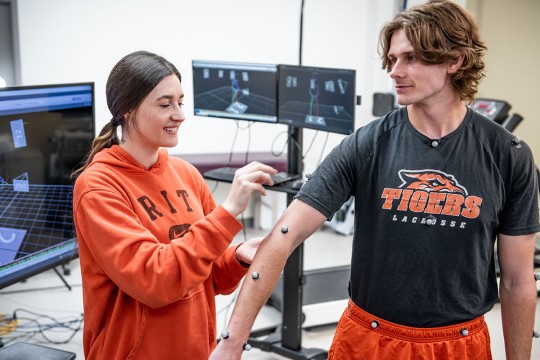
Faculty in the Wegmans School of Health and Nutrition consistently receive funding awards from private, state, and federal sources. This support provides you with unique opportunities to conduct research with our faculty members on local, national, and international research projects on a variety of topics, including:
- Eating competence
- Metabolic syndrome lifestyle interventions
- Motivational interviewing
- PICA and anemia during pregnancy
- Food insecurity
- Childhood anemia in Ghana
- Statewide online nutrition education
Learn more by exploring the Wegmans School’s research initiatives.
Thesis: The completion of a thesis is a required element of the program. Your thesis advisor will provide guidance and feedback throughout the thesis process. The thesis component of the program provides you with the opportunity to put research theory into practice.

Related News
-
November 11, 2025

RIT professor brings nutrition expertise to international collaboration
A remote networking session Associate Professor Brenda Abu attended for academics from African countries has led to a promising collaboration that extends her scholarship and the influence of RIT to communities in Ghana.
-
August 29, 2025

No, you can’t live off protein shakes; RIT student teaches healthy eating
Tiger Nutrition’s peer-to peer education empowers students by making healthy eating advice relatable, accessible, and impactful.
-
April 4, 2025

RIT Graduate Showcase puts students in the spotlight April 10
Graduate students Olivia Towne and Meghan Taylor gave back to the RIT community with their graduate research projects, which focused on the nutritional needs of student athletes and the challenges facing people with food allergies.
