Biotechnology and Molecular Bioscience Bachelor of Science Degree

In RIT’s biotechnology bachelor’s degree you’ll develop technologies for genetics, agriculture, pharmaceuticals, vaccine development, energy/ environment, forensics, and more.
$1M+
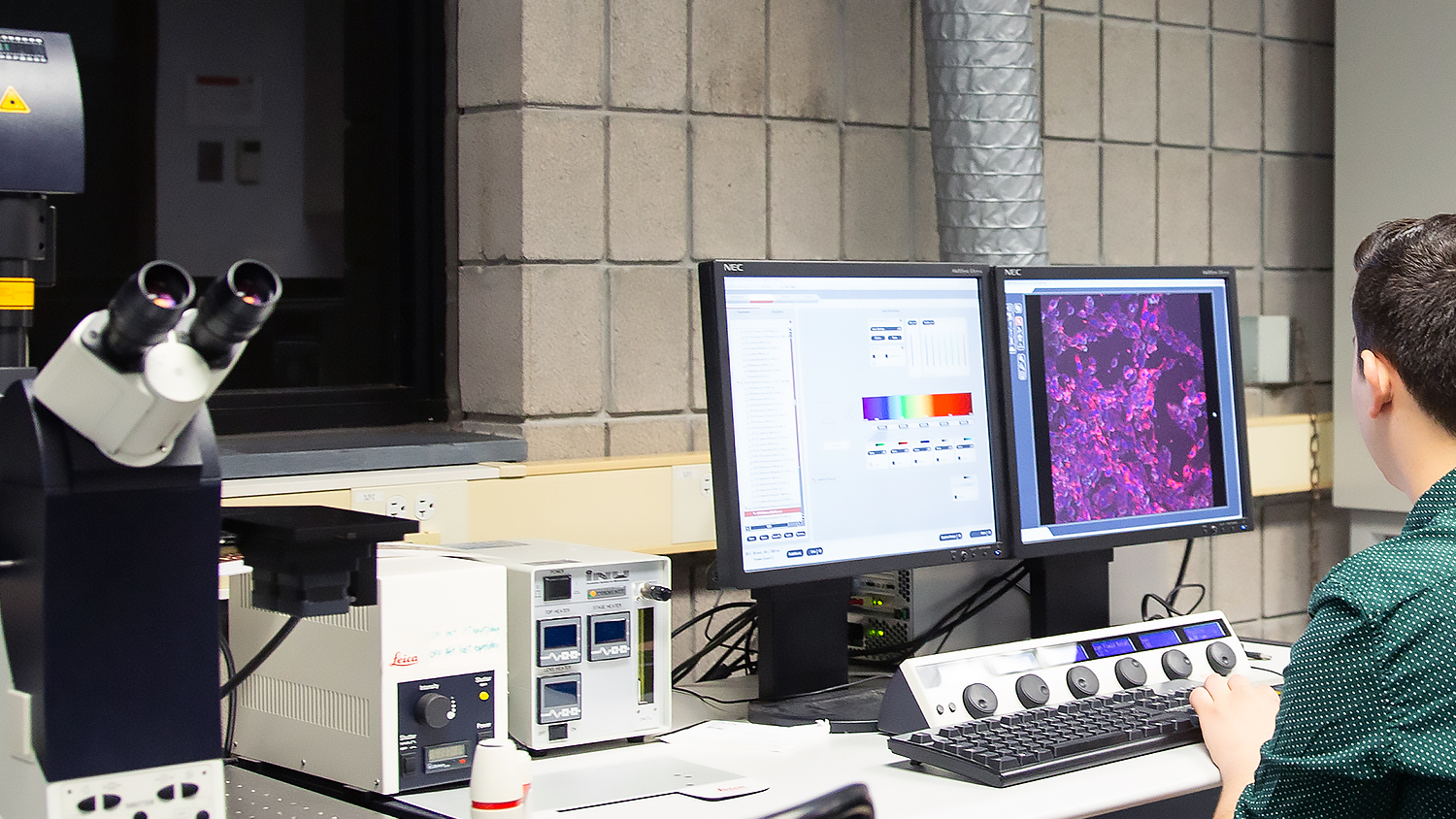
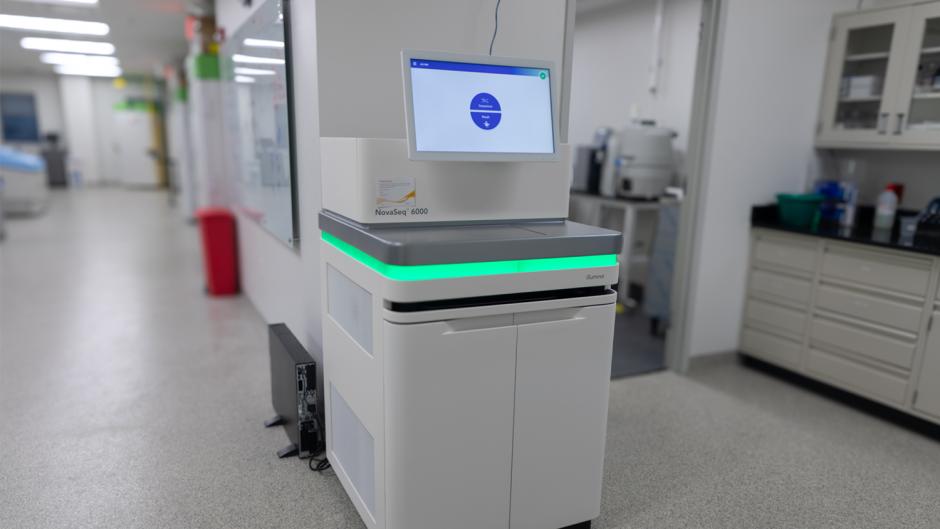
Equipment in Genomics Lab
Overview for Biotechnology and Molecular Bioscience BS
Why Study Biotechnology at RIT
Hands on Experience: Sequence and annotate whole genomes of a variety of organisms using the Illumina MiSeq in the Genomics Lab.
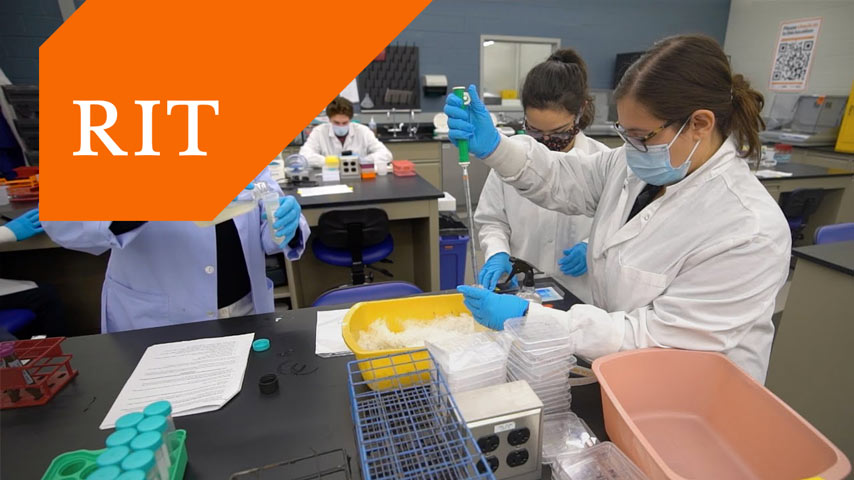
Lab Experience: 70% of the biotechnology and molecular bioscience elective courses have a hands-on laboratory component.
Gain Real-World Experience: Conduct undergraduate research, complete a cooperative education or internship, or study abroad.
Engaging Community: Develop leadership, networking, and communication skills and engage in professional and outreach activities through the Biotechnology Club.
Pre-Med/Pre-Health and Pre-Vet Advising Programs: Receive personalized guidance to become a competitive candidate for admission to medical and veterinary schools and graduate programs in the health professions.
Direct Path to Medical School: RIT’s partnership with the University of Buffalo’s Jacobs School of Medicine offers eligible pre-health/pre-med students early admission and mentorship through the Early Opportunity Program in Medicine.
Jobs at Industry Leading Companies: Recent biotechnology graduates are employed at organizations such as Pfizer, Inc., Roswell Park Cancer Institute, Merck & Co., Johns Hopkins Medicine, National Science Foundation, National Institutes of Health, and the MD Anderson Cancer Center.
Accelerated Bachelor’s/Master’s Available: Earn both your bachelor’s and your master’s in less time and with a cost savings, giving you a competitive advantage in your field.
STEM-OPT Visa Eligible: The STEM Optional Practical Training (OPT) program allows full-time, on-campus international students on an F-1 student visa to stay and work in the U.S. for up to three years after graduation.
In RIT’s biotechnology and molecular biology degree you’ll improve human health by harnessing technology advancements and biomolecular processes to research and develop technologies in genetics, agriculture, pharmaceuticals and vaccine development, environment and energy, forensic science, genetic counseling, and more.
Curriculum for RIT’s Bachelor of Science in Biotechnology
This comprehensive biotechnology bachelor’s degree prepares you to immediately assume challenging positions in research, development, and management in fields as dynamic and diverse as:
- plant biotechnology
- human genetics
- agriculture
- food products
- pharmaceuticals and vaccine development
- environment and energy
- forensic science
- genetic counseling
Building on a core of biology, chemistry, math, and the liberal arts, the courses in the bachelor of science in biotechnology are taught from a molecular bioscience perspective with a focus on the central genetic dogma of molecular biology. The curriculum explores the rapidly expanding field of genetic engineering, and the nearly unlimited potential that controlled genetic experiments hold for improving the quality of life. Specialized areas of emphasis include:
- Recombinant DNA
- Microbial and plant genetic engineering
- Mammalian and plant tissue culture
- Monoclonal antibody production and purification
- Large-scale fermentation techniques (bacterial and mammalian cell)
- Methods for characterization and separation of proteins and nucleic acids in yeast, bacterial, viral, and plant systems
As a student enrolled in the biotechnology bachelor’s degree at RIT, you’ll be exposed to dynamic professors who are leaders in their fields both in the classroom and in the laboratory. The opportunity to participate in meaningful, faculty-sponsored undergraduate research projects prepares you to gain valuable experience for full-time employment or to pursue graduate study.
Furthering Your Education in Biotechnology and Molecular Bioscience
Combined Accelerated Bachelor's/Master's Degrees
Today’s careers require advanced degrees grounded in real-world experience. RIT’s Combined Accelerated Bachelor’s/Master’s Degrees enable you to earn both a bachelor’s and a master’s degree in as little as five years of study, all while gaining the valuable hands-on experience that comes from co-ops, internships, research, study abroad, and more.
- Biotechnology and Molecular Bioscience BS/Bioinformatics MS:
Combine your BS degree in biotechnology and molecular bioscience with an MS in bioinformatics to become a leading professional in utilizing big data and machine learning to tackle complex biological problems. Establish a strong background in the latest technology and techniques used in the biotech fields of genetics, agriculture, pharmaceuticals, energy, and more. The addition of a bioinformatics master’s degree provides the computational training and customized research experience to help you stand out in the job market. The blend of biotechnology and computational skills will make you uniquely prepared for high-paying careers in cutting-edge industries. - +1 MBA: Students who enroll in a qualifying undergraduate degree have the opportunity to enroll in the +1 MBA program by adding an MBA to their bachelor’s degree after their first year of study.
Pre-Med/Pre-Health Advising
RIT’s Office of Pre-Health Advising offers an advising program that’s open to all majors and provides personal, individualized academic counseling to help you create a comprehensive long-term strategy to assist you in building successful applications to medical, dental, and veterinary schools or graduate degrees in the health professions (e.g., occupational therapy, physical therapy, etc.). Our pre-health advisors will have in-depth conversations with you around critical topics that include academic planning and course selection, MCAT and other admission exams, undergraduate research opportunities, clinical experiences and field work, timelines, and much more. Learn more about pre-med/pre-health advising.
Pre-Vet Advising
RIT’s pre-vet advising program provides personalized support to help you prepare successful applications for veterinary medical school. Pre-vet advising offers guidance on course selection, veterinary and animal care experience requirements, the veterinary school application process, and more. Learn about RIT’s pre-vet advising program.
RIT/University of Buffalo’s Early Opportunity Program in Medicine
RIT pre-health/pre-med students have a direct path to medical school through an RIT partnership with the Jacobs School of Medicine and Biomedical Sciences at the University at Buffalo (UB). The Early Opportunity Program in Medicine allows eligible RIT students to secure a pre-admission offer to the Jacobs School while completing their undergraduate degree at RIT. Students accepted into the program gain early access to professional training and mentorship at UB’s medical school, helping them prepare for the demands of medical school and beyond. Learn more about the Early Opportunity Program in Medicine.
-

Join Us for Accepted Student Open House
Visit campus on March 28 or April 11 to meet faculty, tour campus, and ask your questions.
-

Apply for Fall 2026
First-year students can apply for Early Decision II by Jan. 1 to get an admissions and financial aid assessment by mid-January.
Careers and Experiential Learning
Typical Job Titles
| Associate Scientist | Molecular Technician | Laboratory Technician |
| Quality Assurance Laboratory Technician | Plant and Microbial Genetics Researcher | Scientist |
| Analyst | Cytogenetics Lab Medical Technician | Research Associate |
Industries
Research Internships
Research internships, offered both on and off-campus, take place during the summer. RIT offers numerous opportunities for students to participate in research, including three on-campus summer programs: Research Experiences for Undergraduates (REU), Summer Undergraduate Research Fellowships (SURF), and the Summer Undergraduate Research Programs (SURP). Many students participate in undergraduate research for course credit during the academic year.
Cooperative Education
What’s different about an RIT education? It’s the career experience you gain by completing cooperative education and internships with top companies in every single industry. You’ll earn more than a degree. You’ll gain real-world career experience that sets you apart. It’s exposure–early and often–to a variety of professional work environments, career paths, and industries.
Co-ops and internships take your knowledge and turn it into know-how. Science co-ops include a range of hands-on experiences, from co-ops and internships and work in labs to undergraduate research and clinical experience in health care settings. These opportunities provide the hands-on experience that enables you to apply your scientific, math, and health care knowledge in professional settings while you make valuable connections between classwork and real-world applications.
Featured Work and Profiles
-

RIT Co-op Experience Paves Way for Thriving Pharmaceutical Career
Sayali Kadam ’10 turned co-op experiences into a thriving career at Merck! Now Director of Launch Strategy and Operations, she credits RIT's hands-on learning for her success.
Read More about RIT Co-op Experience Paves Way for Thriving Pharmaceutical Career -

From RIT Labs to Life-Saving Cancer Research at AstraZeneca
Dylan Weil ‘15 utilizes his RIT biotechnology lab skills to conduct life-saving cancer immunotherapy research at AstraZeneca.
Read More about From RIT Labs to Life-Saving Cancer Research at AstraZeneca -
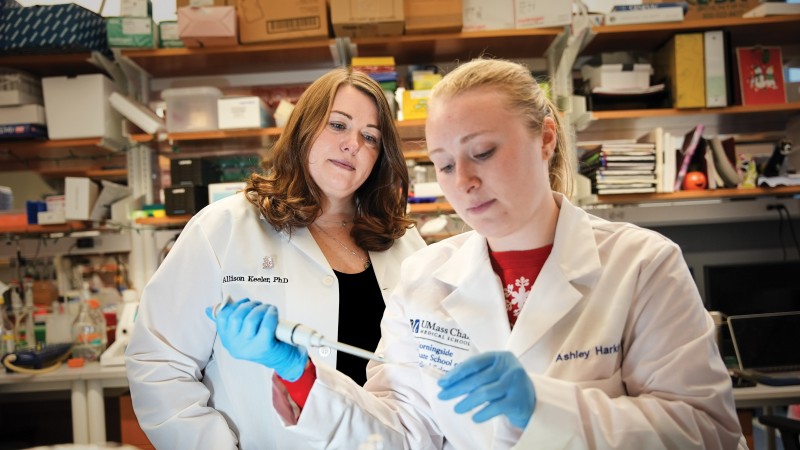
Grad's Experience Leads to Career in Gene Therapy Research
Allison Keeler has turned her lifelong interest in science into a career in medical research. She is now the lead researcher in the Keeler Lab at the Horae Gene Therapy Center.
Read More about Grad's Experience Leads to Career in Gene Therapy Research -

Biotechnology, Diversity, and Inspiration to Pursue a Lifelong Dream
Tandy Arenas-Bertol '14 (biotechnology) As she pursued her lifelong dream of working in the field of science, Tandy Arenas-Bertol ’14 found herself immersed in diversity and inspiration at RIT while pursuing her biotechnology degree.
Read More about Biotechnology, Diversity, and Inspiration to Pursue a Lifelong Dream -

Tackling Real-World Issues with Biotechnology Research
Sydney Purcell (biotechnology) Sydney Purcell is conducting real-world research in the Viral Genetics Lab at RIT alongside Dr. Maureen Ferran, whose work centers on using viral genetics to create cutting-edge cancer treatments.
Read More about Tackling Real-World Issues with Biotechnology Research -

Biotechnology: Lab-based Biology at a Cellular and Molecular Level
Katherine Varandas ’10 (biotechnology) Katherine Varandas ’10 wanted a biology major to prepare her for a job. RIT’s biotechnology program provided hands-on lab experiences that led her to a career in academic research.
Read More about Biotechnology: Lab-based Biology at a Cellular and Molecular Level
Curriculum for 2025-2026 for Biotechnology and Molecular Bioscience BS
Current Students: See Curriculum Requirements
Admissions and Financial Aid
This program is STEM designated when studying on campus and full time.
First-Year Admission
First-year applicants are expected to demonstrate a strong academic background that includes:
- 4 years of English
- 3 years of social studies and/or history
- 3 years of mathematics is required and must include algebra, geometry, and algebra 2/trigonometry. Pre-calculus is recommended.
- 2-3 years of science is required and must include biology and chemistry.
Transfer Admission
Transfer applicants should meet these minimum degree-specific requirements:
- A minimum of college algebra is required. Pre-calculus or calculus is preferred.
- Chemistry and biology are required.
Financial Aid and Scholarships
100% of all incoming first-year and transfer students receive aid.
RIT’s personalized and comprehensive financial aid program includes scholarships, grants, loans, and campus employment programs. When all these are put to work, your actual cost may be much lower than the published estimated cost of attendance.
Learn more about financial aid and scholarships


Research
Real-World Experiences Through Biotechnology Research
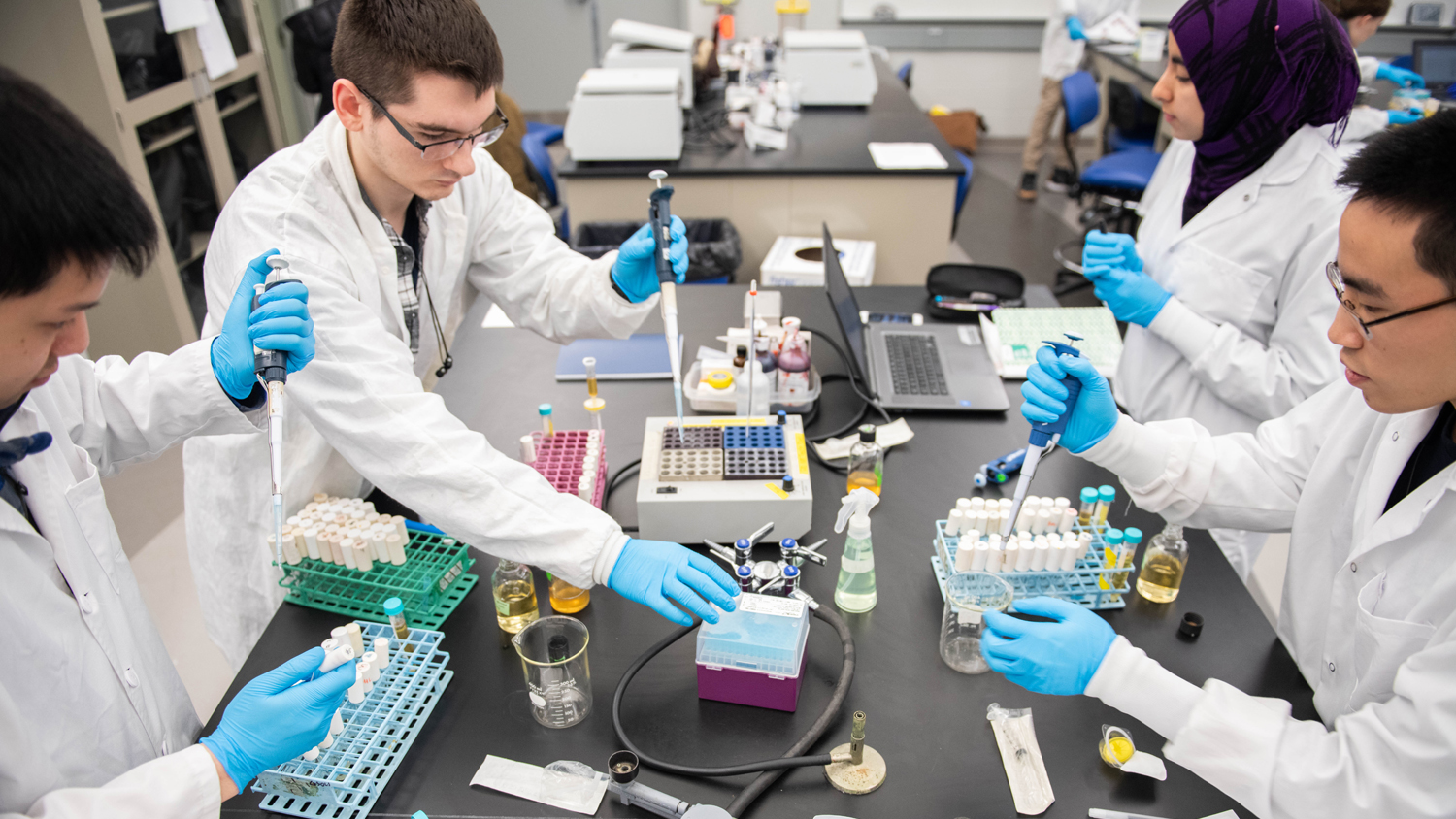
Undergraduate research is strongly encouraged for biotech majors. It can begin as early as your first year. Participation in undergraduate research leads to the development of real-world lab techniques, enhanced problem-solving skills, and broader career opportunities. Our students have opportunities to travel to national conferences for presentations and also become contributing authors on peer-reviewed manuscripts. Explore the variety of life science undergraduate research happening at RIT.
Related News
-
November 12, 2025
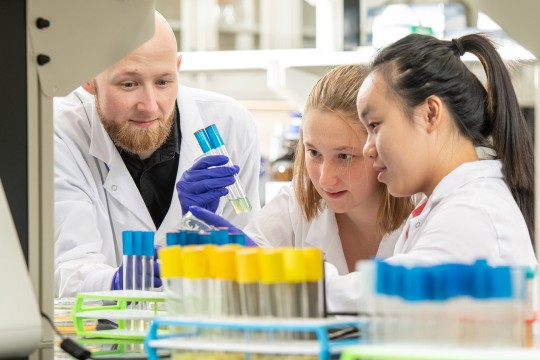
Stefan Schulze’s lab aims to build the foundation for new biomedical treatments
Backed by an award from the National Institutes of Health, Assistant Professor Stefan Schulze is using his expertise in the structure and function of proteins to work with a bacterial pathogen commonly associated with antibiotic resistance.
-
May 1, 2025

Crucial training pipeline for Deaf scientists dismantled by NIH funding cuts
Science speaks to Michelle Koplitz '08 (biotechnology), Sara Blick-Nitko '17 (professional studies), and Wyatte Hall '08 (psychology) about the impact of budget cuts on the Deaf Scientists Pipeline.
-
April 17, 2025

Two College of Science students earn Goldwater Scholarships
Grace Perna, a third-year biotechnology student, and Eva Reilly, a second-year biochemistry major, will use the scholarship to further their research in labs that aim to find better solutions for a range of diseases.
Contact
Thomas H. Gosnell School of Life Sciences