Bioinformatics Master of Science Degree

A bioinformatics master’s degree prepares you to tackle complex problems in biology using big data, data mining, machine learning and modeling.
Overview for Bioinformatics MS
This program is no longer accepting new student applications.
RIT’s bioinformatics master’s degree combines biotechnology, computer programming, and computational mathematics to prepare you to utilize and create technologies that discover, treat, and cure a range of medical illnesses. With a strong foundation in biotechnology, computer programming, computational mathematics, statistics, and database management, you will be well-prepared for academia and careers in the biotechnology, bioinformatics, pharmaceutical, and vaccine industries.
RIT’s Bioinformatics Master’s Degree
Bioinformatics is a field that has been developing over the last thirty years. It is a discipline that represents a marriage between biotechnology and computer technologies and has evolved through the convergence of advances in each of these fields. Today bioinformatics is a field that encompasses all aspects of the application of computer technologies to biological data. Computers are used to organize, link, analyze, and visualize complex sets of biological data to discover, treat, and cure a range of medical illnesses.
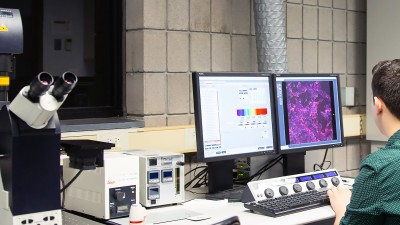
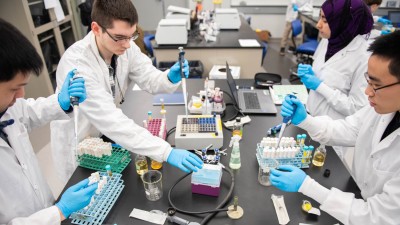
RIT’s bioinformatics master’s degree is focused on cutting-edge computational techniques, such as data mining, to understand biomedical data. In laboratory exercises and assignments, you will learn to sequence DNA and use computer programs to analyze DNA sequences and predict molecular models. You are also encouraged to pursue cooperative education opportunities to gain hands-on career experience in industry.
Current bioinformatics students have worked on projects including:
- Database development
- Cancer vaccine design
- Literature mining
- Molecular dynamics simulation
The program provides you with the capability to enter the bioinformatics workforce and become a leader in the field. The curriculum is designed to fulfill the needs of students with diverse educational and professional backgrounds. Individuals entering the program typically have degrees in biology, biotechnology, chemistry, statistics, computer science, information technology, or a related field. To prepare applicants from various backgrounds, the curriculum includes a comprehensive bridge program that includes courses in biology, mathematics, computer science, statistics, or other related fields. The program offers two tracks, one for students with backgrounds in the life sciences and one for those with backgrounds in the computational sciences.
Careers in Bioinformatics
With the advent of high-throughput technologies such as Next Generation Sequencing and proteomics, bioinformatics has become essential to the biological sciences in general. In the past, laboratories were able to manage and analyze their experimental data in spreadsheets. Many research labs now require the expertise of dedicated bioinformatics core centers or their own in-house bioinformaticists.
Graduates of the bioinformatics master’s program have entered such laboratories, both in industry and academia, as bioinformaticists. Some have also gone on to leverage their biotechnology experiences as wet lab experimentalists. The diversity of skills you will cultivate in the program give you access to a wide range of career choices.
The job market is rich with opportunities for those with graduate degree in bioinformatics, particularly when coupled with research as thesis work. This research provides exposure to real-world problems—and their solutions—not otherwise attainable in an academic setting.
Graduates of the bioinformatics master’s degree currently work senior analysts/programmers, associate systems analysts, bioinformaticist, bioinformatics analysts, bioinformatics engineers, computational biologists, and software engineers.
Curriculum for Bioinformatics MS
Current Students: See Curriculum Requirements
Students are also interested in


Research
Faculty in the College of Science receive research grant awards from organizations such as the National Science Foundation and the National Institutes of Health, which provide you with unique opportunities to conduct cutting-edge graduate-level thesis research. Using modern computational tools and approaches the bioinformatics faculty conduct research on a broad variety of topics including:
- molecular evolution
- ecological modeling
- cancer biology
- genomics
Learn more by exploring our life science research areas.