Freshman Imaging Project brings historic artifacts to new dimension
First-year students create interactive 3D and 2D replicas of a cuneiform tablet and papyrus
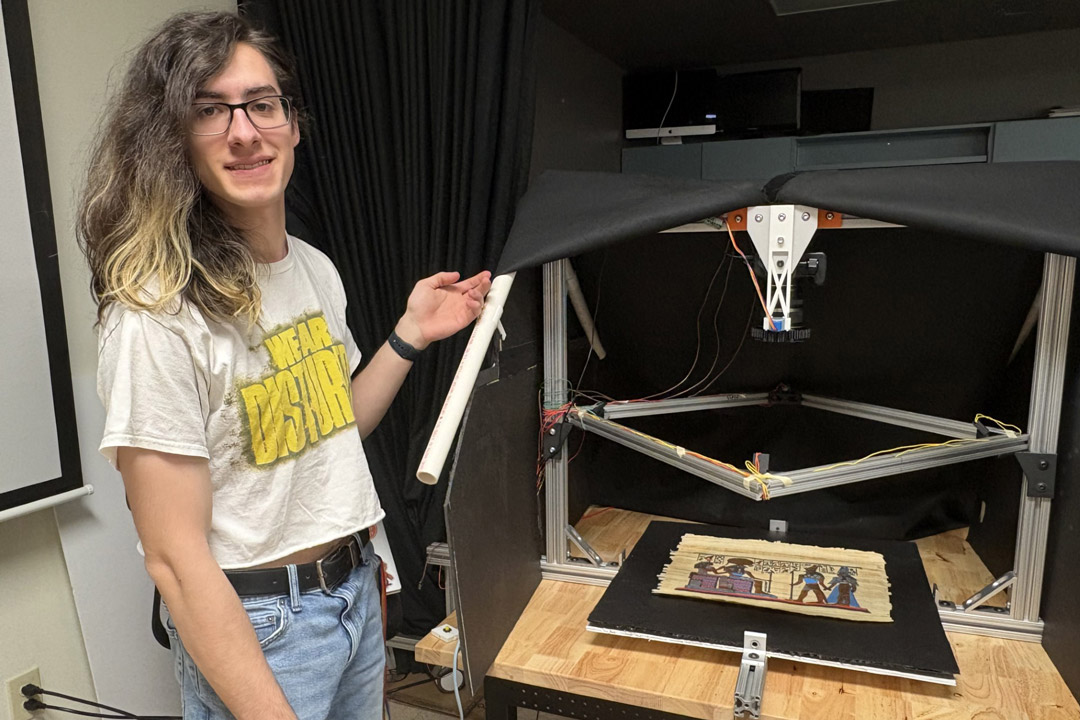
First-year student Iris Angello shows off one of the capture setups for this year’s Freshman Imaging Project. The class uses recreations of artifacts, like this papyrus, for display, but used actual historical objects from RIT’s Cary Graphic Arts Collection for the project.
For first-year imaging science and motion picture science students, the Freshman Imaging Project gives immediate hands-on, collaborative experience as they start their college careers at RIT.
To learn more
The final Freshman Imaging Project can be explored at Imagine RIT on Saturday, April 25. The team will be set up in the Carlson Center for Imaging Science.
The class is tasked every year with a new project where they have to research, design, and build an advanced imaging system that they then present at Imagine RIT: Creativity and Innovation Festival. This year, the class is working with RIT’s Cary Graphic Arts Collection and is creating 3D and 2D digital twins of a cuneiform tablet and papyrus manuscript.
The students are separated into two teams, one for each object, and each team has four subgroups: capture, modeling, rendering, and display. In the end, the class will present virtual representations of the objects that users can interact with through web-based interfaces and novel “Disney-like” display systems.
In addition to the technologies themselves, the class has created a website, brochure, quick start guide, and technical manual to provide more information on the cultural heritage objects and to instruct future users of the systems.
“It’s been a little overwhelming but also a lot of fun,” said Scarlett Higgins, an imaging science student from California. “I learned a lot about myself and about my peers. It’s a good jumping off point to get to know the people in your major who you’re probably going to be working with for the rest of your career.”
Carter Laubach, an imaging science major from Pennsylvania, appreciates getting the early experience.
“I’ve learned so much about how to come up with ideas and follow through with them,” said Laubach. “It really sets up my relationship with the professors in the building and the rest of the imaging science class. It helps us get to know each other.”
Karen Braun ’96 Ph.D. (imaging science), associate director of the Chester. F. Carlson Center for Imaging Science, has taught the class since 2019. Imaging science’s Ph.D. program is the oldest at RIT and the first of its kind in the nation. Braun was the first woman to receive a Ph.D. in RIT’s history and has watched many students grow from the first-year class into graduation.
“Students take the principles of planning a long-term project into their senior projects and other classes,” said Braun. “It’s really inspiring to see how far they come. I think the cohort that builds out of this class is one of the most important things.”
New to the class’s makeup this year is Associate Professor James Ferwerda. His background in computer graphics with applications to cultural heritage imaging helped determine this year’s project. Braun has taught with different instructors over the years. Ferwerda has been great in finding out the strengths of each individual student and making the project interesting to everyone.
“I especially love teaching undergrads because they have such enthusiasm and curiosity,” said Ferwerda. “Being able to work with them and take that positive energy that they have and help them guide it, inform it, and direct it to accomplish something - that, to me, is why we’re doing what we’re doing here.”
