Graduating student applies medical illustration to upcoming documentary

Audrey Thompson (back row, second from left) with fellow medical illustration students, Associate Professor Glen Hintz, and Orly and Ed Wiseman, who head production company Moving Pictures Inc. The students contributed medical illustrations to the Wisemans' latest documentary project.
As a medical illustrator, Audrey Thompson appreciates the value of educating through visuals.
She worked on a project this semester where she leveraged her skills to teach patients and the general public about a widely unrecognized health epidemic. Thompson, who is graduating from RIT this week with a BFA in medical illustration, and four other students in the program were hired as medical illustrators in the making of an upcoming lifestyle documentary.
The film details airway disorders in humans such as sleep apnea. The students’ anatomically accurate illustrations and animations — set to appear throughout the documentary — visually inform viewers of disorder symptoms and treatments like medical devices and procedures.
“I like the project because it’s great to be part of something where you’re educating people about something they might not know about,” said Thompson, from Portland, Ore.

Audrey Thompson
The four other students creating visuals to support the film’s storytelling are: Rio Hayama, Katelyn McDade, Abby Nautel, and Veronika Zsenits.
The students were hired for the project by Moving Pictures Inc. — a digital production studio in New York City headed by Emmy Award-winning Orly and Ed Wiseman, whose notable work includes Reading Rainbow.
“(Medical illustration) is needed and it’s exciting,” Thompson said. “The audience for the documentary is really just the public and I think the images will really help. They might see the symptoms and think, ‘That sounds just like me.’”
Thompson’s time at RIT was defined by additional experiences that enabled her to deploy her RIT education in real-world settings.
After making a miniature clay model of a figure model in the 3D Applications: The Figure course her first year, Thompson grew motivated to take a ceramics class. From there, the hands-on making didn’t stop. She also explored other ceramics, printmaking, and sculpture practices through the craft and materials studies minor.
The pieces she made in her minor had traces of her medical illustration background — like making a CT scan design for a screenprinting project and crafting a 3D eyeball.
“It’s really cool to take other classes that are not in your major,” she said. “You should do it while you have the opportunity when you’re here. Being a medical illustrator sometimes informs my 3D work. It’s fun to do stuff in the medical illustration scope but put it onto a 3D form.”
While in a mold-making class taught by Peter Pincus, associate professor of ceramics, Thompson was asked to assist Pincus with a multidisciplinary project. It led to the creation of “Thetis Confined: Portland Zoetrope,” a stylized, contemporary interpretation of the famous Roman glass cameo, the Portland Vase.
Thompson teamed up with medical illustration and film and animation students, along with Pincus and Mari Jaye Blanchard, associate professor of animation. Pincus made the vessel’s form as a clay zoetrope — a cylinder-shaped, pre-film animation device that presents the illusion of motion by showing sequenced drawings when spun.
Thompson was responsible for illustrating a reimagined story of Thetis, a shape-shifting Greek mythology figure who appeared on the original vase. Thompson’s succession of drawings showing Thetis morphing into different forms were transferred to decals and affixed to the zoetrope through kiln firing.
The final piece was exhibited at Crocker Art Museum in Sacramento, Calif.
Audrey Thompson
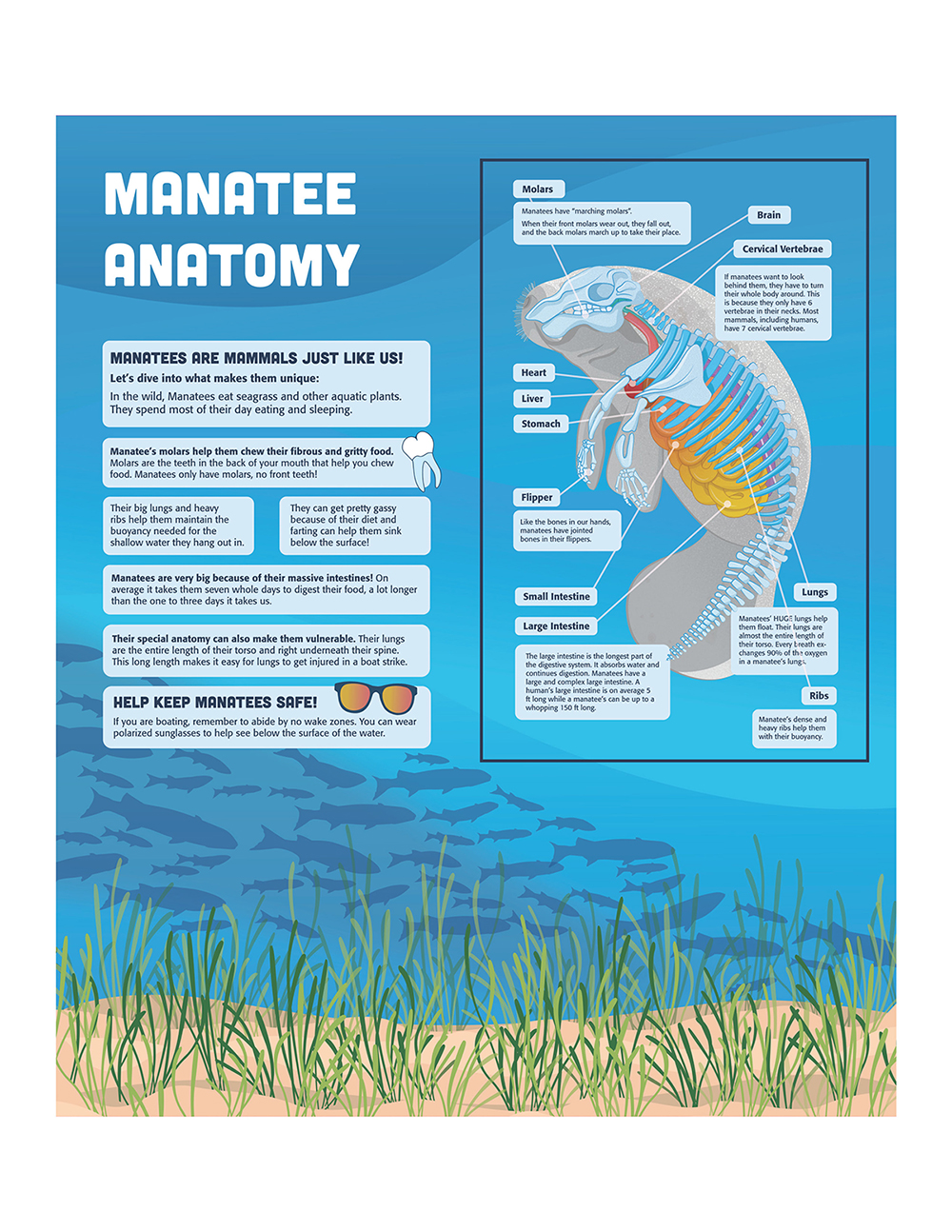
The manatee illustration and explainer text Thompson created for the Mote Laboratory & Aquarium exhibit.
Another rewarding opportunity came last summer at Mote Marine Laboratory & Aquarium in Sarasota, Fla., where she was an exhibit design and scientific illustration intern.
Thompson had the autonomy to design an exhibit of her choosing, ultimately developing an interactive display that teaches kids about manatee anatomy. She illustrated the skeleton and anatomical parts of the sea mammal, along with educational labels and descriptions, with slidable polycarbonate layers revealing different parts of the manatee.
Thompson said the aquarium plans to display the exhibit in the future.
“It was great to make something that people can interact with,” Thompson said.