Pioneering type design duo to receive RIT's 2026 Goudy Award
Norman Posselt
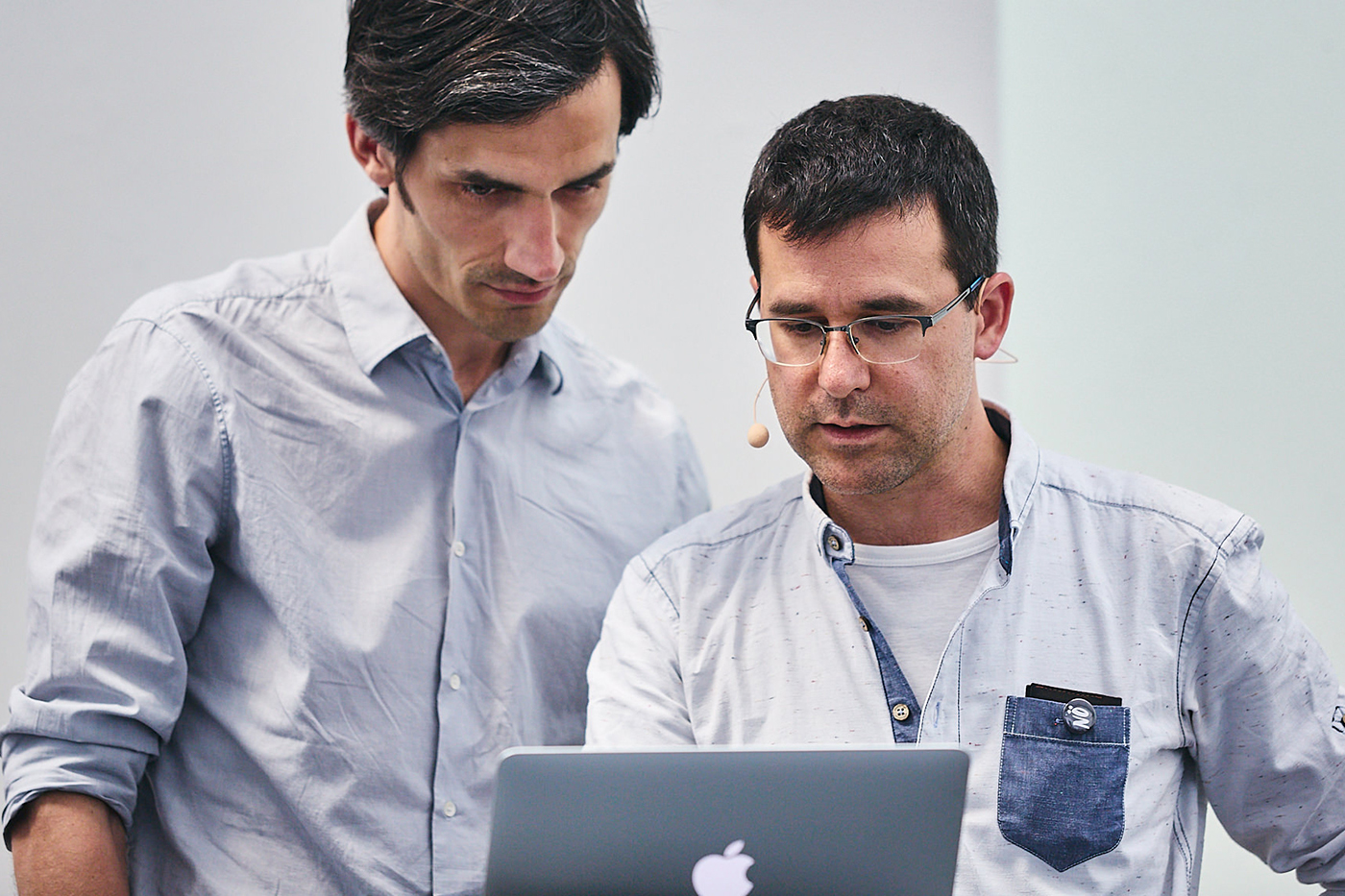
Georg Seifert, left, and Rainer Erich Scheichelbauer are the originators of Glyphs, a game-changing font editing software noted for being greatly accessible to users interested in developing their own high-quality typefaces.
When Chuck Bigelow was honored with RIT’s Frederic W. Goudy Award in 1987, Steve Matteson ’88 (printing) was there, with backstage access that sparked his ambitions.
As a then-student, Matteson supported the audio needs of that presentation of the Goudy Award, a long-standing honor celebrating outstanding practitioners in type design and related fields. He pinned a microphone to Bigelow, leading to friendly conversation.
Bigelow, who later taught at RIT, is a pioneer of digital type design. His Goudy Award lecture made Matteson rethink his goal of becoming a commercial printer.
“His talk captured my imagination about being a type designer,” Matteson said. “Chuck made it clear that type is being designed to solve problems every day. And with every change in technology, there is more work to make type perform better.”
Thanks to their backstage chats, Bigelow soon called Matteson about an opportunity at a laser printer manufacturer. The role allowed Matteson to create his first typeface and launch his career as an eminent typeface designer working with clients such as Apple, Google, Microsoft, Toyota, and Unilever.
“It was kismet,” Matteson said.
In August 2025, Matteson returned to RIT as the Melbert B. Cary Professor in Graphic Arts in the School of Design. As fate would have it, one of Matteson’s core responsibilities is, in consultation with other experts on campus, to select this year’s Goudy Award recipients.
Type designers and developers Georg Seifert (from Germany) and Rainer Erich Scheichelbauer (Austria) will accept the 2026 Goudy Award during a public presentation from 4:30-5:30 p.m. Friday, April 10, in RIT’s Carlson Auditorium. A reception in the Cary Graphic Arts Collection, set against the “Orbis Typographicus” exhibition, will follow.
Seifert and Scheichelbauer are the originators of Glyphs, a game-changing font editing software noted for being greatly accessible to users interested in developing their own high-quality typefaces.
Matteson said he admires that Glyphs supports digitally-disadvantaged writing systems — those not commonly available on major operating systems. The app promotes new typefaces in a wide assortment of native tongues.
“The two of them built this architecture for making fonts that are far and above anything ever made in digital typography,” Matteson said. “It’s groundbreaking.”
In the early days of Glyphs, Seifert grew aware of especially difficult barriers in Arabic font design. Due to letters meshing together and the script’s use of diacritics — accents and other markings to denote pronunciation — making new typefaces was complicated.
With Glyphs, Seifert and Scheichelbauer were able to define letter and diacritic positioning in a way rarely done before or since. On the Glyphs website, Sahar Afshar, an Iranian typeface designer and researcher, gave a testimonial stating, “It doesn’t make sense to design Arabic in anything but Glyphs.”
“When I was looking into a font design tool, one main thing was that letters will never be alone,” Seifert said. “They are always in words. That is the basic idea — you draw inside that context.”
Identical focus was also placed on other digitally-disadvantaged writing systems, such as Devanagari and other Indic scripts.
Matteson said font creation software was long marred by near-irreparable bugs and lacking customer service, until Seifert and Scheichelbauer came along with Glyphs.
Scheichelbauer travels to numerous conferences to present about Glyphs and lead workshops. The routine interface with users delivers the direct feedback, and in turn service, the company is known for. Seifert handles Glyphs’ programming needs, from new features to bug fixes, also in response to customers’ experiences.
“That’s how we got many implementations. It’s user feedback,” Scheichelbauer said. “Constant contact with users is super important to us, and seeing how they use the software.”
As a type designer, Seifert is known for the popular typeface families Graublau Sans and Graublau Slab, as well as co-developing the Berlin airport’s typeface. Scheichelbauer, meanwhile, studied photography, philosophy, and Dutch before helping Glyphs get to where it is today. He also started his own font foundry, Schriftlabor, in 2014.
“They’re hugely invested in the design community and helping people,” Matteson said. “They’re hands-on with everyone.”
The Goudy Award has a shared legacy between RIT's School of Design, Cary Graphic Arts Collection, and former School of Printing. In addition to Matteson, other members of the 2026 selection committee included Lorrie Frear (professor), Steven Galbraith (Cary Collection curator), Amelia Hugill-Fontanel (Cary Collection associate curator), and Alex Lobos (School of Design director).
Following the award presentation, Seifert and Scheichelbauer will help lead a series of workshops, open to all RIT students, on Saturday, April 11.