New RIT course on AI and copyright helps creative students feel empowered
AI & Copyright for Creatives offers a foundational understanding of copyright law and guidance on how students can protect their original works
Carlos Ortiz/RIT
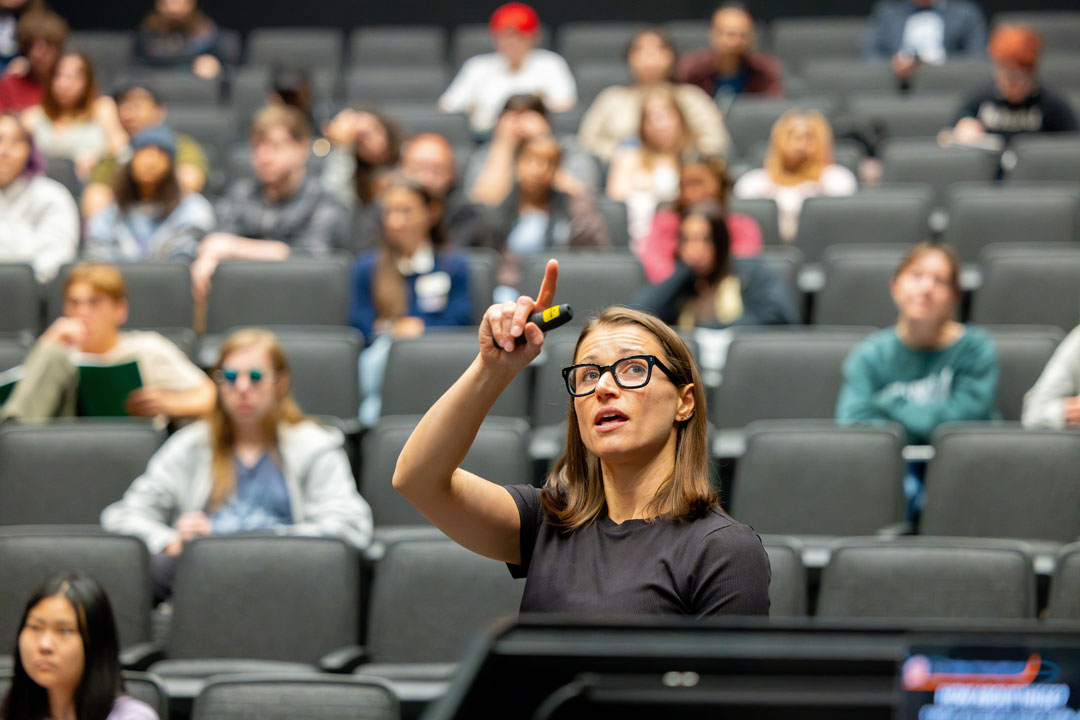
Adjunct Professor Rachel DiNunzio, above, is teaching a new course on AI & Copyright for Creatives. The goal of the course is to inform students of their rights and protections as artists in the face of an ever-evolving digital world.
Working in a creative field without having a thorough understanding of copyright law is like driving a car without taking a driver’s license exam, according to Rachel DiNunzio, adjunct professor at Rochester Institute of Technology. Without knowledge of the laws that protect artists and their original works, creatives can easily put themselves at risk or be taken advantage of when negotiating work contracts.
To ensure students in RIT’s College of Art and Design are “road ready” once they graduate, DiNunzio worked with Shanti Thakur, professor and director of the Digital Summer Institute, to craft a new course called AI & Copyright for Creatives.
The course provides students with foundational knowledge of copyright law and encourages them to explore how those laws do and do not protect their work in the new digital world shaped by artificial intelligence (AI). While the course has a heavy focus on the defensive tactics for protecting artists’ rights, students will also learn about offensive tactics that can protect their work, such as data poisoning.
“Right now, we are seeing lawmakers try to make decisions, seek regulations, and update some of the laws that we have, but these things are not figured out yet,” said DiNunzio. “Without the foundational knowledge of those efforts or the laws already in place that protect us, a lot of creatives can feel as though they’re swimming aimlessly in an abyss.”
DiNunzio’s hope is that the course can help students feel empowered in navigating their legal rights as artists, and that the knowledge gained will help them confidently face changes brought about by AI and any other future technological developments.
This knowledge has proven vital for Calliope Temple, a third-year student in RIT’s new media design program. She explained that new media design students are encouraged to explore new technologies, but when it came to AI, she felt unsure of the right approach and what was appropriate for her field.
Enrolling in AI & Copyright for Creatives allowed her to increase her understanding of the ethical impacts of AI, and how the technology can and can’t be used in the creative process. She’s been eager to bring her new knowledge back to her peers in the RIT Honors Program, the new media club, and other students associated with the HArts special interest housing.
According to Temple, one of the most beneficial course assignments she completed was going through the process of registering her copyrights for a short video she created. She also shared that learning from guest speaker Atreya Mathur, director of legal research at the Center for Art Law in New York City, during class was one of the biggest highlights of her semester.
“The course has put into words a lot of the stuff I vaguely knew about copyright and AI, clarified a lot of things that I didn’t know, and debunked myths I’ve heard about copyright,” said Temple, from Ashland, Mass. “Now, when these situations do arise, I have concrete knowledge of how to face them.”
Over the last year, RIT’s College of Art and Design hosted multiple open forums where students, faculty, and staff expressed their thoughts and concerns about AI. When reflecting on those forums, Thakur said it became clear that students wanted a dedicated course on copyright law.
“People stealing each other's images is as timeless as time itself. What is different now is that many artists must put their work on websites or social media for promotion, and we have so little control over what can be scraped by AI,” said Thakur. “Whatever side of the spectrum you're on, whether you want to boycott AI or whether you want to use AI, you have to know how to protect your work.”
Todd Jokl, dean of the College of Art and Design, said that it is critical for students to have a baseline knowledge of AI before they graduate and embark on their own creative careers.
“We must make sure we are doing right by our students by helping them understand the impacts that AI and other emerging technologies have on creative fields,” said Jokl. “Our goals are to ensure our students understand how they can choose to utilize the technology, and to engage them in critical discussions around the various legal, ethical, and economic concerns regarding the use of AI.”
AI & Copyright for Creatives will continue to be offered in spring 2027 and in future semesters. The course is available to any students enrolled in the College of Art and Design, both at the graduate and undergraduate level.
The College of Art and Design is RIT’s creative hub that operates at the intersection of technology, the arts, and design. Enrolled students learn from experts with knowledge ranging from centuries-old and contemporary methods of producing fine art to the latest in digital media. The college’s students, faculty, and alumni are trailblazing artists, designers, and scientists who are leaders in their fields. Alumni can be found at companies such as Adidas, Apple, Dolby, Google NASA, and the Walt Disney Company.