Computer Science Master of Science Degree

Overview for Computer Science MS
Why Pursue an MS in Computer Science at RIT?
STEM-OPT Visa Eligible: The STEM Optional Practical Training (OPT) program allows full-time, on-campus international students on an F-1 student visa to stay and work in the U.S. for up to three years after graduation.
Flexible Learning: Choose between on-campus or online study.
Cutting-Edge Specializations: Explore dynamic fields such as computer graphics, data science, and artificial intelligence through specialized coursework, equipping you with advanced skills for career advancement.
Personalized Degree: Tailor your degree by selecting from a diverse array of cluster courses, allowing you to delve deeper into your areas of interest and expertise while gaining a broad understanding of the ever-evolving field of computer science.
Comprehensive Preparation: Our program, designed for both computer science majors and those with a strong background in applied fields, provides a comprehensive curriculum encompassing theoretical principles, practical applications, and research opportunities, preparing you for academic and research careers in computer science or related disciplines.
RIT’s computer science master’s degree is designed for students who have an undergraduate degree or minor in computer science, as well as those who have a strong background in a field that emphasizes applied computing, such as engineering, science, or business. The degree is offered on a full- or part-time basis and can be completed either on-campus or online.
Computer Science Master’s Degree–On-Campus or Online
In the computer science master’s degree, you’ll experience a curriculum designed for breadth and depth across all areas of computer science, ensuring you acquire the intellectual tools necessary to thrive in this rapidly evolving discipline. With focused course work in areas such as artificial intelligence, computer graphics and computational media, data science, distributed systems, programming languages and tools, security, and theory, you’ll be prepared for professional, academic, or research career advancement in a range of areas.
The on-campus and online versions of the program–from curriculum, faculty, and cluster options–are identical. You will have access to RIT’s resources, including computing labs and libraries. Skilled advisors in the Office of Career Services and Cooperative Education provide advice and guidance to help you plan, prepare, and meet your career goals and aspirations. Application requirements and the admission review process are the same for both programs. On-campus applications are considered for scholarships, while those in the online program receive the reduced Graduate RIT online tuition rate.
Computer Science Master’s Curriculum
The computer science master's degree (whether on-campus or online) consists of one core algorithms course, three courses in a specialization area, four elective courses, and a capstone activity; either a thesis or a project and an additional elective course. A capstone project is completed in one semester and a capstone thesis is typically completed over two semesters.
Specializations
Foundational and advanced courses are offered in the following areas:
- Artificial intelligence: encompasses the study of algorithms and architectures that enable effective decision-making in complex environments. Courses cover computer vision, robotics, virtual theater, sensor networks, data mining, document recognition, and the theoretical foundations of decision-making (e.g., Markov chains and the properties of voting protocols).
- Computer graphics and computational media: provides the technical foundations for graduate studies in computer graphics and image understanding. Areas for further study include graphics programming, rendering and image synthesis, computer animation and virtual reality, image processing, and analysis, and data visualization.
- Data science: studies the foundational data management and knowledge discovery challenges prevalent in the design, analysis, and organization of data. The courses cover general database issues including database design, database theory, data management, and data mining.
- Distributed systems: studies systems formed from multiple cooperating computers, including the analysis, design, and implementation of distributed systems, distributed middleware, and computer networking protocols, including security.
- Programming languages and tools: studies the design, implementation, and theory of programming languages, uses and builds tools for software development, program analysis, and formal verification, and teaches practical programming skills in diverse programming paradigms.
- Security: spans topics from networking to cryptography to secure databases. By choosing different domains in which to study security students gain a broad understanding of both theoretical and applied knowledge.
- Theory: studies the fundamentals of computation, which includes complexity theory to determine the inherent limits of computation, communication, and cryptography and the design and analysis of algorithms to obtain optimal solutions within those limits.
Electives: Electives provide a breadth of experience in computer science and applications areas. Students who wish to include courses from departments outside of computer science need prior approval from the graduate program director. Refer to the course descriptions in the departments of computer science, software engineering, mathematics, statistics, and engineering for possible elective courses.
Master's Thesis/Project: Students may choose to complete the program with either a thesis or a project and an additional elective course. Students who choose the thesis option write a comprehensive document and give an oral presentation on their research. Students who choose the project option write a summary report and participate in a public poster session.
-

Don't Delay Your Ambitions Until the Fall
This program offers a spring start, which means you can jumpstart your graduate journey and begin your studies this January.
-

Affordable Now. Valuable for Life.
Earn your master’s degree without the full price tag. With Master Up you can receive a 30% tuition scholarship for an RIT master’s degree.
-

Discover how graduate study at RIT can help further your career objectives.
Virtual Admissions Webinars | Recordings available
Virtual Academic Sessions | October 20 - October 29
On-Campus Open House | November 20
Careers and Cooperative Education
Typical Job Titles
| Associate Software Engineer | Backend Developer | Big Data Platform Engineer |
| Data Scientist | Full-Stack Software Engineer | Site Reliability Engineer |
| Software Developer | Software Engineer | Technology Analyst |
Cooperative Education
What makes an RIT education exceptional? It’s the ability to complete relevant, hands-on career experience. At the graduate level, and paired with an advanced degree, cooperative education and internships give you the unparalleled credentials that truly set you apart. Learn more about graduate co-op and how it provides you with the career experience employers look for in their next top hires.
Cooperative education is optional but strongly encouraged for graduate students in the computer science MS degree.
Featured Work and Profiles
-

Video: RIT Computing Graduate Students Thrive in Academia and Industry
Learn more about our leading research opportunities and state-of-the-art facilities in this new video.
Read More about Video: RIT Computing Graduate Students Thrive in Academia and Industry
Curriculum for 2026-2027 for Computer Science MS
Current Students: See Curriculum Requirements
Note for online students
The frequency of required and elective course offerings in the online program will vary, semester by semester, and will not always match the information presented here. Online students are advised to seek guidance from the listed program contact when developing their individual program course schedule.
Admissions and Financial Aid
This program is available on-campus or online.
On Campus
| Offered | Admit Term(s) | Application Deadline | STEM-OPT Visa Eligible |
|---|---|---|---|
| Full-time | Fall or Spring | Rolling | Yes |
| Part-time | Fall or Spring | Rolling | No |
Online
| Offered | Admit Term(s) | Application Deadline | STEM-OPT Visa Eligible |
|---|---|---|---|
| Full-time | Fall or Spring | Rolling | No |
| Part-time | Fall or Spring | Rolling | No |
Full-time study is 9+ semester credit hours. Part-time study is 1‑8 semester credit hours. International students requiring a visa to study at the RIT Rochester campus must study full‑time.
Application Details
To be considered for admission to the Computer Science MS program, candidates must fulfill the following requirements:
- Complete an online graduate application.
- Submit copies of official transcript(s) (in English) of all previously completed undergraduate and graduate course work, including any transfer credit earned.
- Hold a baccalaureate degree (or US equivalent) from an accredited university or college. A minimum cumulative GPA of 3.0 (or equivalent) is recommended.
- Satisfy prerequisite requirements and/or complete bridge courses prior to starting program coursework.
- Submit a current resume or curriculum vitae.
- Submit a personal statement of educational objectives.
- Submit two letters of recommendation.
- Entrance exam requirements: GRE optional
- Submit English language test scores (TOEFL, IELTS, PTE Academic, etc.), if required. Details are below.
English Language Test Scores
International applicants whose native language is not English must submit one of the following official English language test scores. Some international applicants may be considered for an English test requirement waiver.
Duolingo (DET): 130
IELTS: 6.5
LanguageCert Academic: 74
PTE Academic: 60
TOEFL: 88/4.5
International students below the minimum requirement may be considered for conditional admission. Deaf and hard-of-hearing test takers with significant hearing loss do not need to take the listening and speaking sections for the TOEFL and IELTS. Each program requires balanced sub-scores when determining an applicant’s need for additional English language courses.
How to Apply Start or Manage Your Application
Cost and Financial Aid
An RIT graduate degree is an investment with lifelong returns. Graduate tuition varies by degree, the number of credits taken per semester, and delivery method. View the general cost of attendance or estimate the cost of your graduate degree.
A combination of sources can help fund your graduate degree. Learn how to fund your degree
Additional Information
Prerequisites
Applicants must satisfy prerequisite requirements in mathematics (differential and integral calculus, probability and statistics, discrete mathematics, and computer science theory) and computing (experience with a modern high-level language [e.g., C++, Java], data structures, software design methodology, introductory computer architecture, operating systems, and programming language concepts).
Bridge Courses
If an applicant lacks any prerequisites, bridge courses may be recommended to provide students with the required knowledge and skills needed for the program. If any bridge courses are indicated in a student's plan of study, the student may be admitted to the program on the condition that they successfully complete the recommended bridge courses with a grade of B (3.0) or better (courses with lower grades must be repeated). Generally, formal acceptance into the program is deferred until the applicant has made significant progress in this additional coursework. Bridge program courses are not counted as part of the 30 credit hours required for the master's degree. During orientation, bridge exams are conducted. These exams are equivalent to the finals of the bridge courses. Bridge courses will be waived if the exams are passed. Bridge courses commonly assigned in the first semester are CSCI 603/605/661.
Online Study Restrictions for Some International Students
Certain countries are subject to comprehensive embargoes under US Export Controls, which prohibit virtually ALL exports, imports, and other transactions without a license or other US Government authorization. Learners from the Crimea region of the Ukraine, Cuba, Iran, North Korea, and Syria may not register for RIT online courses. Nor may individuals on the United States Treasury Department’s list of Specially Designated Nationals or the United States Commerce Department’s table of Deny Orders. By registering for RIT online courses, you represent and warrant that you are not located in, under the control of, or a national or resident of any such country or on any such list.


Research
Faculty members in the department of computer science are actively engaged in the following research areas: artificial intelligence, computer graphics and computational media, computer science education, data science, distributed systems, language and tools, security, and theory.
There are many opportunities for graduate students to participate in these research activities as part of their thesis or project work and as independent study.
Related News
-
September 16, 2026

It’s OK to ask for help at RIT’s computing tutoring center
The Liangxiao Zhu Tutoring Center, in RIT’s Golisano College of Computing and Information Sciences, is open to any student taking introductory programming courses offered in the computing college.
-
June 15, 2026
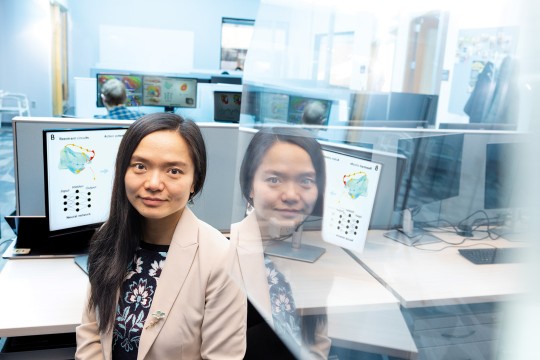
RIT computing researchers are fusing physics and AI to transform healthcare
A team of RIT researchers, led by Professor Linwei Wang, is improving healthcare by creating hybrid AI digital twins of patient’s organs and diseases. The work will lead to real-time, physics-integrated digital twins of the liver and improved AI models that could assist doctors with heart surgery.
-
May 18, 2026

Professor earns NSF CAREER Award to defend AI models from attackers
RIT computer science professor Weijie Zhao has earned a National Science Foundation CAREER Award to defend machine learning from adversarial threats.

