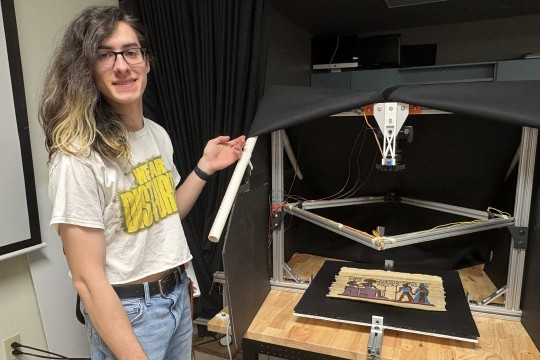
Freshman Imaging Project fuels a passion for innovation in RIT’s first-year students
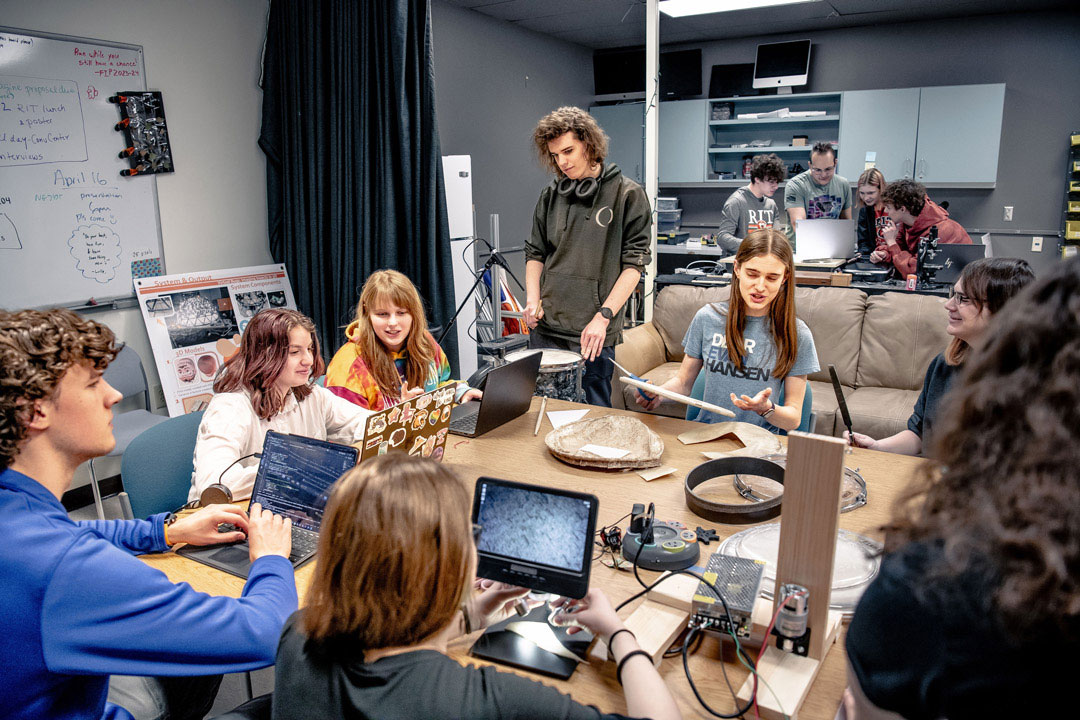
Scott Hamilton/RIT
First-year students get hands-on experience researching and developing imaging systems in the Freshman Imaging Project course
Hands-on educational experience is key to future innovation, and students in Rochester Institute of Technology’s Freshman Imaging Project receive it as soon as they step foot on campus.
Recognizing the importance of hands-on learning, alumnus Ricardo Motta has created the Ricardo J. Motta Endowed Fund for RIT’s Freshman Imaging Project. The gift will help enhance student experiences including providing them with essential equipment and supplies.
The class, offered in the Chester F. Carlson Center for Imaging Science, consists of first-year imaging science and motion picture science students who are tasked with researching, designing, and building an advanced imaging system. Projects have ranged from creating a system that can reveal hidden text on historical documents to building a machine to analyze the qualities of strawberries.
Imaging science is an interdisciplinary field combining computer science, engineering, and physics to explore image creation, perception, and analysis.
For decades, freshman projects have taught students to think creatively, to solve problems, and to collaborate, igniting their understanding of imaging early on and laying the groundwork for the future.
Ricardo Motta ’91 BS/MS (imaging science) credits RIT’s imaging science program and his freshman project for his successful career.
Motta was working in the film industry in his home country of Brazil after dropping out of engineering school, but after seeing information about RIT, he applied and enrolled.
“I was pursuing filmmaking, I had a great job, I was up-and-coming,” said Motta, “but I became really interested in understanding all about light, the numbers, the optics, lenses, image quality, and sensitometry. I decided I had to learn that and, at age 22, to be a student again. I was very lucky that RIT accepted me.”
Provided
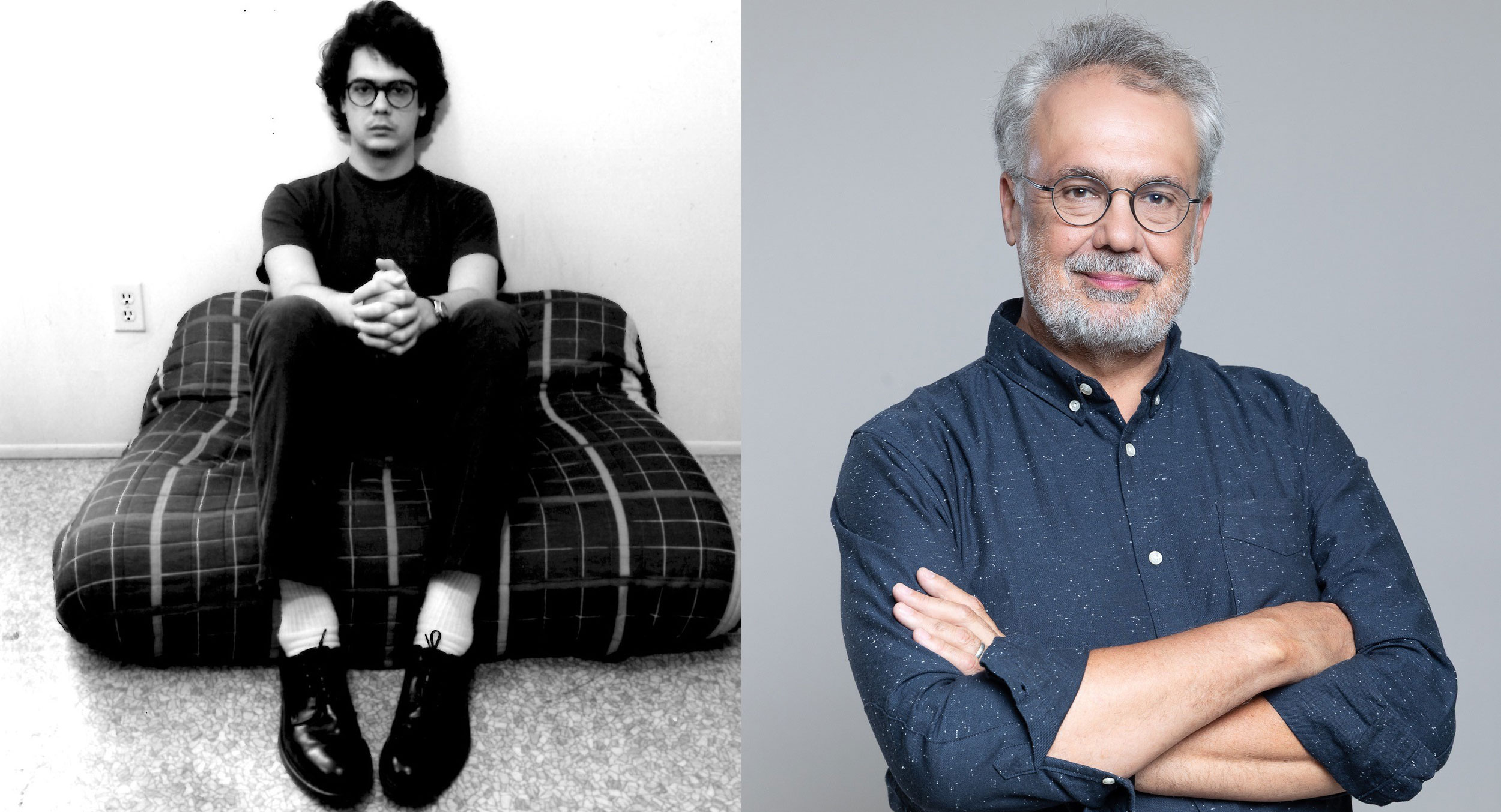
Ricardo Motta is pictured around the time he completed his project in 1982, left, and in a recent portrait, right.
While adjusting to college life and improving his third language of English, Motta took on a freshman project in photochemistry designing a single step (called a monobath) film development. He found he had a lot to learn but he loved the experience and doing the research
A few years later, Motta was in Franc Grum’s first color science class offered at RIT. Grum helped found the Munsell Color Laboratory and color science program in 1983. To this day RIT offers the only graduate degrees in color science in the nation.
Motta presented his master’s project on CRT colorimetry that combined imaging and color science at conferences where he met industry professionals. Those connections landed him a job at Hewlett Packard Laboratories in California in 1987, working on the team that invented ink-jet printing. He developed the digital halftoning image processing for many of the first consumer color printers.
After more than a decade with the company, he became the chief imaging architect and HP had become an imaging powerhouse that eventually challenged Kodak. His thesis project evolved into sRGB, the color image standard universally used by computers and the internet.
From there he was the founder of Pixim, a pioneering CMOS image sensor startup. He later became a distinguished engineer at Apple, NVIDIA, and Google. He has over 60 patents and pioneered many meaningful innovations such as the LED flash used in phones and, most recently, the camera behind the screen in the new 2026 iPhones. Currently, he works alone, developing machine perception for robots.
Motta’s impressive career all began with the early hands-on experience he gained at RIT.
“The freshman project was what made me a better student,” said Motta. “The ability to do a project, guided by deeply knowledgeable people, having the right equipment, even as a freshman, was great. People see images, but they don’t know how they are created. Going hands-on is a great opportunity to learn that.”
This year’s Freshman Imaging Project students are researching sideline imaging systems used in soccer matches, inspired by the World Cup. Karen Braun ’96 Ph.D. (imaging science), associate director of the Chester F. Carlson Center for Imaging Science, has taught the class since 2019 and is joined this year by co-instructor Ricardo Figueroa '20 Ph.D. (computing and information sciences), director of the School of Film and Animation. The class is also collaborating with RIT’s soccer programs with men’s soccer head coach Bill Garno ’88 and women’s soccer assistant coach Monica Cook ’10 BS, ’14 Ph.D. (imaging science).
Braun was the first woman to receive a Ph.D. in RIT’s history. RIT offered the first imaging science program in the U.S. and is the only formal imaging science program in the nation. For more information, go to the Chester F. Carlson Center for Imaging Science’s website.