Richard Dillio ’13 Turned His Curiosity About Gamers Into a Career in Washington
An interest in how gamers make decisions led Richard Dillio from RIT’s graduate program to a career working on behalf of the video game industry in Washington, D.C
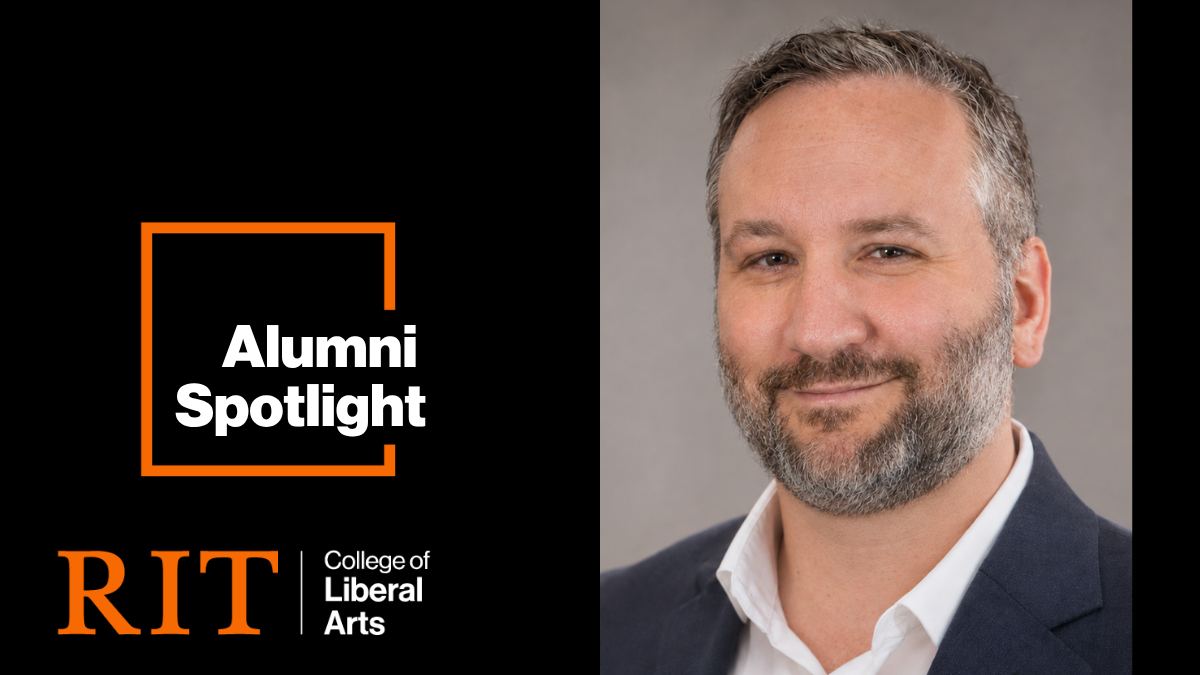
Richard Dillio ’13 has always been interested in video games. But rather than wanting to make games, he wanted to understand the people who play them.
That curiosity led Dillio to RIT, where he earned a Master of Science in Communication.
Along the way, his academic interests became the foundation for his career — and his liberal arts education gave him the skills to navigate an industry he never expected to enter professionally.
Dillio’s path to RIT was already unconventional. After high school, he spent six years in the U.S. Navy before attending the University of Rochester, where he earned a degree in English. He returned to school in 2012 to pursue graduate studies at RIT.
“I’m a liberal arts guy,” Dillio said.
At RIT, he found an academic environment that allowed him to explore his longstanding interest in video games from a different perspective. Rather than studying game development, Dillio wanted to understand how gamers used information when deciding which games to purchase.
At the time, the video game media landscape was changing rapidly. During his time in the Navy, from 1999 to 2005, Dillio relied on video game magazines for information about new releases. Internet access aboard the ship was limited and sporadic, so magazines remained an important source.
After leaving the Navy, he watched as conversations about video games increasingly moved online.
“As things got more and more online, you noticed the conversations about games were, from gamers themselves, you could actually read what your fellow gamers thought about a game,” he said.
Dillio wondered whether that shift was changing how people made purchasing decisions.
For his master’s thesis, he surveyed gamers about the importance of different sources of information when deciding whether to purchase a game. His research found that professional critics were less influential than word-of-mouth recommendations and user reviews.
While the platforms have changed, Dillio said the basic trend has continued, with YouTube, Twitch, social media and user reviews now playing significant roles in how consumers discover and evaluate games.
His research was shaped in part by two RIT professors who helped him see connections between his interests and broader areas of scholarship.
Professor Rudy Pugliese was Dillio’s first contact at RIT and encouraged him to join the graduate program. Professor Bruce Austin, who taught research methods, helped him connect his interest in video games with theories traditionally associated with film criticism.
“Those two professors in particular were really, really helpful, and they were great mentors to me,” Dillio said.
Another important connection came through Professor Grant Cos’s course on media and the First Amendment. Dillio wrote a paper about video games and the First Amendment and, while researching the topic, repeatedly encountered the Entertainment Software Association (ESA), the organization that represented the video game industry.
At the time, the ESA had recently won a U.S. Supreme Court case involving First Amendment protections for video games. Dillio’s academic work had unexpectedly introduced him to an organization operating at the intersection of the topics he had been studying.
He decided to pursue a job there.
It took persistence.
After working for a small startup in Pittsburgh, Dillio repeatedly applied to the ESA. Eventually, the organization hired him for a position that closely aligned with his background and interests.
“I just was willing to talk to people and not take ‘no’ for an answer within the bounds of reason,” he said.
Dillio eventually moved to the Washington, D.C., area, where he continues to work in the video game industry. He said the professional network he developed during his time with the ESA has also helped shape his career. For Dillio, however, the most lasting benefit of his education has been broader than a particular degree or career connection. He points specifically to two skills: speaking and writing.
“Being able to write clearly and concisely is so important,” he said. He also credits his graduate education with teaching him how to approach ambiguous problems, gather information from different sources, synthesize it and make a case for a particular position. Those skills have become central to his professional work, where issues often involve public relations, government relations and other complex questions rather than straightforward technical problems.
“Being able to read, write, synthesize information, present it, make an argument, like make your case for something, that’s all extremely valuable,” Dillio said. “I use that stuff every day constantly.”
Dillio’s career illustrates the versatility of a liberal arts education. His path began with an English degree, continued through graduate research into video game consumers and ultimately led to a career advocating for the video game industry in the nation’s capital.
The common thread has been his ability to ask questions, investigate complex subjects and communicate what he discovers — skills that have proven valuable far beyond the classroom.
More Featured Profiles and Work

Quincy Myles Jr.
Computing


Interactive Media
