AI and Physics Transform Healthcare
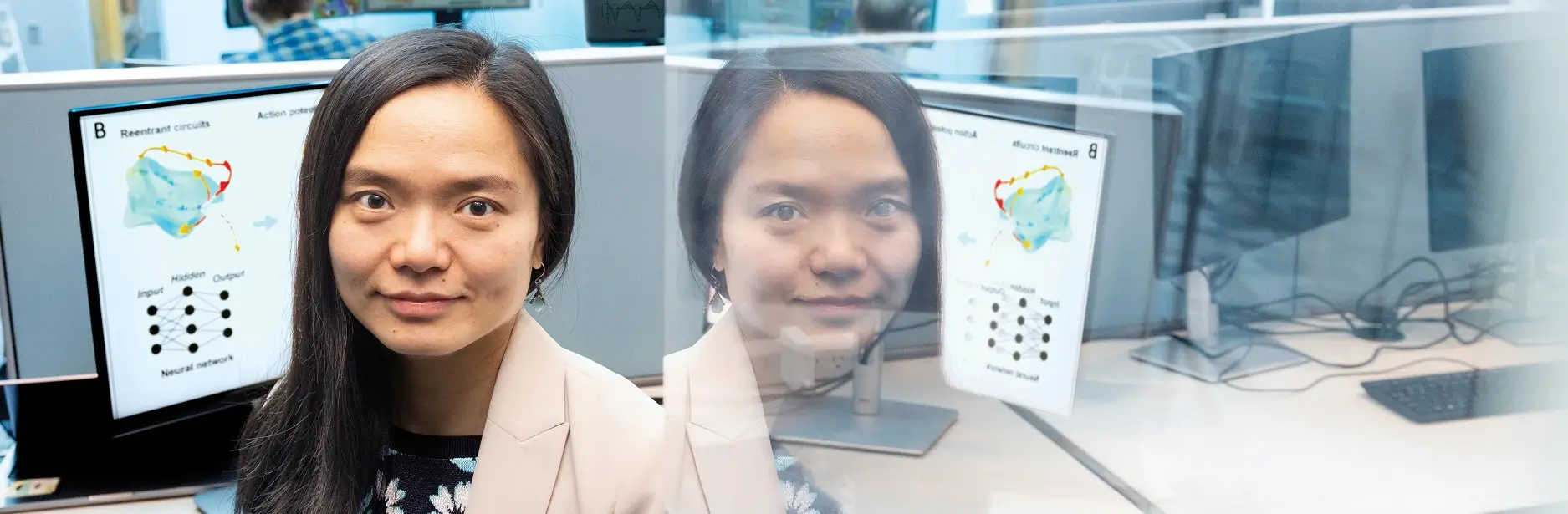
RIT computing researchers are fusing physics and AI to transform healthcare
Story by Scott Bureau
During surgery to correct an abnormal heartbeat, doctors rely on a mix of imaging and inference. Still, many critical details remain hidden.
At RIT, artificial intelligence (AI) researchers want to arm clinicians with something more powerful and accurate.
Experts in the Computational Biomedicine Laboratory are developing physics-integrated digital twins of patients’ organs, including the heart and the liver. Building these AI-enhanced mirrors requires a careful merging of physics-based models and neural networks, called hybrid AI.
This pioneering approach is led by Linwei Wang, the Bruce B. Bates Endowed Professor in Golisano College of Computing and Information Sciences. Her research has been supported by more than $10 million in funding from the National Institutes of Health and National Science Foundation. Her lab currently has nine Ph.D. students, and she has mentored dozens of graduates who have gone on to work in the AI industry and academia.
The hybrid AI approach works because it is more interpretable and adaptable than traditional AI. For doctors and patients, that means more accurate models, increased personalization for each patient, better generalization to a heterogeneous population, and less invasive medicine.
“Hybrid AI is about integrating what we already know scientifically with what we can learn from data,” said Wang. “Healthcare is a field where both matter, and we want systems that are powerful, interpretable, and personalized.”
The goal is to combine human knowledge with AI. The experts hope their technology can someday be used in predicting the trajectory of health and disease, testing the potential outcome of interventions, and supporting lifesaving decision-making.

It’s not black and white
When Wang arrived at RIT, she was among the first students in the new computing and information sciences doctoral program. It was 2007—a few years before IBM’s Watson would win Jeopardy!
While earning her master’s degree in Hong Kong, Wang developed a fascination with using scientific human physiology and physics knowledge to better understand data.
“In physics, we actually know quite a bit, like how waves propagate and the elasticity of a material put under stress,” said Wang. “I wondered, how can we use all this existing knowledge to enhance what we learn from an individual’s electrocardiogram, or other medical imaging and scans.”
After defending her dissertation, Wang stayed at RIT to continue researching as a faculty member. Her work quickly gained attention, as she earned a National Science Foundation Faculty Early Career Development award and then the Presidential Early Career Award for Scientists and Engineers.
Meanwhile, the AI boom was starting. Powerful neural networks could be used to uncover patterns unimaginable to the human brain. However, not understanding why AI makes certain decisions can be a problem. Plus, AI hallucinations could perpetuate false information.
“Physics knowledge and deep learning each have their own pros and cons,” said Wang. “We can use one to help the other and eventually get to the point where they work together.”
That vision has become the foundation of hybrid AI. The researchers are finding a middle ground between fully transparent physics systems—which they call white-box models—and pure data-driven AI systems—which can be as opaque as a black box.
A gray-box modeling approach provides better insight into a system’s internal workings, while resolving imperfect knowledge with data. In healthcare applications, the goal is to create a new neural network that is informed by physics and trained on personalized medical data.
Casey Meisenzahl ’19 (computer science), ’23 MS (computer science) is helping to create this new neural network.
While working on his master’s degree, Meisenzahl became a research assistant in Wang’s lab. Now, as Meisenzahl works on his doctoral degree, he is combining AI with the physics of motion. One day, his work could assist with surgical navigation.
“The goal is to have a real-time, personalized digital twin of the patient’s liver,” said Meisenzahl. “You have the real liver and the digital twin, and we want to keep them in sync.”
The virtual replica of a patient’s liver could be helpful for surgeons planning a tumor biopsy, a resection, or laparoscopic surgery. Using MRI imaging, clinicians may be able to see part of the liver, but hybrid AI can help recreate the rest—even as the liver moves around in the body.
“On average, there are about 6 millimeters of error in a physics liver simulation,” said Meisenzahl. “With hybrid AI we have been able to cut the error rate in half.”
Currently, Meisenzahl is working to refine how the model interprets new geometries, shapes, and deformations of the liver. He also wants to make the digital twin dynamically adaptive to live data from patients.
To advance surgical guidance technologies, RIT is collaborating with Vanderbilt University experts who are pushing biophysical simulation to its limits in the pursuit of smarter, more capable medical devices and systems.
“Can AI learn the complicated physical effects that elude our current modeling capabilities?” said Michael Miga, professor and director of the Vanderbilt Institute for Surgery and Engineering (VISE). “It’s an intriguing question for this field and one that we are actively pursuing together.”
Trusting a digital twin
Ph.D. student Sumeet Atul Vadhavkar is working to improve digital twins of the heart. He said the key element is that clinicians and patients need to trust the AI that he builds.
It’s also personal for Vadhavkar ’23 MS (computer science) because both his parents and his brother are medical doctors.
“I feel like people don’t have a very positive outlook on AI when it comes to their health,” said Vadhavkar. “They would rather trust a human being who has done it thousands of times than some black-box AI model. With hybrid AI, we’ll know exactly what it’s doing and why, and we can prove that it is accurate. Then, perhaps, people will be able to trust it.”
Vadhavkar’s aim is to help doctors with ventricular tachycardia (VT) ablation—a complex procedure that uses catheters to destroy specific heart tissues that are causing abnormal rhythms.
“During the surgery, doctors must first map the arrhythmia source, which can take hours,” said Vadhavkar. “With a digital twin that replicates the electrical activity of the heart, doctors could do the mapping and diagnosis beforehand, making it less invasive.”
For the heart research, RIT is collaborating with the University of Pennsylvania. Medical experts explained that this research could meaningfully improve ablation strategy by guiding access, depth, and lesion extent without added procedural risk.
“What is most intriguing about the hybrid AI approach is the paradigm shift from trying to directly find and define a VT isthmus (while attending to patient’s hemodynamic needs and overcoming anatomic obstacles and boundaries) to inferring its 3D structure as a hidden cause of observed ventricular activation,” said Dr. Saman Nazarian, director of the Arrhythmia Imaging Research Laboratory and professor at the University of Pennsylvania.
Vadhavkar is currently building a methodology that is more adaptable from one patient to another. He said this is critical because today’s AI models already use a lot of energy and take a lot of time to operate.

Maryam Toloubidokhti ’25 Ph.D. (computing and information sciences) was also attracted to Wang’s lab because of her interest in both medicine and computer science.
While searching for Ph.D. programs, Toloubidokhti, who is originally from Iran, found Wang’s webpage. She was hooked once she saw how gray-box modeling could be applied to a clinical domain.
“This hybrid AI work felt like a really good bridge for me,” said Toloubidokhti, who considered going to medical school.
She also saw hybrid AI as a good bridge for clinicians, because it’s a type of AI that they could actually trust. Toloubidokhti explained that hybrid AI retains interpretability and reliability because physics guides the neural network, while AI fills in gaps where physics models fall short.
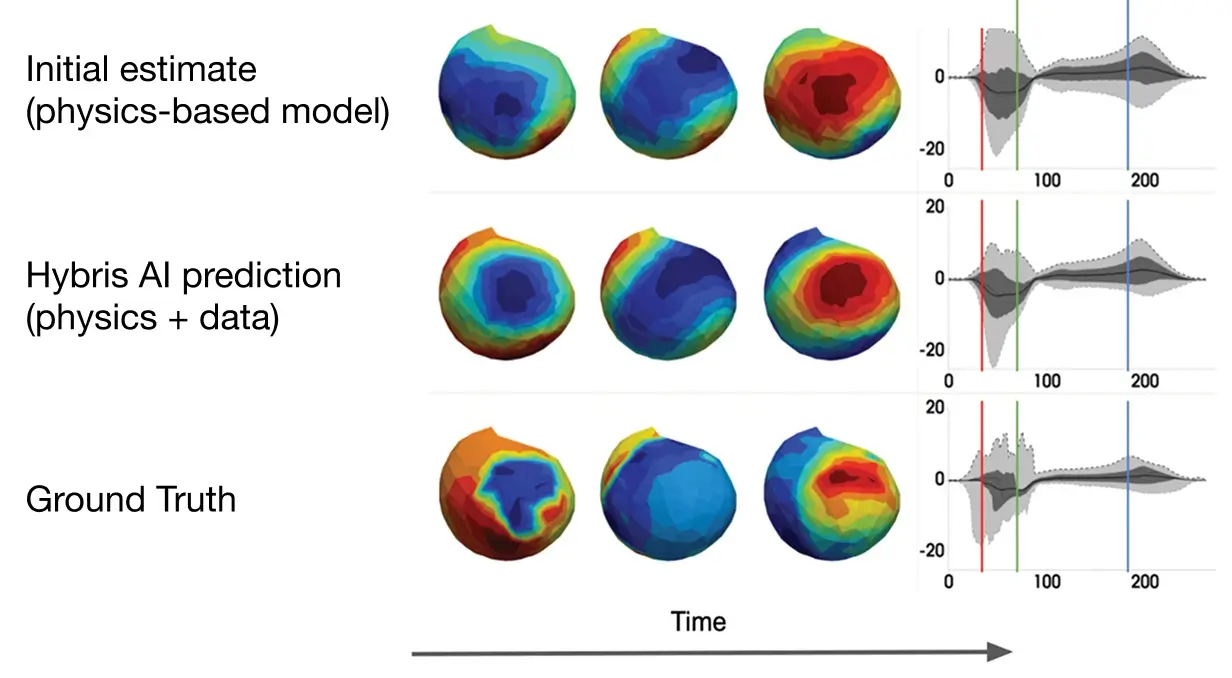
“Even an electrocardiogram with 12 leads on the body has information loss and noise,” said Toloubidokhti. “Hybrid AI can be used to fill in the gaps and create a better reflection of what’s happening in the heart.”
As a student, Toloubidokhti published 18 papers on her work, including one at the International Conference on Learning Representations, the premier gathering of deep-learning professionals.
Now, she is working as an applied researcher at the AI startup Articul8. There, she uses her expertise in deep learning to build large-scale generative AI systems for enterprise applications across a range of industries.
“It’s exciting to think that my research can contribute to how hybrid AI methods are being developed for medical applications,” said Toloubidokhti. “Given the rate of change in AI, I hope to see people use this in practice someday.”