Engineering students dive into projects to learn about naval ship technologies
Engineering program provides opportunities to develop underwater vessel sensing, robotics and maintenance systems
Traci Westcott/RIT
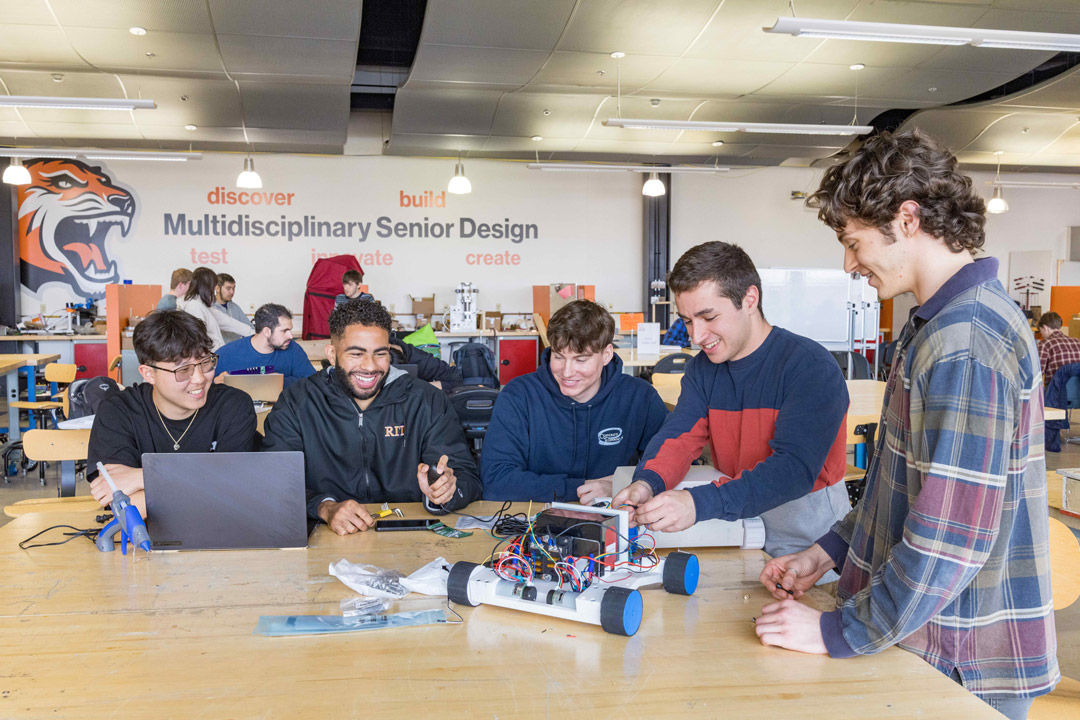
The UNDER project team, from left to right, Trevor Cline, Jonathan Jacobs, Jared Burns, Ryan Schaeffer, and Matthew Ermo discuss updates to the autonomous, underwater robotic system they built this semester.
With wheels that can attach to the bottom of a ship and high-tech sensors, a group of undergraduate engineering students built a robot prototype that may one day clean and inspect the outer hulls of Navy aircraft carriers.
“We call it a Roomba for a ship,” said Ryan Schaeffer, project lead and member of the Underwater Non-Destructive Evaluation Robot (UNDER) student team. They built the robotic prototype as part of RIT’s Multidisciplinary Senior Design (MSD) program. It is one of three sub-projects funded by the Naval Sea Systems Command to develop specific technical capabilities and all with elements of machine learning.
Imagine RIT
The Kate Gleason College of Engineering Navy projects will be part of the 2026 Imagine RIT: Creativity and Innovation Festival, taking place on campus Saturday, April 25, from 10 a.m. – 5 p.m.
“The students really embraced the projects,” said Kathleen Lamkin-Kennard, a professor of mechanical engineering in RIT’s Kate Gleason College of Engineering, who received the funding and is leading the three projects that began this fall with phase one. “There is some overlap in each one. It’s been cool to see the teams go into design reviews back-to-back. They each have similar challenges, but how they approached each has been radically different.”
Those differences are reflected in the way each team will adapt sensing and imaging technologies integrated with machine learning/AI algorithms for different tactics required for the projects.
Along with the UNDER project, another team is building an autonomous system for detecting and following target objects. Aptly named SHARK, the system must move stealthily to locate objects with low signatures (minimized sound produced by propellers or other equipment).
And a third team is developing an autonomous underwater vehicle that can self-navigate obstacles and avoid detection. The FISH team is focused on evasion tactics.
Each project has set goals phased over three years to build the sensing and intelligence capabilities needed for each system. It will provide the students a chance to see the overall expected outcomes and apply what they learn in class—and to test new skills—to complete the projects.
“I don’t think any of us really came into the project with any sort of background in robotics. We are all starting from scratch here,” said Schaeffer, a fifth-year mechanical engineering student. “The biggest thing is you want to immediately get to designing and building, but you have to move at a turtle’s speed to learn everything about possible robotic options before you can choose what route you want to go. Then you can finally start actually designing and building things.”
Matthew Ermo agreed: “For me, it has been learning about part selection and resourcing for the project. That is going to be very valuable going forward in a job.”
Ermo, a fifth-year computer engineering student, had some background through his courses in electronics and how systems connections needed to be made. He recommended the different motors, batteries, and microcontrollers for the robot. Shaeffer had little 3D printing experience, but through the project he took advantage of the different 3D print equipment and facilities on campus.
“It made prototyping easier,” he said.
Traci Westcott/RIT
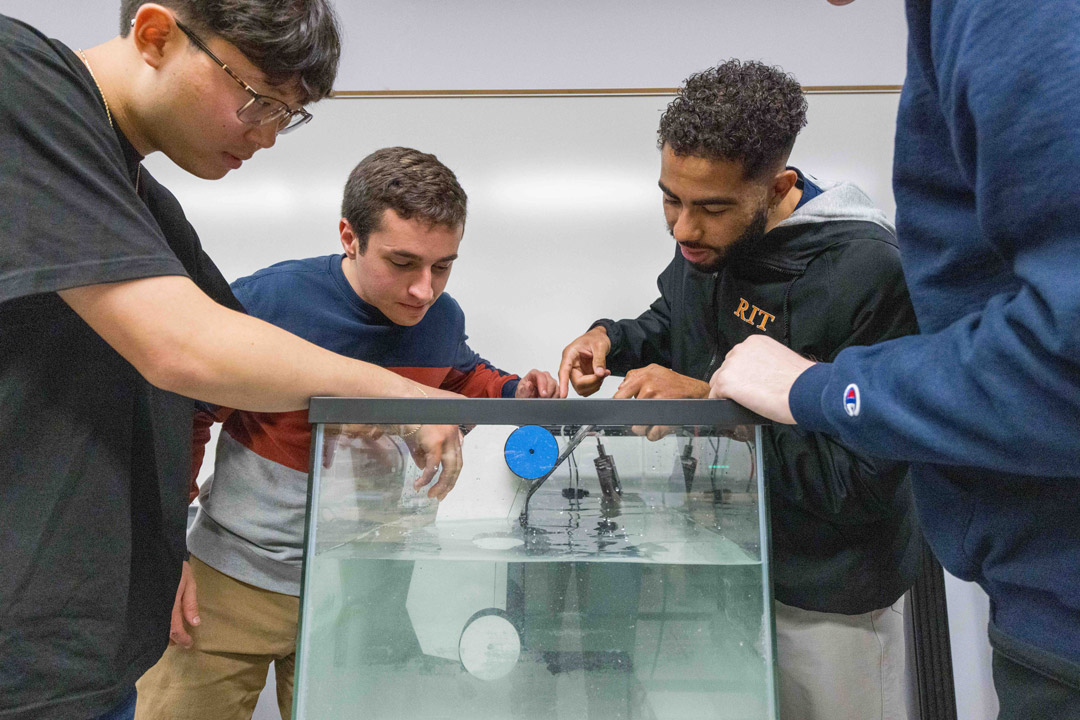
During part of the design phase, the UNDER project team tested the robotic system in a saltwater tank they built in Professor Kathleen Lamkin-Kennard’s campus lab.
Throughout the design stage and into the build process, the students worked closely with Lamkin-Kennard, and engineering faculty members serving as team advisers Beth DeBartolo, Jennifer Indovina, Alexander Loui, and Ti’ona McCauley.
Representatives from the naval command also participate in regular design reviews with the teams. They provide helpful insights into the real-world challenges the Navy faces and how technology could improve situations from military strategy to day-to-day operations, such as the robotic maintenance project.
While the Navy has extensive, regular maintenance processes in place, a ship at sea still picks up algae and barnacles—called biofouling. The Navy maintains that millions are spent annually on extra fuel due to biofouling drag, according to the U.S. Navy/Office of Naval Research Communications. There are emerging robotic technologies provided by the Navy and civilian partners that are transitioning maintenance from reactive, in-dock cleaning to continual care at sea.
Some projects, like this one with the Navy, are several-year undertakings and current MSD students are expected to hand off clear documentation for the next project team.
“Our main goal this year is to get something that moves and drives, ideally at the end of this we’ll have a fully autonomous robot that can drive wherever it needs, cleaning as it goes, and then maybe additional functions like inspecting for cracks in the hull,” said Schaeffer. “We took some inspiration from what is currently out there and tried to adapt it and put our own spin on it to make something a little more robust for the Navy to be able to use.”
