Supply Chain Management Bachelor of Science Degree

Manage logistics, planning, and distribution of goods from production to consumers with RIT’s supply chain management degree.
$68.6K
Median First-Year Salary of RIT Graduates from this Supply Chain Management BS degree
#59
Best Undergraduate Business Schools
Overview for Supply Chain Management BS
Why Pursue a Supply Chain Management Degree at RIT
Earn Lean Six Sigma Yellow Belt certification through process improvement and project management.
Latest industry trends and software taught by top faculty and industry practitioners with leadership from the Management Advisory Board.
Network with industry experts as part of the Association for Supply Chain Management (ASCM) club, a nationally affiliated ASCM chapter.
Advanced supply chain courses and electives, many from RIT’s Kate Gleason College of Engineering, enhance your knowledge of the integration of engineering and technology with problem solving and organizational efficiency.
Many companies and organizations are involved in making supplies and products readily available so producers, manufacturers, and consumers, can have them when and where they want them, and at a competitive price. Coordinating and managing all of the organizations and suppliers involved in the activities that move products to the right places and the right times is the goal of supply chain management. More than ever, technology is driving supply chain processes and strategies to help give companies a competitive edge.
What is Supply Chain Management?
It’s not often a supply chain gets interrupted to the point where consumers cannot find the products they need. But when it does, people notice. And the disruption can cause chaos.
When the Covid-19 virus created panicked buying at grocery stores around the country, suddenly consumers couldn’t find toilet paper, paper towels, canned soup, tuna, rice, or cleaning products. As a result of those empty grocery store shelves, the public came to understand the importance of supply chain management in our every day lives.
What is a Supply Chain?
A supply chain is a complex and interconnected system that begins with business strategists forecasting or predicting consumer demand for goods and ends with products available for consumers to purchase. In between is a complex web of purchasers and negotiators managing raw materials and suppliers, information systems that manage inventory and data, transportation systems that move and distribute materials and goods between warehouses and retail operations, and retail stores stacking shelves and selling products to you, the consumer.
Supply chain optimization occurs when you manage this intricate, expansive network of suppliers, producers, vendors, warehouses, transportation networks, logistical partners, and retailers. This is the focus of the supply chain manager, the supply chain analyst, and other professionals in the field that deal with the wide range of responsibilities that keep the global supply chain humming along. Gaining the expertise you need to build a career in this dynamic field comes from a degree in supply chain management.
RIT’s Supply Chain Management Degree
RIT’s bachelor’s degree in supply chain management provides you with the knowledge needed to effectively develop, implement, and manage efficient global supplier systems in order to maximize customer value. Supply chain management coordinates a wide range of supply chain processes required of both businesses and business partners, including suppliers, to deliver products and services. You will gain a solid understanding of the areas needed to support supply chain management, such as supply chain strategies, logistics, information systems, lean/quality management, customer service, purchasing, negotiations, contracts, forecasting, inventory management, and project management. In addition to business operations, supply chain management plays a critical role in medical missions, disaster relief operations, and other types of service industries.
Supply Chain Courses
The degree in supply chain management includes foundational business courses in financial and management accounting, economics, marketing, business planning, and operations management. Supply chain management courses–in topics that include database management systems, enterprise systems, managing supplier relations, logistics in supply chain management, and Lean Six Sigma fundamentals–prepare you for a range of dynamic careers in the field. You’re free to select elective courses that round out your degree and add in-depth study within supply chain management. Elective courses include cross-cultural management, exporting and global sourcing, business intelligence, and negotiations and decision making, to name a few.
Furthering Your Education In Supply Chain Management
Today’s careers require advanced degrees grounded in real-world experience. RIT’s Combined Accelerated Bachelor’s/Master’s Degrees enable you to earn both a bachelor’s and a master’s degree in as little as five years of study, all while gaining the valuable hands-on experience that comes from co-ops, internships, research, study abroad, and more.
- +1 MBA Early Acceptance Pathway: Successful RIT applicants who are offered admission into the BS degree in supply chain management as an incoming first-year student may also be offered conditional early acceptance into the +1 MBA Early Acceptance Pathway. This option enables you to earn both your BS degree and an MBA in as little as five years of study. Learn how the +1 MBA Early Acceptance Pathway can help you add a competitive advantage to your studies.
- +1 MBA: Students who enroll in a qualifying undergraduate degree have the opportunity to add an MBA to their bachelor’s degree after their first year of study, depending on their program. Learn how the +1 MBA can accelerate your learning and position you for success.
-
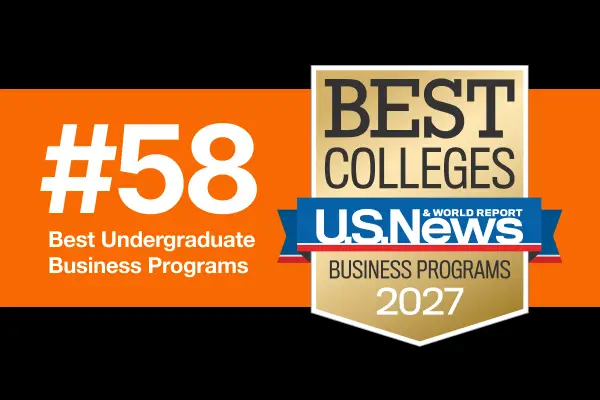
A National Leader in Business Education
RIT’s Saunders College of Business is among the best business schools in the nation for an undergraduate business degree, according to U.S. News & World Report.
Learn more about how to be A National Leader in Business Education
-

Apply for Fall 2027
Early Decision I and Early Action deadlines are November 1.
-
Meet Us on Campus
Learn about academics, co-op and internships, financial aid, and more at one of our on-campus open houses.
October 12 | October 24 | November 14
Careers and Cooperative Education
Typical Job Titles
| Supply Chain Analyst | Purchasing Specialist | Sourcing Analyst |
| Operations Manager | Procurement Associate | Logistics Analyst |
Industries
Cooperative Education
What’s different about an RIT education? It’s the career experience you gain by completing cooperative education and internships with top companies in every single industry. You’ll earn more than a degree. You’ll gain real-world career experience that sets you apart. It’s exposure–early and often–to a variety of professional work environments, career paths, and industries.
Co-ops take your knowledge and turn it into know-how. Business co-ops provide hands-on experience that enables you to apply your knowledge of business, management, finance, accounting, and related fields in professional settings. You'll make valuable connections between course work and real-world applications as you build a network of professional contacts.
Students in the supply chain management degree are required to complete at least one block of cooperative education.
Featured Work and Profiles
-

From Saunders to L3Harris: A Supply Chain Management Journey
Gloria Diaz ’26 "RIT and Saunders have prepared me for the job market in many ways beyond what I have learned in the classroom. Through career classes, workshops, career fairs, employer events, Career Connect, and...
Read More about From Saunders to L3Harris: A Supply Chain Management Journey -

From Design to Delivery: Driving Impact in Aerospace Operations
Halle Wagner, co-op ’27 "The most distinctive advantage of my Saunders experience is the school's size and the favorable student-to-faculty ratio that allowed me to maximize my education. The environment at Saunders feels...
Read More about From Design to Delivery: Driving Impact in Aerospace Operations -

A Legacy of Learning and Leadership at Saunders
Sarah Fillip, co-op ’26 "Being a student at the Saunders College of Business has equipped me with the skills and experiences necessary to succeed in the professional world." Honeywell | Charlotte, North Carolina
Read More about A Legacy of Learning and Leadership at Saunders -

How Co-ops and Clubs Propelled Alum's Career Early On
Edie Wilson ’22 RIT/NTID alumna Edie Wilson, ’21, B.S. in Business (Supply Chain Management) and ’22, M.S. in Business (Global Supply Chain Management) credits her career success in the supply chain management field...
Read More about How Co-ops and Clubs Propelled Alum's Career Early On -

Research Insights: Variety’s not always the spice of life
Kevin Sweeney Product variety, operational performance, and sales
Read More about Research Insights: Variety’s not always the spice of life -

Research Insights: Storms on the horizon
How supply chains are at risk from climate change.
Read More about Research Insights: Storms on the horizon
Curriculum for 2026-2027 for Supply Chain Management BS
Current Students: See Curriculum Requirements
Admissions and Financial Aid
First-Year Admission
First-year applicants are expected to demonstrate a strong academic background that includes:
- 4 years of English
- 3 years of social studies and/or history
- 3 years of math is required and must include algebra, geometry, and algebra 2/trigonometry. Pre-calculus is preferred.
- 2-3 years of science
Transfer Admission
Transfer applicants should meet these minimum degree-specific requirements:
- A minimum of college algebra is required. Pre-calculus or calculus is preferred.
Financial Aid and Scholarships
100% of all incoming first-year and transfer students receive aid.
RIT’s personalized and comprehensive financial aid program includes scholarships, grants, loans, and campus employment programs. When all these are put to work, your actual cost may be much lower than the published estimated cost of attendance.
Learn more about financial aid and scholarships


Related News
-
October 6, 2026

Supply chain disruptions create opportunities for RIT students
The Saunders Supply Chain program boasts a 100 percent co-op placement rate and, paired with the university’s nationally ranked co-op and internship program, allows students to learn on the job and define their career paths.
-
September 28, 2026

QS World Rankings 2027
Saunders College of Business at Rochester Institute of Technology is nationally and internationally ranked and recognized. Saunders received several high rankings from QS World, which in 2027 ranked 1,503 top universities around the globe.
-
March 25, 2026

Saunders ranked among best undergraduate business schools by Poets&Quants
Saunders College of Business’s undergraduate and graduate portfolio is nationally and internationally ranked and recognized. Most recently, in the Poets&Quants list of best undergraduate business program, Saunders placed #42 in career outcomes, and #71 overall.
Contact

Saunders College of Business