Schools and Departments

Critical thinking and analysis, ethical reasoning, collaboration, communication, and a flexible, growth mindset—the study of liberal arts disciplines at RIT builds a foundation of future-proof, high demand skills for nearly any imaginable career or life path.

Institute for Interdisciplinary Innovation
The Institute for Interdisciplinary Innovation (I3) strives to be a hub for innovative thinking, collaboration, and the advancement of interdisciplinary education in the humanities and social sciences. Our future-forward, multidisciplinary programs and activities present are designed to equip grads for a lifetime of success in an ever-changing world. The institute is home to three undergraduate programs and the Center for Worldbuilding and Storytelling.
Learn More about the Institute for Interdisciplinary Innovation
School of Communication and English
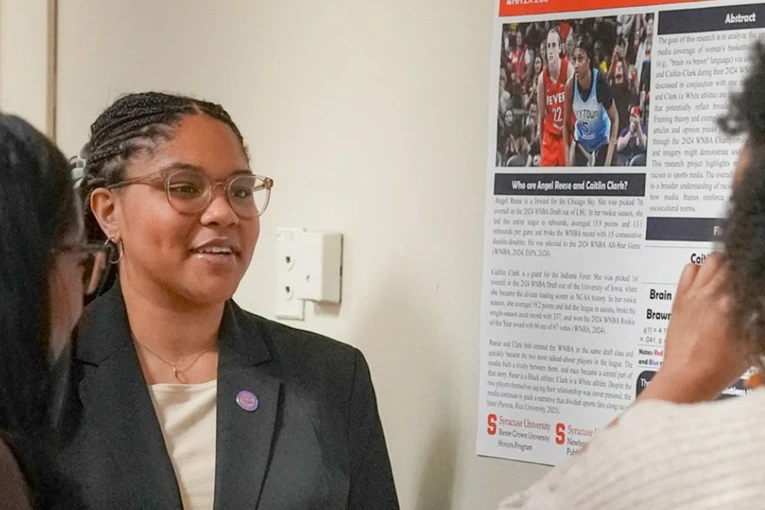
The School of Communication and English’s degree programs, minors, and immersions emphasize applied theory and practical knowledge that build the communication skills necessary to succeed in a variety of industries. Coursework leverages strengths from across the university to develop proficiency in technical or professional areas such as design, photography, marketing, healthcare, or technology and creates interdisciplinary opportunities to practice these skill sets inside and out of the classroom. Our faculty are dedicated to exceptional teaching and providing individual attention to students. The school maintains a small feel, with a strong sense of community and a commitment to student mentorship.

The School of Performing Arts is home to coursework, minors and immersions in the areas of music, theater, and fine arts. The school offers the opportunity both in and out of the classroom to participate in musical ensembles, theater performances, and other experiential learning opportunities. We believe that the study of fine arts empowers our students to use technology in creative and innovative ways. The faculty come from a diverse range of scholarly, performance, and creative backgrounds and are highly respected scholars in their respective fields.

School of Psychology and Cognitive Science
The School of Psychology and Cognitive Science offers coursework and programs that help you develop skills for your future career and lifelong learning, including critical thinking and professional communication. The school offers opportunities to join cutting-edge research and programs that are advancing study in a host of fields. We provide an environment where faculty and student collaborative research thrives, expanding the knowledge of behavior, cognition, perception, and other key areas. Our faculty iare teachers and scholars who work to advance the science of psychology and help you apply that science to your chosen career field.
Learn More about the School of Psychology and Cognitive Science
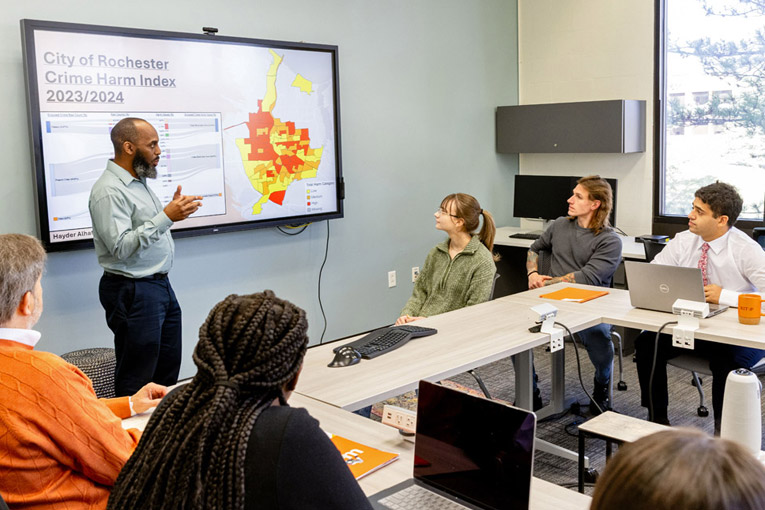
RIT’s School of Public Affairs prepares students to navigate the complex political, economic, and ethical challenges of the 21st Century. Programs and courses provided by the School of Public Affairs offer interdisciplinary perspectives on important national and international issues as well as opportunities for students to work directly with our research-active faculty. Our focus on systems-level analysis of complex problems and professional communication skills prepares students for a range of career outcomes in business, government, law, consulting, and non-governmental organizations at the national and international levels.

The Department of Communication’s degree programs, minors, and immersions emphasize applied theory and practical knowledge that build the communication skills necessary to succeed in a variety of industries. Coursework leverages strengths from across the university to develop proficiency in technical or professional areas such as design, photography, marketing, healthcare, or technology and creates interdisciplinary opportunities to practice these skill sets inside and out of the classroom. Our faculty are dedicated to exceptional teaching and providing individual attention to students. The school maintains a small feel, with a strong sense of community and a commitment to student mentorship.

Department of Criminal Justice
The Department of Criminal Justice degree programs, minors, and immersions emphasize the social scientific study of crime, criminal justice, and legal studies. RIT’s approach combines theoretical perspectives with hands-on experience, emphasizing areas of crime, criminal behavior, social control mechanisms, administration, planning, and management, as well as problem-solving techniques based on current research in the field. Students are encouraged to be active participants in the process of creating this knowledge through undergraduate research projects. A variety of opportunities exist to engage in active research and to present the results of these projects at professional conferences.
The Department of Economics takes a mathematical approach to analyzing social issues and pressing problems. It emphasizes quantitative analysis, computing, and communication skills, as well as critical thinking and problem-solving. Whether you pursue the undergraduate major, minor, or immersion, you’ll gain an understanding of the forces that shape financial and social policies in the modern world, as well as learn how to predict outcomes and develop solutions to economic challenges. The department offers small class sizes, a wide variety of unique courses, and the opportunity to work one-on-one with faculty members on publishable research projects.

The Department of English offers minors and immersions that embrace technology and promote lifelong learning. You will gain skills in writing, textual analysis, language analytics, creative production, and digital culture. Our faculty work to inspire “thinkers” and “tinkerers” who develop into responsible communicators capable of adjusting to the rapidly transforming social environment and global society. The department offers a wide variety of courses, from creative writing workshops in world building and poetry, to analyzing literature by authors from around the world, to advancing language science and natural language processing that is used in top technologies such as voice-enabled smart speakers and phones.

The Department of History offers minors and immersions that promote broad perspectives on human experiences, teach critical appraisal of primary and secondary sources, develop communication and writing skills, and enable you to make comparisons and draw contrasts across a global historical perspectives—all skills that are essential in a wide variety of professions, including business, education, journalism, law, politics, and public service. We are a tight-knit department with faculty who have a wide variety of professional and scholarly interests, from the history of gender to the history of computing, from the history of Asia to the history of the United States, from the history of imperialism to the history of baseball.

Department of Modern Languages and Cultures
Language and cultural skills are crucial in today’s globalized economy and society and are valued across nearly all industries. The Department of Modern Languages and Cultures is committed to preparing students for active participation in a global society by providing coursework that deepens understanding of different languages and cultures. Students are able to complete an immersion or minor in any of the 10 languages offered by the department, or complete a bachelor’s degree in applied modern language and culture in Chinese, Japanese, French, or Spanish. The department also prepares students to participate in global experiences, such as study or work abroad.
Learn More about the Department of Modern Languages and Cultures

The Department of Philosophy offers an undergraduate degree as well as several minors and immersions that can be paired with most other undergraduate degree programs at RIT. Through studying philosophy, you are taught to evaluate complex problems, identify and examine underlying principles, investigate issues from diverse perspectives, and communicate clearly in both written and oral forms. As a result, our students have done extremely well getting into law, business, and graduate school. The department is motivated by a dedication to excellence in teaching and most of our faculty have received awards for their work in the classroom.
Department of Political Science
The Department of Political Science offers coursework and programs that are unique and innovative, integrating the traditional fields of American government, legal studies, and international relations in order to prepare you for a life and a career in an increasingly globalized world. You will study the ways in which governments address fundamental issues of power, justice, liberty, and order, as well as examine the impact of advances in science and technology on these themes. The department teaches not only the mechanics and strategies of the political process, but also examines limitations on government authority, and responsibilities of citizens.

Public policy explores the intersection of policy, technology, society, and the natural world. Analysis of these intersections plays a critical role in being able to address the many environmental, social, economic, and technological challenges facing society today and in the future. The programs and coursework in the Department of Public Policy allow you to combine your interests in science, technology, government, economics, and other social science fields and obtain the skills and knowledge needed to analyze and, ultimately, advocate for policy change in government or private organizations.

Department of Science, Technology, and Society
The Department of Science, Technology, and Society offers coursework and programs that bridge the humanities, social sciences, natural sciences, and engineering to provide a better understanding of the ways in which these fields are mutually interacting forces in our world. The department teaches how to analyze the socio-cultural, historical, political, economic, environmental, ethical, scientific, and/or technological factors that impact the ways in which we live, as well as how these forces impact one other. We are motivated by the belief that understanding science and technology, past and present, is both socially important and intellectually challenging.
Learn More about the Department of Science, Technology, and Society

Department of Sociology and Anthropology
The Department of Sociology and Anthropology supports an interdisciplinary approach to the study of global, urban, historical, and cultural experience, practices, and change. Our faculty are scholarly experts in archaeology, cultural anthropology, economics, education, folklore, psychology, and sociology which represent academic disciplines dedicated to the understanding of human social life, past and present. We share a commitment to global justice, human rights, and sustainable futures. As faculty in historically related social science disciplines, our research and teaching crosscut important themes and social issues related to gender, class, race and ethnicity, exploitation, domination, and the multiple embodiments of power.
Learn More about the Department of Sociology and Anthropology