Department of Women’s, Gender, and Sexuality Studies
Women’s, Gender, and Sexuality
Studies Program
Breadcrumb
- RIT/
- College of Liberal Arts/
- Academics/
- Departments and Schools/
- Department of Women’s, Gender, and Sexuality Studies
Contact
Overview
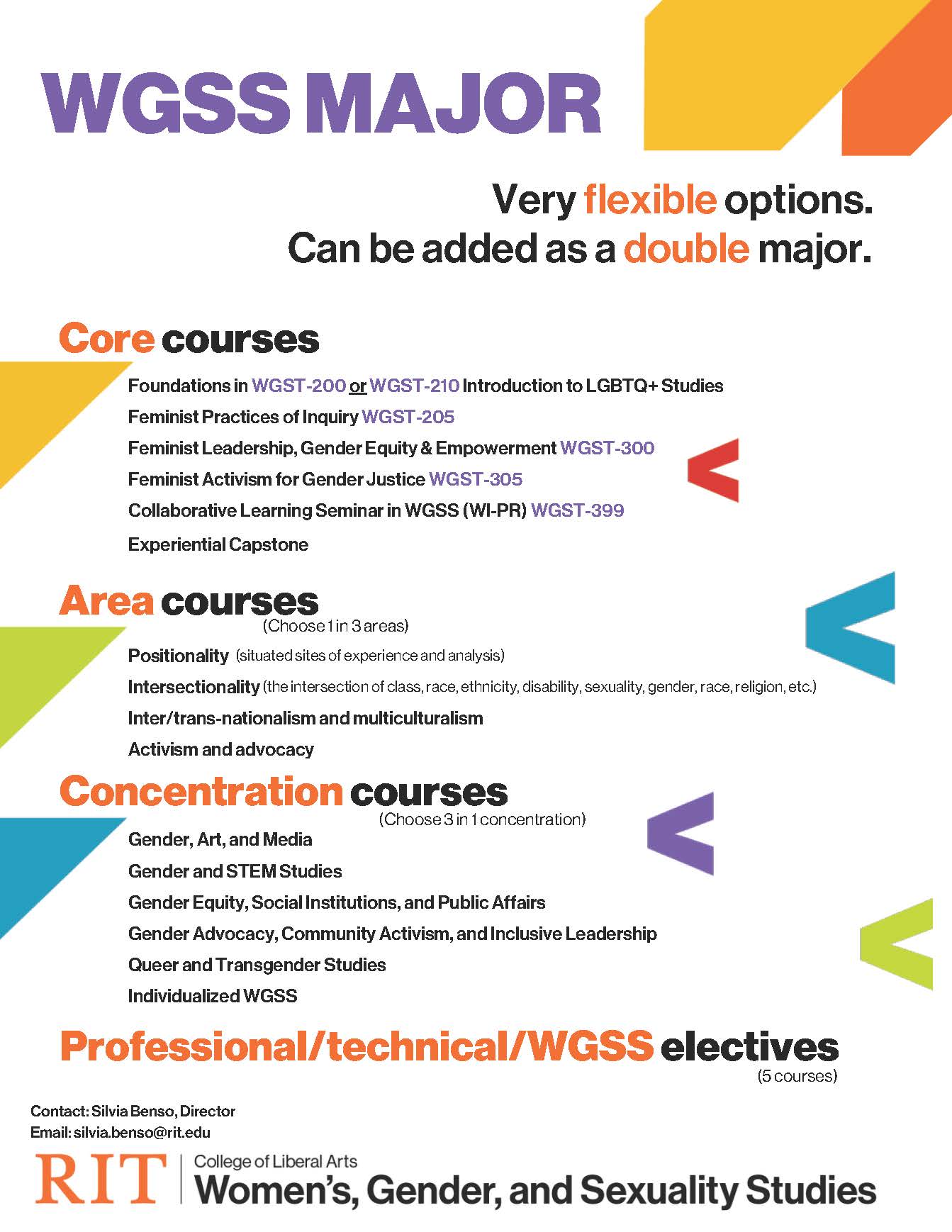
The Women’s, Gender, and Sexuality Studies (WGSS) Program offers an interdisciplinary and multicultural series of courses that explore and question the intersections of gender, sexuality, culture, ethnicity, social class and race. Courses are taught by faculty members from various departments and fields of study and provide a critical framework to explore the significance of gender (along with race, sexuality, and class) in the shaping of women’s and men’s lives. The program focuses on the recovery of women’s contributions in a variety of fields, on women’s and men’s roles in society across cultures, and especially on critical questions about gender neutrality in the shaping of culture.
The Women’s, Gender, and Sexuality Studies Program complements any course of studies and prepares you well for any career in the arts, sciences and technology, health professions, business, law, social and community service, and education.
Careers
For what jobs, careers, and professions is an education in Women’s, Gender, and Sexuality Studies highly beneficial? For what is it an excellent complement? Find out here.
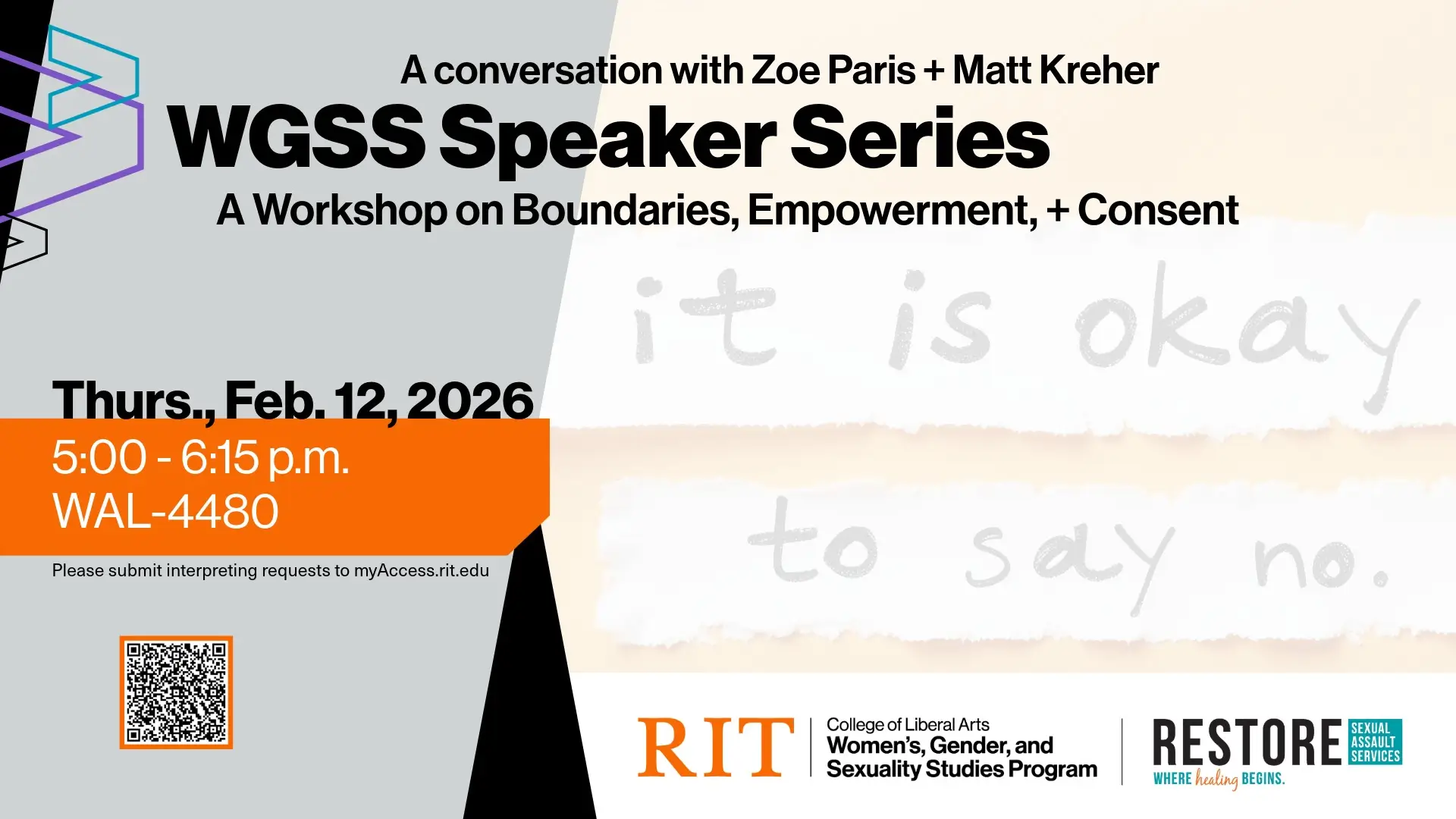
Fall 2021 Speaker Series
The Women’s, Gender, and Sexuality Studies Program is pleased to announce its Fall 2021 Speaker Series.
September 30, 2:30p.m. - 3:45p.m.
Gwynn Thomas, Chair, Global Gender and Sexuality Studies, University at Buffalo
October 14, 2:30p.m. - 3:45p.m.
Beverly Guy-Sheftall, Chair, Comparative Women’s Studies, Spelman College
October 27, 2:30p.m. - 3:45p.m.
Shannon Winnubst, Chair, Women’s, Gender, and Sexuality Studies, Ohio State University
November 15, 2:30p.m. - 3:45p.m.
Alicia Decker, Head, Women’s, Gender, and Sexuality Studies, Penn State University
Latest News
-
June 16, 2021
RIT names Anna Westerstahl Stenport new dean of College of Liberal Arts
Stenport is currently a professor of global studies and chair of the School of Modern Languages at Georgia Institute of Technology’s Ivan Allen College of Liberal Arts. She was selected as the RIT dean following a nationwide search and will begin her new leadership role Sept. 1.
-
April 7, 2021
Difference Makers at RIT: Alumna Celeste Brown
The Division of Diversity & Inclusion is highlighting women whose work makes a positive contribution to the RIT community, including Sociology and Anthropology alumna Celeste Brown, who works as the Head Coach for Women's Ice Hockey.
-
March 19, 2021
College of Liberal Arts honors students for writing excellence
RIT's College of Liberal Arts honored student achievements in writing with 15 writing awards on Friday, March 19. This year marks the 41st year the awards were presented, though the first time the ceremony was held virtually.
Faculty / Staff
Past Directors
Minors and Immersions
In the gender, art, and media immersion students explore how gender issues and identities, in their intersections with culture, race, ethnicity, nationality, social class, age, and (dis)abilities, are represented and portrayed in various artistic, literary, and media forms. By engaging with cultural texts and productions from both historical and contemporary perspectives, the immersion introduces students to critical analysis and knowledge-building methods drawn from fields such as women's and gender studies, feminist theories, critical race studies, queer studies, social justice work, and activism. The immersion teaches students to analyze gendered images as they appear in arts and media, recognize power inequalities and stereotypes in gender representations, and acquire the conceptual skills to critique and improve current conditions of artistic, literary, and media production and consumption in view of increased gender equity and fairness. The immersion complements any course of studies in a number of art and media-related fields such as art and literary criticism, art curation and exhibition, journalism and photojournalism, media studies, filmmaking, literature, photography, advertising and marketing, public relations, social services, and more.
Learn More about Gender, Art, and Media ImmersionIn the gender, art, and media minor students explore how gender issues and identities, in their intersections with culture, race, ethnicity, nationality, social class, age, and (dis)abilities, are represented and portrayed in various artistic, literary, and media forms. By engaging with cultural texts and productions from both historical and contemporary perspectives, the minor introduces students to critical analysis and knowledge-building methods drawn from fields such as women's and gender studies, feminist theories, critical race studies, queer studies, social justice work, and activism. The minor teaches students to analyze gendered images as they appear in arts and media, recognize power inequalities and stereotypes in gender representations, and acquire the conceptual skills to critique and improve current conditions of artistic, literary, and media production and consumption in view of increased gender equity and fairness. The minor complements any course of studies in a number of art and media-related fields such as art and literary criticism, art curation and exhibition, journalism and photojournalism, media studies, filmmaking, literature, photography, advertising and marketing, public relations, social services, and more.
Learn More about Gender, Art, and Media MinorThe queer and transgender studies immersion is an interdisciplinary set of courses whose primary concern is the critical study of cultures, creative expressions, histories, economic structures, and socio-political and legal institutions as they impact the formation of queer and transgender identities and the lives and experiences of people in the LGBTQ+ community.
Learn More about Queer and Transgender Studies ImmersionThe women’s and gender studies immersion allows students to explore the significance of gender as it intersects with racial, ethnic, religious, national, class, sexuality, and dis/ability-based identities, past and present. The immersion introduces critical analysis and knowledge-building methods drawn from fields such as women's and gender studies, feminist theories, critical race studies, queer studies, social justice work, and activism. Courses build knowledge about the personal, social, cultural, economic, and historical dynamics that inform gender and intersecting social categories. It provides valuable skills and experiences applying these different lenses to real-world interactions with diverse individuals and communities, to current social challenges that impact multiple parties, and with an eye to improving equity and fair outcomes for everyone concerned.
Learn More about Women’s and Gender Studies ImmersionThe women’s and gender studies minor provides a critical framework to explore the significance of gender—as it intersects with racial, ethnic, religious, national, class, sexuality, and disability-based identities, past and present. Course builds knowledge about the personal, social, cultural, economic, and historical dynamics that inform gender and intersecting social categories. The minor builds fluency with critical analysis and knowledge-building methods drawn from women's and gender studies, feminist theories, critical race studies, queer studies, social justice work, and activism. The minor also provides valuable skills and experience applying these different lenses to real-world interactions with diverse individuals and communities to current social challenges that impact multiple parties, and with an eye to improving equity and fair outcomes for everyone concerned. Students will learn how to analyze and question power relations in all their rich complexities, locally, and globally.
Learn More about Women’s and Gender Studies MinorCourses
Student Resources
Here you can find resources related to women’s and gender studies such as award opportunities, links to graduate programs, and campus, local, and national organizations.
See Resources for the Women’s, Gender, and Sexuality Studies Program
Mary C. Sullivan Awards
The Women’s, Gender, and Sexuality Studies Program offers two student writing awards, named in honor of the contributions and continued work of Dr. Mary C. Sullivan, Religious Sisters of Mercy.

- The Mary C. Sullivan Women’s, Gender, and Sexuality Studies Writing Award recognizes an outstanding essay (typically between 5-10 pages in length) that addresses a topic of importance to women’s, gender, and sexuality studies. Topics might include difference, patriarchy, power, politics of representation, bodies, sexual harassment and sexual violence, global women’s health, feminist history, gender identities, sexuality, transgender concerns, critical race and ethnic studies, intersectionality, activism, resistance, social justice movements, disability studies, environmental justice, equity, pay gaps, women in science, women’s art and literary practices, and other topics central to women’s, gender, and sexuality studies’ myriad investigations into the relations between gender, racial, ethnic, sexual, and other identities, power, and their social, cultural, and political experiences and possibilities in different contexts.
- The Mary C. Sullivan Women’s, Gender, and Sexuality Studies Knowledge-Building Award recognizes an outstanding research or community-based knowledge-building project that puts women’s, gender, and sexuality studies methods, knowledges, or lines of critical inquiry into practice (creatively, practically, or analytically) to raise awareness or to work towards increasing equity at RIT or another chosen community. As part of the submission, students need to provide a written account of their project (approximately 4-5 pages in length) supported with credible sources and using MLA or APA format that explains a) the project’s aims, b) the target audience, c) the methodology used to complete the assignment, and d) a justification for how the project puts women’s, gender, and sexuality studies approaches or concerns to work in a specific context.
- Open to currently enrolled RIT undergraduate students for work completed in any College of Liberal Arts course or any Women’s and Gender Studies course outside the College of Liberal Arts. The work must have been completed for a course taken in either spring, summer or fall 2020.
- Administered by the CLA Women’s, Gender, and Sexuality Studies Program.
- Annual nomination (by faculty) in Spring semester.
- Winners are presented their awards at the Henry and Mary Kearse Distinguished Lecture and Student Writing Award Ceremony.
- Cash prizes are awarded for the best work in each category.
- Deadline for submission: January 27, 2021.
- Nominated written essays and/or written accounts of knowledge-building projects from the Women’s and Gender Studies or College of Liberal Arts course must be submitted by the instructor with a brief written rationale for the nomination. Please note that knowledge-building projects must be accompanied by a written account (see the Knowledge-Building Award description for details). Each student nomination material should be submitted as one file.
- Instructors should email to WGSS Director, Silvia Benso (silvia.benso@rit.edu) and to WGS Co-Director, Chris Henry Hinesley (chhgsm@rit.edu):
- the nominated student essay or project with accompanying written account (with writers’ names removed from all pages);
- a cover sheet indicating the title of the essay or project, the student’s full name, the student’s university I.D. #, and the name and semester of the course for which the work was completed.
- a brief statement (250 words max.) from the nominating instructor describing why the essay or knowledge-building project was selected for nomination.
- These materials must be received by 5:00 p.m. on January 27, 2021.
- Instructors may submit more than one paper and/or project to the competition.
Please specify if the submitted work is being considered for other awards.
2021
Franke Abbey
“What ‘Bloodchild’ Asks of Us” written for ENGL 320 Genre Fiction: Science and Speculative Fiction (taught by Dr. Laura Shackelford).
2020
Lauren Burke
“Maternal Mortality in the United States: A Sociological Perspective” written for SOCI 322 Society, Environment, & Health (taught by Dr. Anthony Jimenez).
2019
Anna Leah Bowman
“Communication Dynamics and Patient Experience” written for UWRT 150 (taught by Luke Daly).
Emily Israel-Paniccia
“Juvenile Sex Offenders” written for WGST/COMM 255 Seminar on Sexual Violence (taught by Stacy DeRooy).
2018
Christine McCullough (Digital Humanities and Social Sciences Major)
“Defining DH: Intersectionality in the Digital Humanities” written for WGST/PHIL 309 Feminist Theory (taught by Evelyn Brister).
Mary C. Sullivan, R.S.M., is a Sister of Mercy living in Rochester, New York. She has taught in elementary and secondary schools and colleges. Dr. Sullivan has been a much-esteemed first female Dean of the RIT College of Liberal Arts from 1977-1987, Chair of the Academic Senate, an English Department Chair, and a committed teacher and scholar of language and literature. She received the Eisenhart Award for Outstanding Teaching in 1995-6 and received the RITirees Award in 2005 in honor of her exemplary service over her 33 years at RIT. She is Professor Emerita of Literature and Dean Emerita of the RIT College of Liberal Arts. Dr. Sullivan continues to model this impressive combination of scholarship, teaching, writing, leadership, and community activism, which we hope to recognize and promote through the Mary Sullivan Awards for RIT’s students who continue exceptional work along these lines in their College of Liberal Arts coursework.
Dr. Sullivan is the author and editor of the following books: Catherine McAuley and the Tradition of Mercy (University of Notre Dame Press, 1995, 2000); The Friendship of Florence Nightingale and Mary Clare Moore (University of Pennsylvania Press, 1999); The Correspondence of Catherine McAuley, 1818-1841 (The Catholic University of America Press, 2012); and A Shining Lamp: The Oral Instructions of Catherine McAuley (The Catholic University of America Press, 2017).
Make a gift to the Mary C. Sullivan Award fund on the giving page.
Moving Forward: Suffrage Past, Present, and Future
RIT celebrates the 19th Amendment, Equal Rights, and the Power of Voting through a series of initiatives focused on the history of women’s voting activism; the problems and questions that the 1920 expansion of voting rights opened and left unsolved; and the work that remains to be done to continue expanding political representation and participation for all women.
Indigenous Land Acknowledgement
RIT is built on the traditional territory of the Onöndowa'ga:' or “the people of the Great Hill.” In English, they are known as Seneca people, “the keepers of the western door.” They are one of the six nations that make up the sovereign Haudenosaunee Confederacy.
The WGSS Program honors the land on which RIT was built and recognizes the unique relationship that the Indigenous people have with their land. As, through our Program, we endeavor to achieve dignity, respect, justice, equality, peace, and reconciliation for all, we are mindful of the histories of violence, genocide, colonization, and assimilation of Indigenous people that also took place on this territory and we are grateful for the opportunity to live, work, and share ideas on this land.