Mechanical Engineering Bachelor of Science Degree

Whether you are interested in rockets, robots, healthcare, or energy, RIT’s mechanical engineering BS combines cutting-edge technology with hands-on experience to launch your career.
Overview for Mechanical Engineering BS
Why Pursue a Mechanical Engineering Bachelor's Degree at RIT?
Four Dynamic Options: Choose from aerospace engineering, automotive engineering, bioengineering, or energy and the environment
Hands-On Experience: Four required blocks of co-op mean nearly a year of full-time paid work experience in industry.
Top Employers: Companies hiring our students for co-ops include General Electric, L3Harris, Liberty Pumps, Lockheed Martin, NASA, SpaceX, Tesla, and Toyota, to name a few.
Accelerated Bachelor’s/Master’s Available: Earn both your bachelor’s and your master’s in less time and with a cost savings, giving you a competitive advantage in your field.
STEM-OPT Visa Eligible: The STEM Optional Practical Training (OPT) program allows full-time, on-campus international students on an F-1 student visa to stay and work in the U.S. for up to three years after graduation.
What is Mechanical Engineering?
Wherever there is motion or energy, mechanical engineers have played a role in the innovations that define modern life. RIT’s mechanical engineering bachelor's degree provides you with a broad academic base complemented by hands-on laboratory activities and cooperative education experience. You may also choose to expand your studies with professional electives focusing on aerospace engineering, automotive engineering, energy and the environment, bioengineering, or manufacturing and design.
Mechanical engineering is perhaps the most comprehensive of the engineering disciplines. The mechanical engineer’s interests encompass the design of automotive and aerospace systems, bioengineering devices, and energy-related technologies. Careers in mechanical engineering run from research through design and development to manufacturing and sales. Because of their comprehensive training and education, mechanical engineers often are called upon to assume management positions.
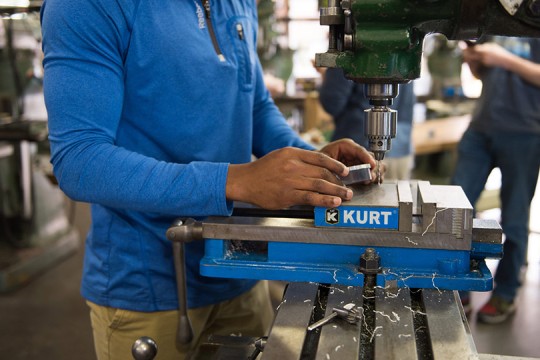
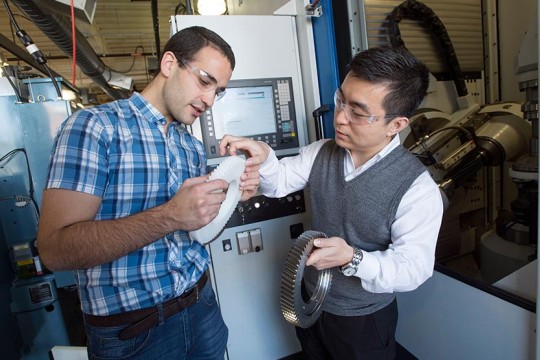
RIT's bachelor's degree in mechanical engineering offers professional courses in bioengineering, energy systems, applied mechanics, manufacturing, materials science, systems analysis, computer-aided graphics and design, robotics, and automotive and aerospace engineering. The department’s laboratories are equipped to provide extensive experimentation in these areas. Laboratory facilities include a well-instrumented wind tunnel, a particle imaging velocimetry laser system for flow visualization, advanced heat transfer systems, robotics, a proton exchange membrane fuel cell, engine dynamometers, fluid flow loops, refrigeration systems, tensile testers, compression testers, torsion testers, hardness testers, X-ray diffractometer, atomic force microscope, dynamic system simulators, a spectrum analyzer, and a well-equipped machine shop.
Mechanical Engineering Courses
The bachelor's degree in mechanical engineering provides a broad academic base complemented by hands-on laboratory activities and cooperative education experience. You will devote your first two years to the study of mathematics, physical sciences, liberal arts, and engineering sciences, while the third and fourth years emphasize engineering science, design, and systems.
You may then specialize by choosing appropriate technical and free elective courses in an area of interest. Each of the listed professional electives includes a significant design project. In the fifth year, you are required to complete Multidisciplinary Senior Design I and II, a two-course capstone design experience.
You will complete liberal arts general education courses in various perspectives to round out your education. During the course of your studies, you must demonstrate writing competency in the English language by successfully completing a Contemporary Issues course offered by the mechanical engineering department.
Mechanical Engineering Bachelor of Science Degree Options
Students pursuing a mechanical engineering degree may select an option in aerospace engineering, automotive engineering, bioengineering, or energy and environment. These options enable you to gain specialized study in a particular area of mechanical engineering.
- Aerospace Engineering: The aerospace engineering option allows for specialized study in all engineering aspects of air- and space-borne vehicles.
- Automotive Engineering: In the automotive engineering option, you are immersed in modern automotive engineering, including the design of engines and automotive components such as braking, powertrain systems, vehicle dynamics, lighting systems, transmission, and fuel economy.
- Bioengineering: In the bioengineering option, you explore the application of engineering fundamentals to the principles of biology, the life sciences, and the physical sciences.
- Energy and Environment: The energy and environment option is focused on the contemporary issues facing the fields of energy and the environment and how you can best develop modern technologies that are kinder to the environment while providing the energy resources we need.
Learn more about the Student Learning Outcomes and Program Educational Objectives for the mechanical engineering degree.
High-Performance Teams and Professional Organizations
Many of mechanical engineering students participate in high-octane performance teams, including the RIT Formula SAE Racing Team, the SAE Aerodesign Club, the RIT Baja SAE Team, RIT SAE Clean Snowmobile Team, and the Human-Powered Vehicle Competition team. They also are encouraged to participate in the student chapters of professional societies such as the American Society of Mechanical Engineers, the Society of Women Engineers, the National Society of Black Engineers, the Society of Hispanic Professional Engineers, the American Institute of Aeronautics and Astronautics, and the Society of Automotive Engineers.
Engineering vs. Engineering Technology
Two dynamic areas of study, both with outstanding outcomes rates. Which do you choose?
What’s the difference between engineering and engineering technology? It’s a question we’re asked all the time. While there are subtle differences in the course work between the two, choosing a major in engineering vs. engineering technology is more about identifying what you like to do and how you like to do it.
Furthering Your Career in Mechanical Engineering
Combined Accelerated Bachelor’s/Master’s Degrees: Today’s careers require advanced degrees grounded in real-world experience. RIT’s Combined Accelerated Bachelor’s/Master’s Degrees enable you to earn both a bachelor’s and a master’s degree in as little as five years of study, all while gaining the valuable hands-on experience that comes from co-ops, internships, research, study abroad, and more.
- Mechanical Engineering BS/Mechanical Engineering ME: In this combined accelerated mechanical engineering BS/ME, put energy and machines to work–from rockets, robots, and airplanes to automobiles, satellites, and renewable energy systems. In the BS dgeree, you’ll study math, science, physics, engineering science, and engineering systems. The MS degree augments your undergraduate studies by giving you the opportunity to apply mechanical engineering principles and theories to enhance your skills through formal education, training, and independent inquiry. Your degree will culminate with a project based paper or a graduate internship experience.
- Mechanical Engineering BS/Mechanical Engineering MS: In this combined accelerated mechanical engineering BS/ME, put energy and machines to work–from rockets, robots, and airplanes to automobiles, satellites, and renewable energy systems. In the BS dgeree, you’ll study math, science, physics, engineering science, and engineering systems. The MS degree augments your undergraduate studies by giving you the opportunity to apply mechanical engineering principles and theories to enhance your skills through formal education, training, and independent inquiry. Your degree will culminate with a project based paper or a graduate internship experience. Your dual degree will culminate with a research-based thesis.
- Mechanical Engineering BS/Science, Technology, and Public Policy MS: This accelerated, dual degree pathway enables you to earn a BS mechanical engineering and an MS degree in science, technology and public policy. As a result, you will build a foundation in mechanical engineering and develop an expertise in policy analysis and management. This cross-disciplinary approach fosters collaborative problem solving, critical and analytical thinking, and communication, equipping you to drive progress in policy areas such as energy, manufacturing standards, workplace safety, environmental sustainability, intellectual property protection, and more.
-

Apply for Fall 2027
Early Decision I and Early Action deadlines are November 1.
-

Meet Us on Campus
Learn about academics, co-op and internships, financial aid, and more at one of our on-campus open houses.
October 12 | October 24 | November 14
Careers and Cooperative Education
Typical Job Titles
| Mechanical Engineer | Product Development Engineer | Automotive Engineer |
| Controls Engineer | Applications Engineer | Design Engineer |
| Manufacturing Engineer | Project Manager | Systems Engineer |
Industries
Cooperative Education
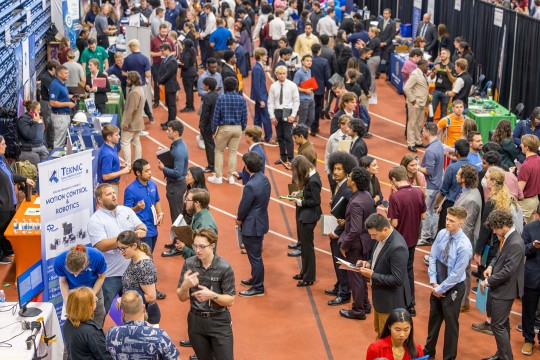
What’s different about an RIT education? It’s the career experience you gain by completing cooperative education and internships with top companies in every single industry. You’ll earn more than a degree. You’ll gain real-world career experience that sets you apart. It’s exposure–early and often–to a variety of professional work environments, career paths, and industries.
Co-ops and internships take your knowledge and turn it into know-how. Your engineering co-ops will provide hands-on experience that enables you to apply your engineering knowledge in professional settings while you make valuable connections between classwork and real-world applications.
Students in the mechanical engineering degree are required to complete four blocks (48 weeks) of cooperative education.
Featured Work and Profiles
-

From RIT to the Final Frontier
Andrew Bernacki ’25 From co-ops and student teams to the Kennedy Space Center, Andrew Bernacki ’25 shows how RIT’s hands-on, career-focused education can turn an ambitious goal into a career doing work that matters.
Read More about From RIT to the Final Frontier -

Alumnus Combines Engineering and Design to Launch Startups
Ryan Larcom ’07 (mechanical engineering), ’07 ME (mechanical engineering, industrial design) is innovation executive at High Alpha Innovation, where he helps businesses bring to market life...
Read More about Alumnus Combines Engineering and Design to Launch Startups -

RIT Formula Racing Zooms to Big Win at SAE Michigan
The student-led race team took first place overall at the annual international collegiate competition.
Read More about RIT Formula Racing Zooms to Big Win at SAE Michigan -

What's Being Made in the SHED
Making at RIT has hit a new level now that several makerspaces in the Student Hall for Exploration and Development (SHED) have opened. Learn what's being created.
Read More about What's Being Made in the SHED -

Mechanical Engineering Alumna Makes History at Indianapolis 500
Nicole Rotondo (’16, mechanical engineering) has driven her passion for motorsports into becoming one of the first women to serve as a trackside engineer on a winning Indianapolis 500 team.
Read More about Mechanical Engineering Alumna Makes History at Indianapolis 500 -

Internship at SpaceX Catapults Graduate into Full-time Position
RIT graduates are leveraging their exceptional co-op and internship experiences to secure top job offers and record-setting starting salaries, with students like Isabella Daquita landing a role at...
Read More about Internship at SpaceX Catapults Graduate into Full-time Position
Curriculum for 2026-2027 for Mechanical Engineering BS
Current Students: See Curriculum Requirements
Admissions and Financial Aid
This program is STEM-OPT Visa Eligible when studying on campus and full time.
First-Year Admission
First-year applicants are expected to demonstrate a strong academic background that includes:
- 4 years of English
- 3 years of social studies and/or history
- 4 years of math is required and must include algebra, geometry, algebra 2/trigonometry, and pre-calculus. Calculus is preferred.
- 2-3 years of science. Chemistry and physics are required.
Transfer Admission
Transfer applicants should meet these minimum degree-specific requirements:
- A minimum of pre-calculus is required. Calculus is preferred.
- Chemistry and physics is required.
Financial Aid and Scholarships
100% of all incoming first-year and transfer students receive aid.
RIT’s personalized and comprehensive financial aid program includes scholarships, grants, loans, and campus employment programs. When all these are put to work, your actual cost may be much lower than the published estimated cost of attendance.
Learn more about financial aid and scholarships


Research
The faculty and students in the Kate Gleason College of Engineering are engaging in numerous areas of research, which takes place across all of our engineering disciplines and often involves other colleges at RIT, local health care institutions, and major industry partners. Explore the college's key research initiatives to learn more about our research in:
Related News
-
September 29, 2026
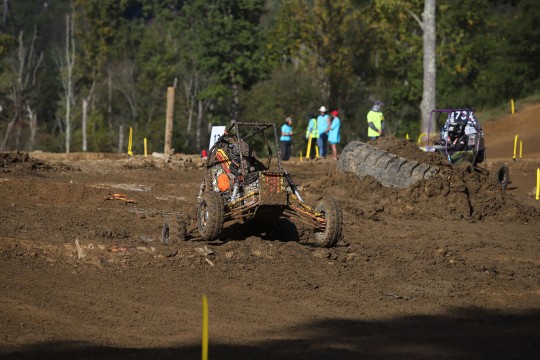
RIT Baja Racing finishes season No. 2 in North America
RIT's Baja team captured first place at the Baja SAE Ohio competition, outperforming 83 collegiate teams from around the world. The win positions RIT Baja No. 2 in North America for the 2026 season.
-
August 28, 2026
The Princeton Review cites RIT as a top university for career outcomes
RIT once again made The Princeton Review Best Colleges list and was ranked among the top 50 schools for “Colleges that Create Futures” in its Best 392 Colleges 2027 edition.
-
June 30, 2026

RIT mechanical engineering graduate made career connections through K-12 University Center
RIT alumna Julia O’Gorman will relocate to the Atlanta area to start her new job at Robins Air Force Base.
Contact

Department of Mechanical Engineering