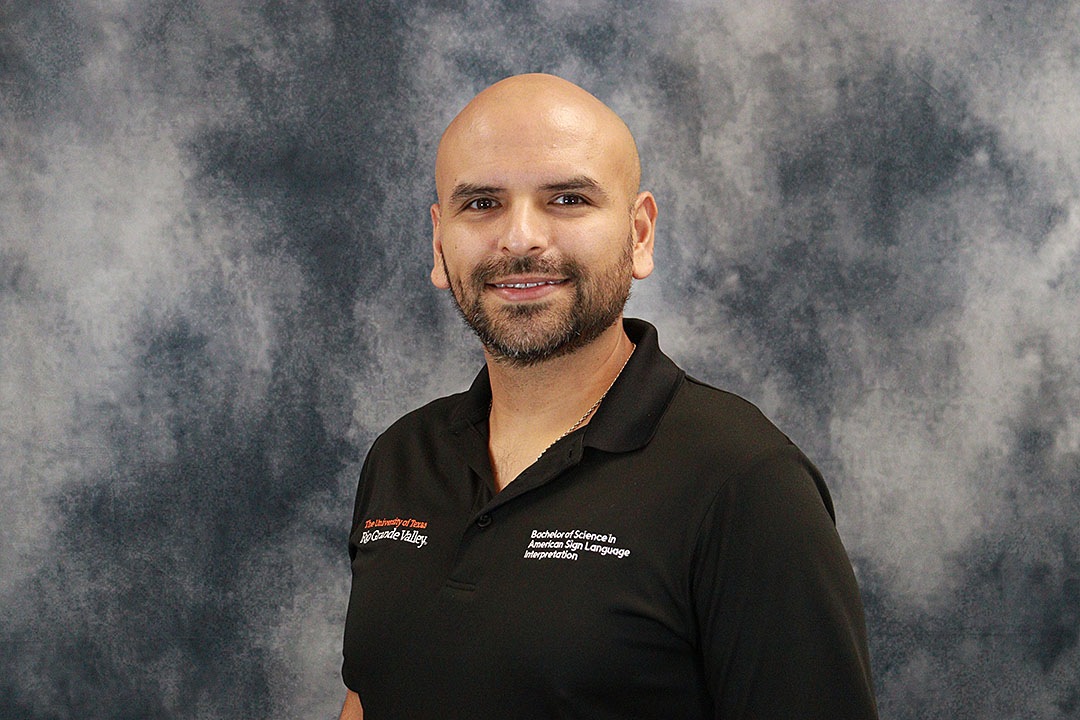
When Eric Cardenas ’09 (applied computer technology), ’14 (sociology and anthropology) received scholarships for college, he chose to attend RIT/NTID to obtain a career-focused education and contribute to the Deaf community. Now a proud RIT/NTID graduate, Cardenas is an American Sign Language educator, committed to providing accessible education and inclusive communication between deaf and hearing worlds.
A Pharr, Texas, native with a passion for technology and social dynamics, Cardenas majored in applied computer technology with a focus on web development, fascinated by the innovative blend of coding and accessibility. After completing his associate degree, he enrolled in RIT’s Sociology and Anthropology program to pursue his interest in Urban and Community Studies.
While a student at RIT/NTID, Cardenas got involved with the Hispanic Deaf Club (HDC), now known as the Latin American Deaf Club (LADC), as a student leader dedicated to raising awareness of Latino heritage, providing support, and empowering students of all backgrounds. One of his most cherished memories was collaborating with various student clubs to organize cultural events and activities, which helped shape his career path toward teaching and leadership.
Upon graduating, he continued his studies at Gallaudet University, where he earned a Master of Arts degree in Sign Language Education to address the growing need in the Deaf community for dedicated and skilled teachers. He returned to his hometown in Rio Grande Valley when the American Sign Language Interpreting program was launched there in 2020, helping to expand interpreting practices.
Today, he is a lecturer in the Department of Communication Disorders at the University of Texas Rio Grande Valley. He is also a Doctor of Education candidate in Educational Leadership and Administration, focusing his research on educational leadership in ASL interpreting programs and aiming to cultivate programs for professionals who can lead the charge in Deaf education reform.
Why did you choose RIT/NTID for college and how did your education or experiences at RIT/NTID help shape your career path?
I chose RIT/NTID to major in information technology because I was interested in developing websites, and then I transferred to the sociology program at RIT because of my passion for urban and community studies. My education and experiences at RIT/NTID helped shape my career path profoundly, as I discovered my love for teaching and working with technology, which has guided me ever since.
You are now a lecturer for the department of communication disorders at University of Texas at Rio Grande Valley. What sparked your interest in teaching Deaf Studies and American Sign Language
After graduating from RIT, I took time to reflect on my identity and explore my own struggles. I realized the Deaf community needed more dedicated teachers, and in that moment, I decided to pursue a master's in sign language education. When my hometown launched its ASLI (American Sign Language Interpreting) program, I knew it was time to return and help expand ethical ASL interpreting practices.
What subjects are you currently teaching and what do you hope your students will learn or gain from the courses you teach?
I currently teach ASL III, ASL IV, Linguistics, Deaf Culture, Fingerspelling, and Interdisciplinary Interpreting. I hope my students will gain a deep appreciation for the nuances of Deaf culture and language, practical skills to become confident interpreters, and the empathy to advocate effectively for the Deaf community in real-world settings.
What are the most rewarding parts of your job as a lecturer?
As a lecturer, the most rewarding part is making a tangible difference in my students' lives. Also, it's incredibly fulfilling to see my student interpreters graduate and go on to provide vital services for the Deaf community.
As a current a Ph.D. student, what research topics or areas you are focusing on and why?
I'm actually pursuing an EdD, and my research focuses on Educational Leadership in ASLI programs across the nation. I'm driven by a desire to strengthen these programs to ensure that they produce ethical, culturally skilled interpreters who can lead and innovate in Deaf education.
Looking back, what are some of your favorite memories or moments when you were a student at RIT/NTID?
When I was a student, my favorite moments were collaborating with various clubs and working with the Hispanic Deaf Club (HDC) to organize our trip to Cedar Point, amusement park in Ohio. Those experiences built lasting friendships and a strong sense of community.
Tell me some fun facts about yourself.
Here's a fun one: Back in 2010, I had a MacBook Pro and enough money to buy Bitcoins when they were just pennies each, but I didn't know how to set up a P2P (peer-to-peer) transaction. If I had, I'd probably be a self-made billionaire by now!