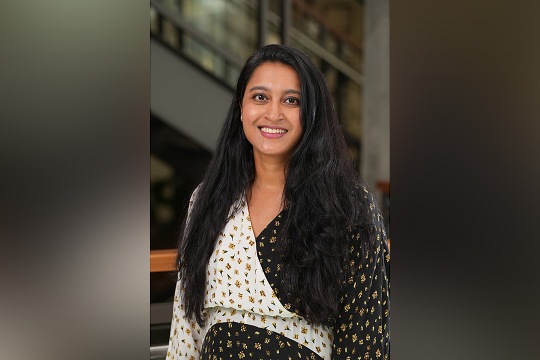
Deaf Hub Vital Signs wrapped up another successful year with Tiffany Bridgett, PhD! Bridgett’s presentation, “Transforming Barriers into Purpose: A Deaf Psychologist’s Change, Care, and Advocacy” gave the audience her perspective on navigating through hardship and transforming barriers into purpose to become a clinical psychologist.
The Deaf Hub Vital Signs Lecture Series is an annual event that features a BIPOC or female healthcare professional who is deaf or hard-of-hearing. We invite these professionals to interact with students and share their academic and professional journeys at Rochester School for the Deaf (RSD) and Rochester Institute of Technology (RIT). The guest presenter shares their experiences, from embarking on their academic journey to obtaining a healthcare degree.
As spring arrived with a fresh look on this event, Bridgett looked back to her experience of her tour at RSD and RIT.
Tiffany Bridgett, PhD
Bridgett is a Deaf licensed clinical psychologist in Massachusetts, and founder of Lifestyle & Access, PLLC, providing accessible, culturally responsive mental health care for Deaf individuals and hearing clients impacted by complex trauma, serious mental illness (SMI), and systemic barriers to care. With more than a decade of experience across hospital, school, and community settings, she uses trauma-informed, relational, and collaborative approaches. As a neurodivergent psychologist, Bridgett brings empathy and authenticity to her work and also trains mental health interpreters nationwide in trauma-informed practice, ethics, and cross-cultural collaboration.
If you missed this year’s Deaf Hub Vital Signs, her presentation was recorded and is available here. Watch and learn more about her insight as a clinical psychologist!
1. Can you share your reflections as a Vital Signs guest presenter?
Being invited as a Vital Signs guest presenter was both an honor and a deeply reflective experience. It gave me the opportunity to pause and look back on my journey—not just as a clinical psychologist, but as a Deaf professional navigating systems that were not always designed with accessibility in mind. Sharing that journey in a space like RIT/NTID, where there is a strong sense of community and lived understanding, felt especially meaningful.
What stood out to me most was the level of engagement from students and community members. There was a shared curiosity, but also a shared recognition of the barriers we often face and the creativity and persistence required to move through them. It reminded me that our individual paths, while unique, are also deeply connected—and that visibility and representation truly matter.
2. What was the most memorable part of your visit? Why did this moment resonate with you?
The most memorable part of my visit was connecting with students after the presentation, particularly those who saw aspects of their own experiences reflected in my story. Those conversations felt real and unscripted—students asking thoughtful questions, sharing their own uncertainties, and expressing their hopes for the future.
That moment resonated with me because I remember what it felt like to be in their position—wanting to pursue something meaningful while also questioning whether the system would make space for me. Being able to stand in front of them now, not as someone who has everything figured out, but as someone who has navigated those uncertainties, felt full circle. It reinforced for me the importance of showing up authentically and making space for others to envision themselves in roles that may not always feel accessible.
3. As a RIT alumna, what advice would you share with the current RIT/NTID students who want to become a clinical psychologist?
I would encourage students to hold onto their “why.” The path to becoming a clinical psychologist can be long and, at times, demanding—but staying connected to your purpose will help ground you when things feel uncertain.
It is also important to advocate for yourself early and often. Whether that means ensuring access in academic settings, seeking out mentors, or asking for opportunities that may not be readily offered—self-advocacy is not just helpful, it is essential. At the same time, you do not have to do this alone. Building a network of support—peers, mentors, and professionals who understand or are willing to learn—can make a significant difference.
Finally, I would remind students that their lived experiences are not a limitation—they are a strength. As Deaf clinicians, we bring critical perspectives to the field of psychology, particularly in understanding access, communication, and cultural nuance. There is space for you in this field, even if you have to help create it along the way.