Deaf People at Work

Misunderstandings about deaf and hard-of-hearing people often stem from limited exposure, outdated assumptions about communication, and lack of awareness about technology and legal protections.
This resource highlights common misunderstandings and pairs them with accurate workplace realities to help organizations build more inclusive, informed, and equitable environments. Understanding the diversity, capability, and strengths of deaf and hard-of-hearing employees can help businesses expand their talent pool, improve team communication, and foster workplaces where everyone can thrive.
Click or tap on the cards below to learn more.
Workplace Reality
Most DHH employees are highly adaptable and experienced in diverse communication modes. Effective communication tools include video relay services (VRS), captioning, text-based messaging, and sign language interpreters. Many Deaf people are comfortable with elbow or shoulder taps or flashing room lights on and off as a way to get their attention. Employers are responsible under the Americans with Disabilities Act (ADA) to provide reasonable accommodations, such as interpreters for meetings or captioned videos, which are manageable business expenses or even free through relay services in some states.

Workplace Reality
Job Accommodation Network studies show that most accommodations cost less than $500 and many cost nothing. Captioning meetings or using instant messaging requires minimal resources. Tax credits and deductions are available to offset costs for accessibility improvements, making it feasible and financially smart for employers to accommodate DHH workers.
Workplace Reality
DHH employees are equally capable of performing job duties as their hearing peers. Their hearing does not affect their intelligence, skill, or work ethic. The ability to speak is not a measure of intelligence. Many DHH have advanced degrees and excel in roles requiring high concentration, visual awareness, or attention to detail. Employers with DHH staff consistently report high productivity and low turnover, demonstrating strong loyalty and job performance.
Workplace Reality
Existing safety laws (ADA, OSHA, NFPA) require visual and non-auditory alert systems, such as flashing or varying lights and adding mirrors to improve access to surroundings, to ensure that ALL employees receive equal safety communication.
DHH people work safely in various industries, from healthcare to manufacturing, when given visual alert systems (like flashing alarms), text-based communication tools, and accessible training. With their heightened sensitivity, Deaf people can feel vibrations that indicate problems with machines and equipment.
Workplace Reality
Team integration depends on inclusive culture and communication, not on hearing status. When coworkers are educated about Deaf culture and communication etiquette (e.g., facing the person, speaking clearly, using captions), workplace relationships thrive.
Many organizations offer Deaf awareness training, which improves morale, inclusion, and overall team effectiveness. The Working Together online, self-paced course is available for free.
Workplace Reality
Employers sometimes fear violating the Americans with Disabilities Act (ADA) regulations or mishandling accommodations. However, the ADA provides clear guidance and support through resources like the Equal Employment Opportunity Commission (EEOC) and Department of Labor – Office of Disability Employment Policy (ODEP). Employers who make good-faith efforts to provide access and inclusion are protected and often gain a reputation for inclusive leadership.
Workplace Reality
DHH employees are just as ambitious and career-driven as their hearing peers; and they excel in a wide range of high-skill fields including engineering, healthcare, education, cybersecurity, finance, science, technology, and the arts. Many earn advanced degrees, hold professional certifications, and successfully rise to roles such as managers, entrepreneurs, researchers, and senior executives. Career growth and advancement depend on opportunity, access, mentorship, and workplace inclusion, not hearing status.
Barriers that may restrict DHH employees and limit promotions are usually systemic, such as lack of communication access in meetings or professional development opportunities. When workplaces provide accommodations and equal access, DHH employees pursue leadership roles, promotions, and professional growth just like anyone else.
Workplace Reality
Deaf people who use American Sign Language (ASL) as their primary language are part of a distinct cultural and linguistic minority. While members of the medical community may perceive deafness as a disability, members of the Deaf community often view deafness as a source of pride and identity, defined by shared language, history, and experiences.
Self-disclosure about deafness is a deeply personal decision. Many Deaf professionals hesitate to disclose their Deaf identity because of biases and misconceptions in workplaces that still equate deafness with incapability, rather than cultural diversity and strength.
Workplace Reality
Deaf and hard of hearing individuals are a highly diverse group whose hearing levels, lived experiences, and communication preferences vary widely. Some use American Sign Language (ASL), some speak, some rely on hearing aids or cochlear implants, and many use a combination of methods, including captioning, texting, lipreading, or assistive technology. Communication choices often shift depending on the situation, environment, or people involved. Because there is no “one-size-fits-all” approach, the most effective strategy is simply to ask each person how they prefer to communicate in different workplace settings.
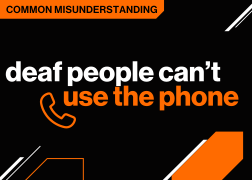
Workplace Reality
Many Deaf and hard of hearing individuals use phones through t-coils in their hearing aids and cochlear implants, bluetooth-streamed calls, texting, video calls, or Video Relay Services (VRS) with interpreters. In the workplace, they can join calls through relay or use captioned meetings and group chats to communicate quickly and effectively. Most video conferencing software also contain AI features that capture notes and support communication.