Reading and Deafness (RAD) Lab

Click here to see if you are eligible for any current studies!
The Reading And Deafness (RAD) Lab uses eye-tracking, behavioral language assessments, and other psycholinguistic methods to examine how deafness, sign language experience, and bimodal bilingualism shape reading in deaf and hearing children and adults. We study how the sensory experience of being deaf and early access to sign language, both independently and together, influence the way people process written text. Ultimately, we aim to use our findings to inform early language and educational practices that support stronger literacy outcomes for deaf and hard-of-hearing children.
We are actively seeking research participants and passionate researchers to join our team! For more information, contact Dr. Cooley at fgcdls@rit.edu.
Research Overview
Reading is a complex cognitive process that requires a reader to integrate visual and linguistic information to efficiently and accurately extract meaning from text. Much of early schooling focuses on instructing children how to read, then pivots to children reading to learn. Reading is also necessary to communicate with others in a digital age and for independence during daily life. As such, the ability to read is essential for academic and professional success. In my research, I assess reading behaviors of deaf readers from strengths-based and bilingualism perspectives to understand the strategies that underlie skilled reading in this population. The ultimate goal of this line of research is to influence language and educational practices for deaf students to ensure we are meeting the needs of this underserved and understudied population.
Publications
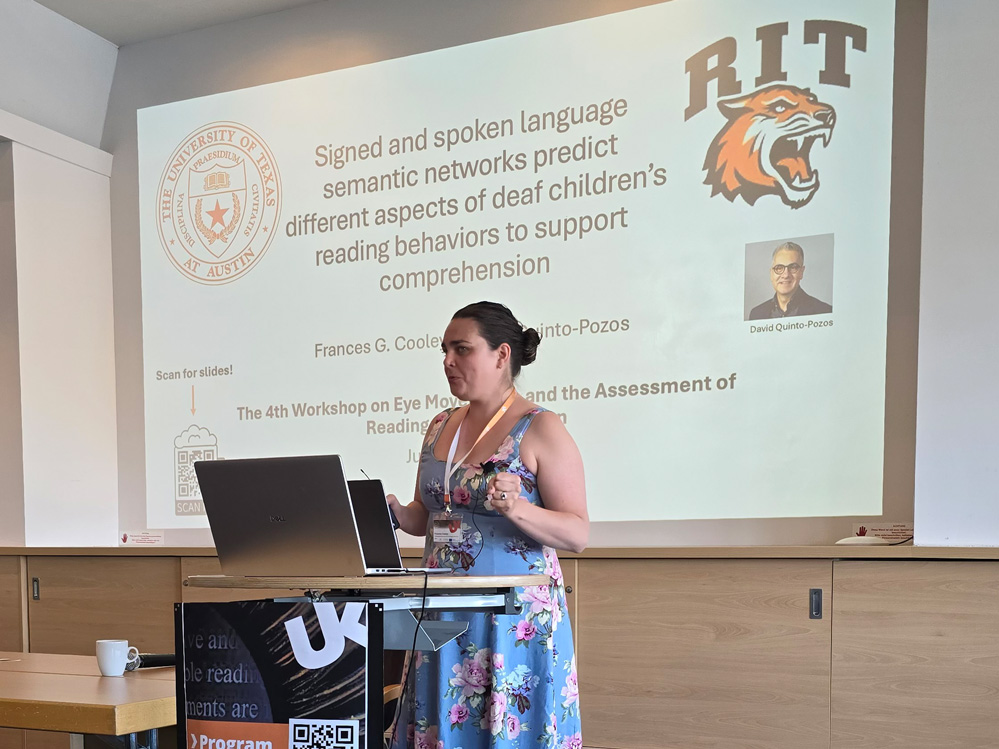
Cooley, F. G. & Quinto-Pozos, D. (2026). Deaf child signers’ reading behaviors are predicted by their bilingual (signed and spoken) vocabularies: Evidence from eye-tracking. Journal of Eye-Movement Research, Special Issue: Eye Movements in Reading and Reading Related Difficulties, 19(4), 1–17. https://doi.org/10.3390/jemr19040083
Schotter, E. R., Milligan, S., Cooley, F. G., & Emmorey, K. (2026). Identifying the visual and linguistic sources of reading efficiency: A comparison of individual differences among deaf and hearing readers. Journal of Vision, 26(6), 2–2.
Sinclair, G., Cooley, F. G., Stringer, C., Saunders, E., Emmorey, K., & Schotter, E. R. (2026). The impact of an enhanced perceptual span on landing position: Evidence from hearing and deaf readers. Journal of Experimental Psychology: Human Perception and Performance, 52(3).
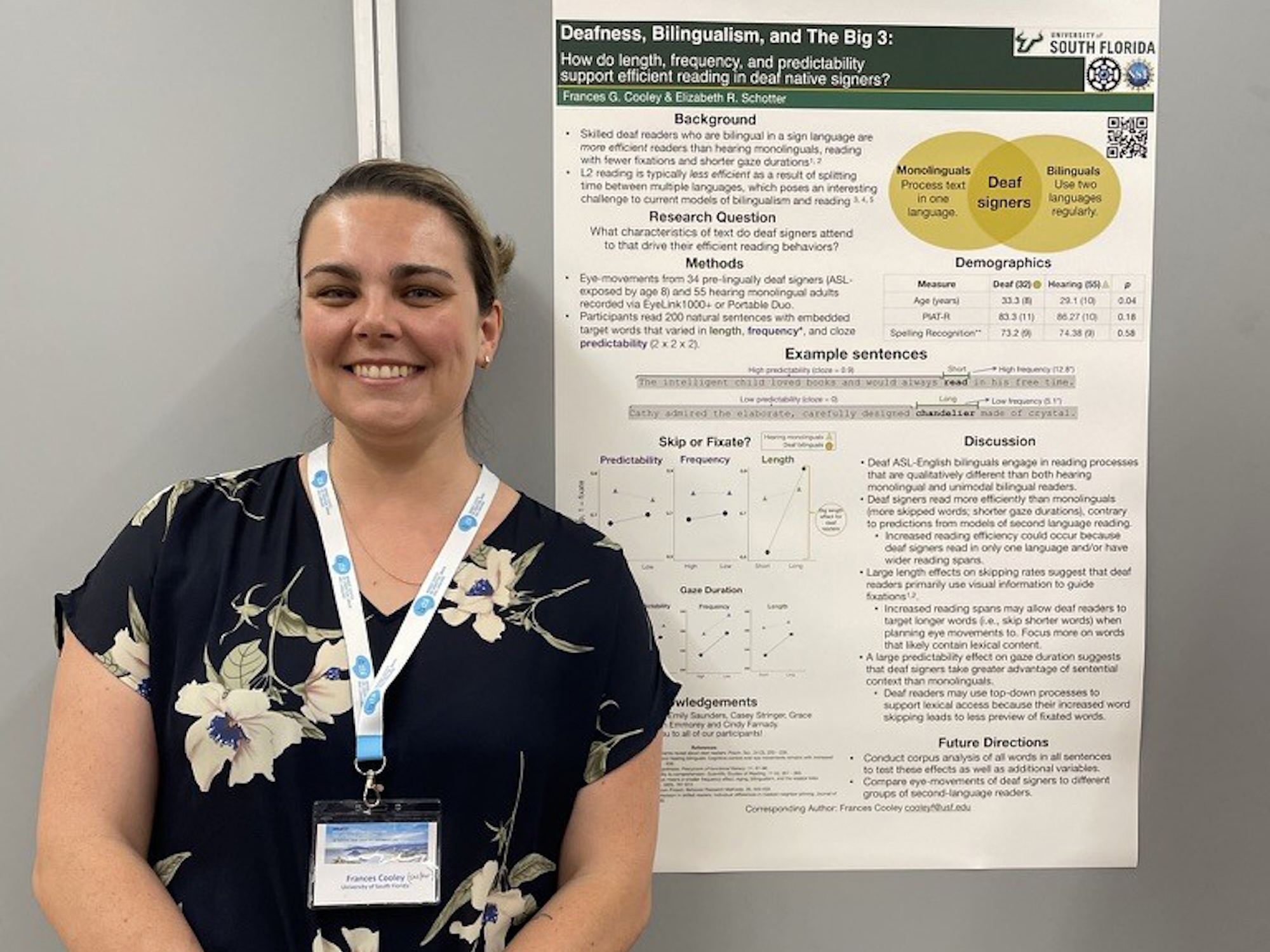
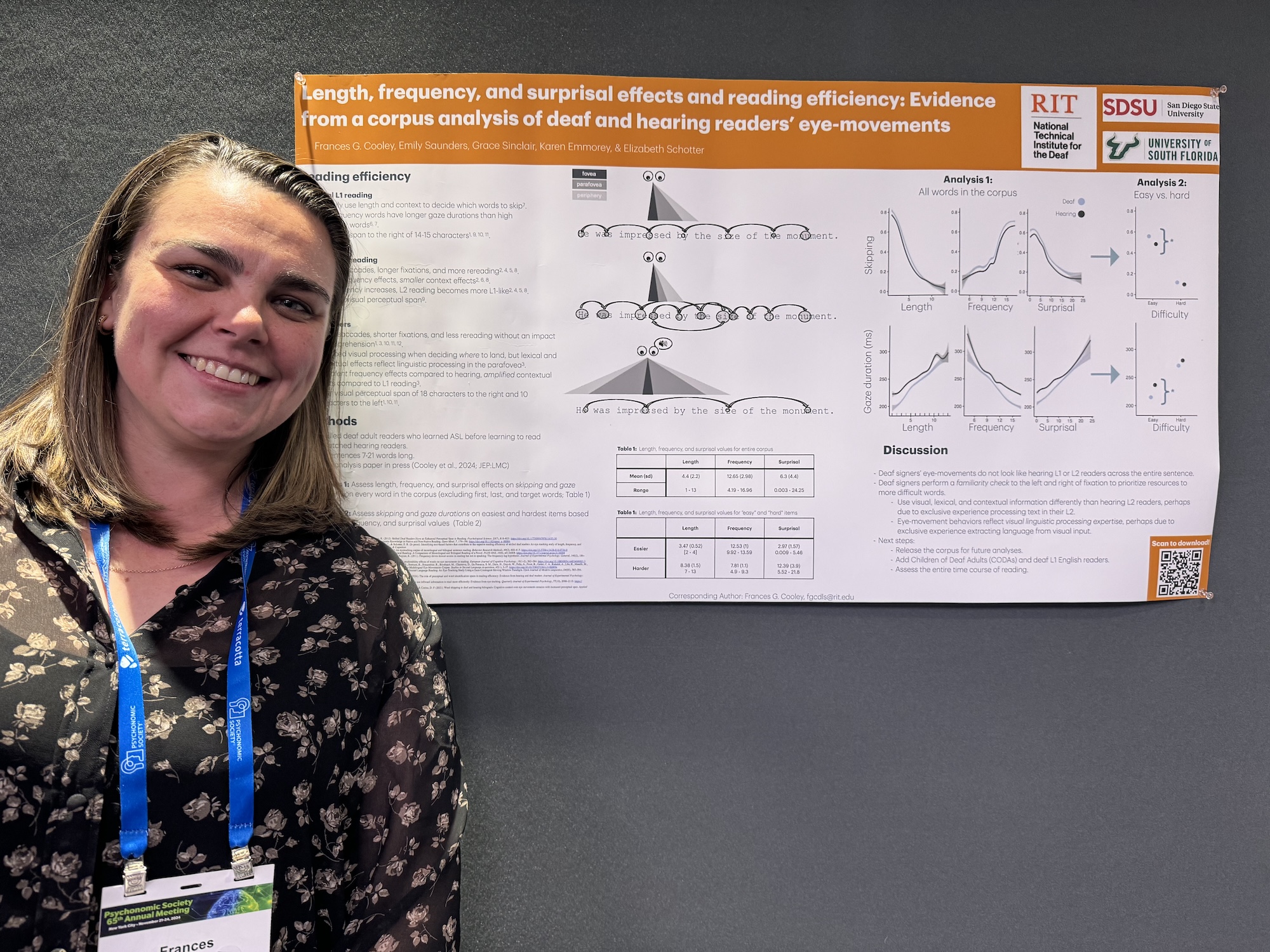
Cooley, F. G., Emmorey, K., Saunders, E., Sinclair, G., Stringer, C., & Schotter, E. R. (2025). Identifying text-based factors that contribute to the superior reading efficiency of skilled deaf readers: An eye-tracking study of length, frequency, and predictability. Journal of Experimental Psychology: Learning, Memory, and Cognition. https://doi.org/10.1037/xlm0001415
Cooley, F. G., Emmorey, K., Saunders, E., & Schotter, E. R. (2025). Presenting the Signers’ Eye-movements in English Reading (SEER) Corpus: An eye-tracking dataset of reading behaviors by deaf early signers and hearing non-signers. Behavior Research Methods, 58(1), 26. https://doi.org/10.3758/s13428-025-02881-2
Emmorey, K., Akers, E. M., Saunders, E., Bannazadeh, M., Droubi, E., Cooley, F. G., & Schotter, E. R. (2025). Assessing the Effects of Sign Language Experience Versus Deafness on the Leftward Reading Span. Cognitive Science, 49(12), e70162. https://doi.org/10.1111/cogs.70162
Schotter, E.R., Stringer, C., Cooley, F.G., Saunders, E., Sinclair, G., & Emmorey, K. (2024). The perceptual and word identification spans in reading: Evidence from deaf and hearing adults. Journal of Experimental Psychology: General.
Stringer, C., Cooley, F. G., Saunders, E., Emmorey, K., & Schotter, E.R. (2024). An enhanced leftward word identification for deaf readers. Quarterly Journal of Experimental Psychology
Cooley, F. G. & Quinto-Pozos, D. (2023). Examining speech-based phonological recoding during reading for adolescent deaf signers. Journal of Experimental Psychology: General, 152 (7), 1995-2007.
Quinto-Pozos, D. & Cooley, F. G. (2020). A developmental disorder of signed language production in a native deaf signer of ASL. Languages: Atypical Speech, Language, and Communication Development, 5 (40).
Shield, A., Cooley, F. G., & Meier, RP. (2017). Sign language echolalia in deaf children with Autism spectrum disorder, Journal of Speech, Language, and Hearing Research, 60, 1622-1634.


Contact
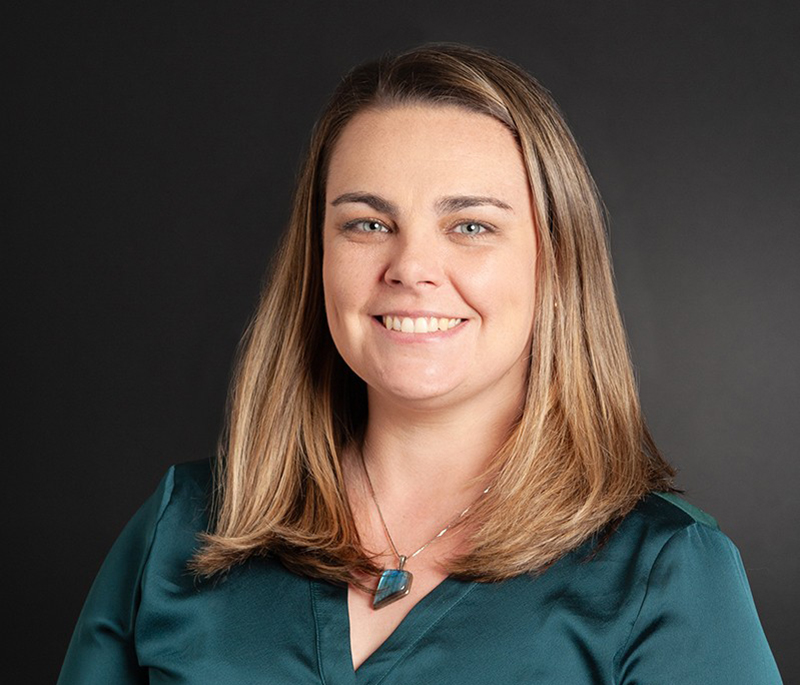
Frances G. Cooley
Assistant Professor of Psychology
Office: LBR 06-2228
Email: fgcdls@rit.edu
BA: Brain and Cognitive Science, American Sign Language from University of Rochester
MA/PhD: Linguistics, University of Texas at Austin
Postdoctoral fellowship: Psychology, University of South Florida with Dr. Liz Schotter in the EMAC Lab
Curriculum Vitae (CV)