CLA Women's and Gender Studies Speaker Series: To(o) Queer the Artist: An Aesthetics of Self-Making
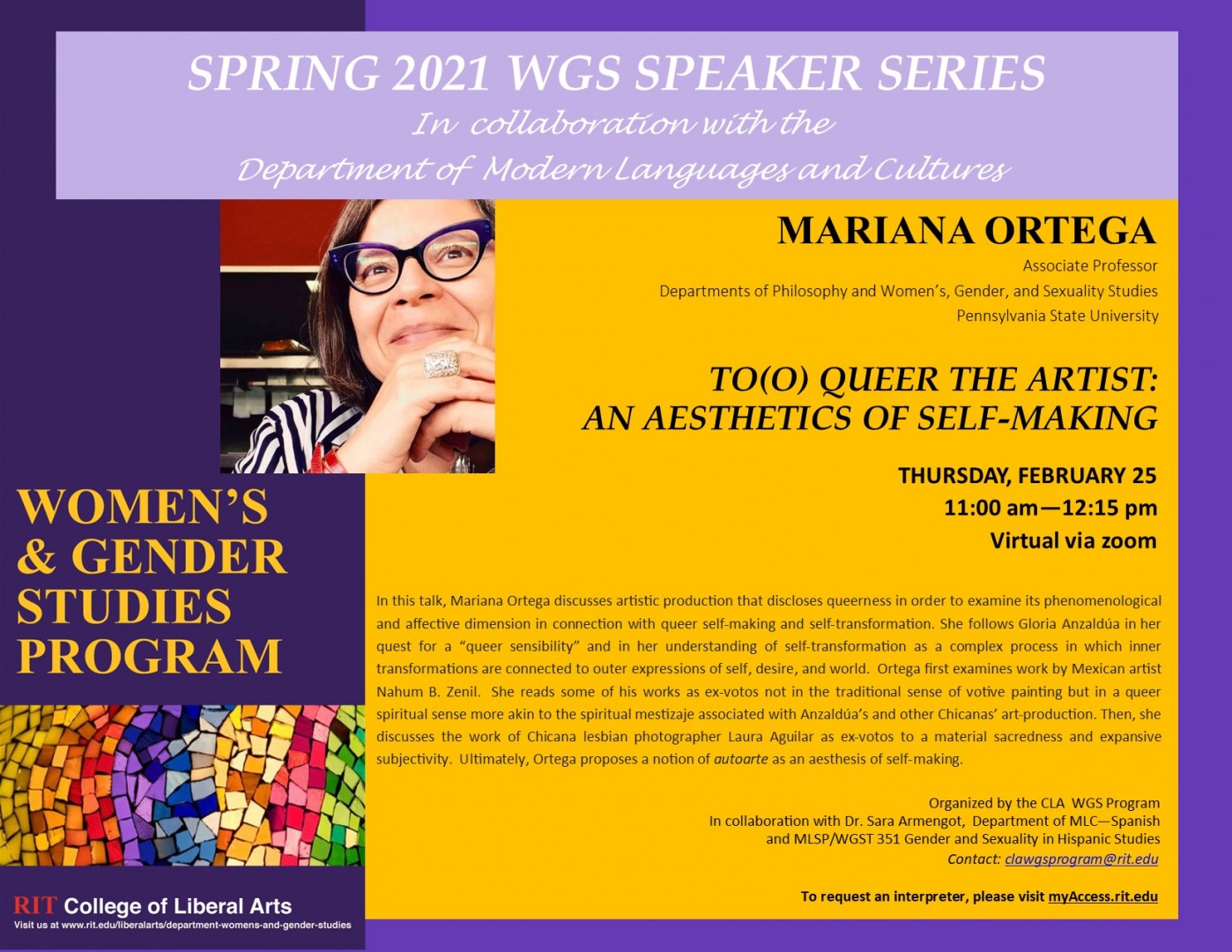
CLA WOMEN'S AND GENDER STUDIES SPEAKER SERIES
MARIANA ORTEGA
Associate Professor
Departments of Philosophy and Women’s, Gender, and Sexuality Studies
Pennsylvania State University
TO(O) QUEER THE ARTIST:
AN AESTHETICS OF SELF-MAKING
THURSDAY, FEBRUARY 25
11:00 am—12:15 pm
Virtual via zoom
See registration link above
In this talk, Mariana Ortega discusses artistic production that discloses queerness in order to examine its phenomenological and affective dimension in connection with queer self-making and self-transformation. She follows Gloria Anzaldúa in her quest for a “queer sensibility” and in her understanding of self-transformation as a complex process in which inner transformations are connected to outer expressions of self, desire, and world. Ortega first examines work by Mexican artist Nahum B. Zenil. She reads some of his works as ex-votos not in the traditional sense of votive painting but in a queer spiritual sense more akin to the spiritual mestizaje associated with Anzaldúa’s and other Chicanas’ art-production. Then, she discusses the work of Chicana lesbian photographer Laura Aguilar as ex-votos to a material sacredness and expansive subjectivity. Ultimately, Ortega proposes a notion of autoarte as an aesthesis of self-making.
Mariana Ortega works on Latina/x feminisms, phenomenology, critical philosophy of race, and aesthetics. Her research focuses on questions of self and identity as well as visual representations of race, gender, and sexuality. She is the author of In-Between: Latina Feminist Phenomenology, Multiplicity, and the Self (2016). She is co-editor with Andrea Pitts and José Medina of Theories of the Flesh: Latinx and Latin American Feminisms, Transformation and Resistance (2020); and co-editor with Linda Martín-Alcoff of Constructing the Nation: A Race and Nationalism Reader (2009). She is the founder and director of the Latina/x Feminisms Roundtable.
Event Snapshot
When and Where
Who
Open to the Public
Interpreter Requested?
No