Cognitive Science Speaker Series | Electrophysiological investigations of natural speech and language processing
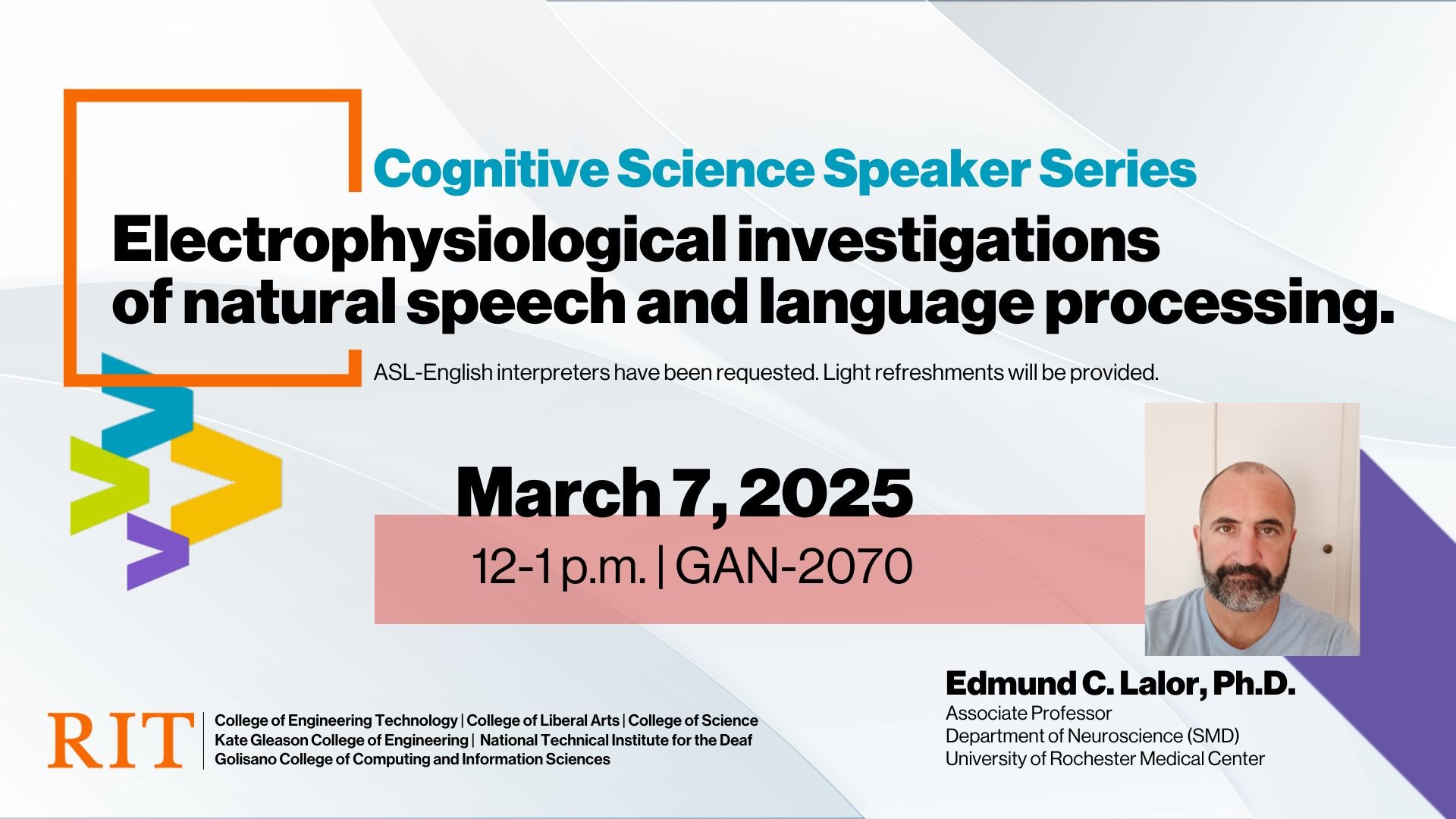
Speaker: Edmund Lalor Ph.D.
Title: Electrophysiological investigations of natural speech and language processing
Short Bio: Ed Lalor received the B.E. degree in electronic engineering from University College Dublin (UCD), Ireland in 1998 and the M.Sc. degree in electrical engineering from the University of Southern California in 1999. After periods working as a silicon design engineer for a Dublin-based company and a primary school teacher for children with learning difficulties, Ed joined MIT's Media Lab Europe, where he worked from 2002-2005 as a research scientist investigating brain-computer interfacing and attentional mechanisms in the brain. This research led to a PhD in biomedical engineering which was completed through UCD in 2006. Subsequently, he spent 2 years in New York working as a postdoctoral research fellow in the Cognitive Neurophysiology Laboratory at the Nathan Kline Institute for Psychiatric Research and as an adjunct assistant professor in the City College of New York. He returned to a position as a Government of Ireland Postdoctoral Research Fellow based at the Institute of Neuroscience and the Centre for Bioengineering in Trinity College Dublin in 2008. Following a brief stint at University College London's Institute of Ophthalmology, he returned to Trinity College Dublin as an Assistant Professor in 2011. In 2016, he joined the Departments of Biomedical Engineering and Neuroscience at the University of Rochester as an Associate Professor, where he directs a lab aimed at understanding sensation, perception and cognition in the human brain, especially as it relates to the perception of the kinds of inputs we receive in daily life.
Abstract: Speech is central to human life. However, how the human brain extracts meaning from the dynamic patterns of sound that constitute speech remains poorly understood. It is generally accepted that this ability is underpinned by hierarchical processing in the human brain, with much of the evidence in support of this idea having come from neuropsychology or brain imaging studies. However, both of these approaches have limitations with respect to studying the neurophysiological processing of many of the rapid, dynamic features of speech. In this talk I will discuss a series of studies aimed at using a model-based framework to analyze EEG responses to naturalistic speech stimuli. This will include describing our attempts to dissociate the general auditory processing of speech sounds from the linguistic processing of speech units and the process of language comprehension. I will also discuss some of our efforts to explore the effects of attention and multisensory input on speech and language processing at different hierarchical levels.
ASL-English interpreters have been requested. Light refreshments will be provided.
Event Snapshot
When and Where
Who
Open to the Public
Interpreter Requested?
Yes