A Garden City in a Forest: Viewing Improvement from Unruly Ground
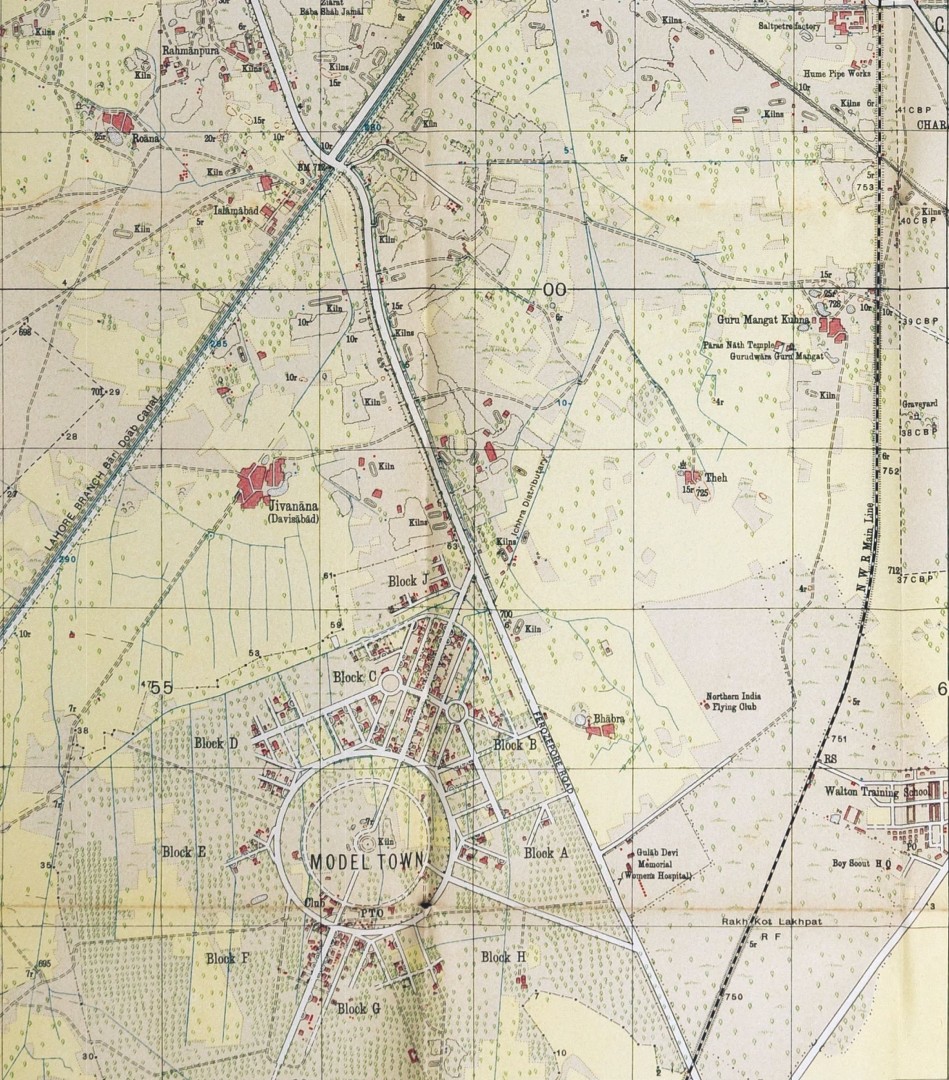
In the early-twentieth century, as earlier forms of agrarian “improvement” were taking on urban dimensions, Model Town, a now-iconic town planning experiment, laid the groundwork for the direction of future planning in the city of Lahore, Pakistan. The project’s history as a modern garden suburb, where social aspirations are translated into spatial form, is well known. In this talk, Nida Rehman will attend instead to the drawn-out and not always smooth processes of enclosure, privatization, and improvement. She will examine the conversion of indigenous scrub forest in Lahore’s outskirts, first into an irrigated plantation, and then into the model garden suburb. Dilating the efforts to prime pasture, forest, and arable land as future urban ground, Rehman will scrutinize a key episode in Lahore’s planning history through alternative traversals of the suburb’s landscape. Here, stories of deep-rooted trees and darting jackals from the past, read alongside recent work on the immanence, within the urban, of more-than-human liveliness and agrarian logics, provide new lenses for re-evaluating improvement qua urbanization at this conjunctural moment. Such a perspective from the ground reveals, she argues, relations, inhabitations and latent futures that remain buried when the story of the city is told only through the demarcations and abstractions of development.
Nida Rehman is a Pakistani-born urban geographer and architect, and Associate Professor at Carnegie Mellon University, where she serves as Track Chair for the PhD in Architecture program. As an interdisciplinary scholar and educator, Nida works at the intersection of urban political ecology, environmental humanities, and post/de-colonial studies. Her work explores how discourses, governance, and experiences of urban nature are shaped by colonial processes and uneven development, and how people engage with urban nature to create possibilities for change. Nida examines these issues through her research on cultural landscapes and political ecologies in Lahore, Pakistan; through collaborative and public-facing work as co-founder of the South Asia Urban Climates collective; and community-centered approaches to environmental and spatial justice in Pittsburgh and the Mon Valley region. She is currently working on a book, The Intractable Garden: Improvement and unruliness in Lahore’s landscapes, which proposes the garden as an expansive lens to examine the histories of colonial agricultural and horticultural improvement that still play out in the city, and the practices and ecologies that run up against prescriptions of colonial design. She has published in International Journal of Urban and Regional Studies, Antipode, Planning Perspectives, Comparative Studies of South Asia, Africa and the Middle East, and The Botanical City (2021), and exhibited at the 2024 Lahore Biennale. She is co-editor of the book Crowdsourcing, Constructing, and Collaborating: Methods and Social Impacts of Mapping the World Today (Bloomsbury 2020).
Rehman's lecture is organized by the Urban Natures Corridor Group, funded by the Central New York Humanities Corridor, and sponsored by the RIT Department of Sociology and Anthropology. It is open to all RIT students, faculty, and staff; no registration is required.
Please make interpreting and other access requests at myaccess.rit.edu.
Event Snapshot
When and Where
Who
This is an RIT Only Event
Interpreter Requested?
No