Imaging Science Seminar - Imaging Science at the British Library
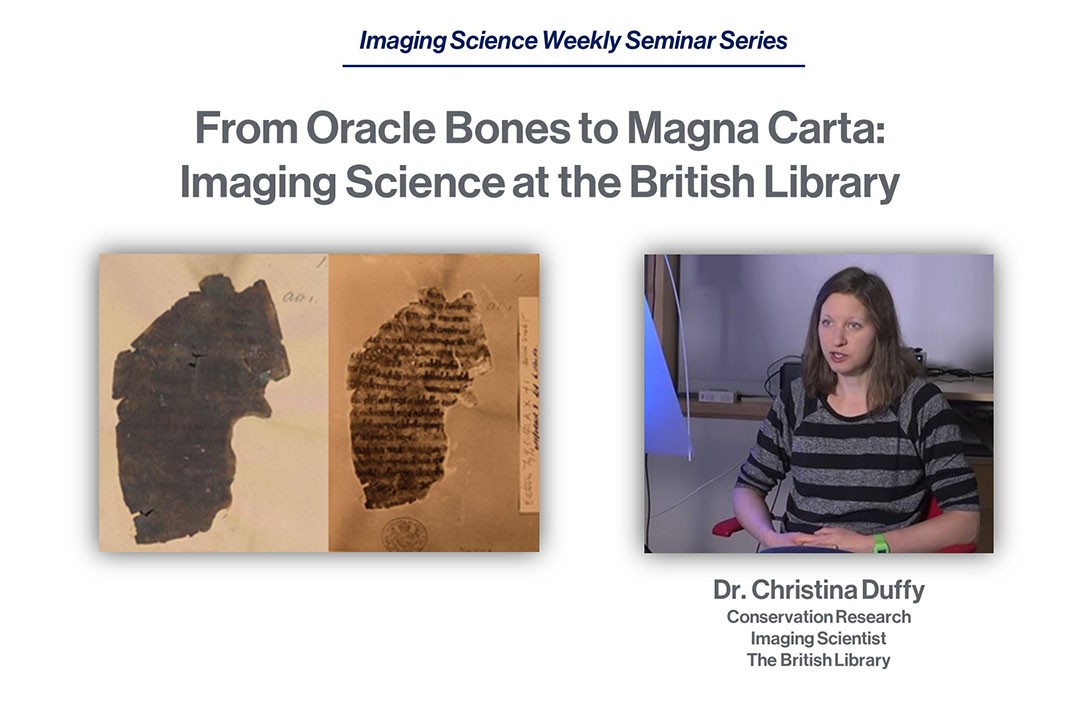
From Oracle Bones to Magna Carta - Imaging Science at the British LibraryDr. Christina DuffyConservation Research Imaging ScientistThe British LibraryAbstract:The British Library is the national library of the United Kingdom holding over 150 million items with an additional three million new items added annually. The 625 km of shelving includes manuscripts, maps, newspapers, magazines, prints, drawings, music scores and patents. The fundamental purpose of the Library is to make intellectual heritage accessible for research, inspiration and enjoyment. It is therefore imperative that these texts are legible. The sheer variety of substrate material (paper, parchment, papyrus, bone, leather etc.) and writing material (pencil, iron-gall ink, carbon-ink, pigment etc.) presents an incredible challenge to imaging. In 2012, a new role of Conservation Research Imaging Scientist was introduced to develop strategies and solutions to resolve issues of illegibility. One of the imaging techniques adopted by the Library - multi-spectral imaging (MSI), has proven an invaluable aid to scholars. MSI has been used on some of the Library’s most significant Treasures and has enabled discovery of a fugitive figure on a folio of Leonardo da Vinci’s notebook, brought new interpretations of the illuminations of the 14th century anonymous poem Sir Gawain & the Green Knight (one of the masterpieces of Middle English literature) to light, as well as recovering text on one of the four original 1215 Magna Carta manuscripts; the Canterbury Magna Carta. Other imaging techniques such as micro-computed tomography have enabled 3D interpretation of items including St Cuthbert Gospel; an early 8th-century pocket gospel book written in Latin. Its finely decorated leather binding is the earliest known Western bookbinding to survive thanks to being hidden in St Cuthbert’s coffin for several years during the Viking invasions. Further processing of CT datasets has enabled true condition assessments of the Library’s oldest collection items – Chinese Oracle bones, which were used for divination over three thousand years ago. Through a combination of multi-spectral imaging and post-processing imaging techniques, some of the primary challenges posed by fire-damaged, naturally faded and chemically damaged materials at the British Library are being overcome. This has improved accessibility, conservation and preservation practices.Speaker Bio:Christina Duffy graduated with a BSc in Physics with Astronomy from Dublin City University in 2007 before completing a PhD on Meteoritics and Planetary Science from Imperial College London in 2011. Her final thesis ‘Characterising Primitive Chondrite Components' describes a range of analytical techniques applied to meteorite samples in the process of classification. Christina has worked as Conservation Research Imaging Scientist at the British Library since 2012 and uses a range of imaging techniques and post-processing methods to enhance and recover faded or lost information from British Library collections.Intended Audience:All are welcome. No background knowledge required.
Event Snapshot
When and Where
Who
Open to the Public