Physics Colloquium - Role of Polymer Physics in Elastic Flow Instabilities
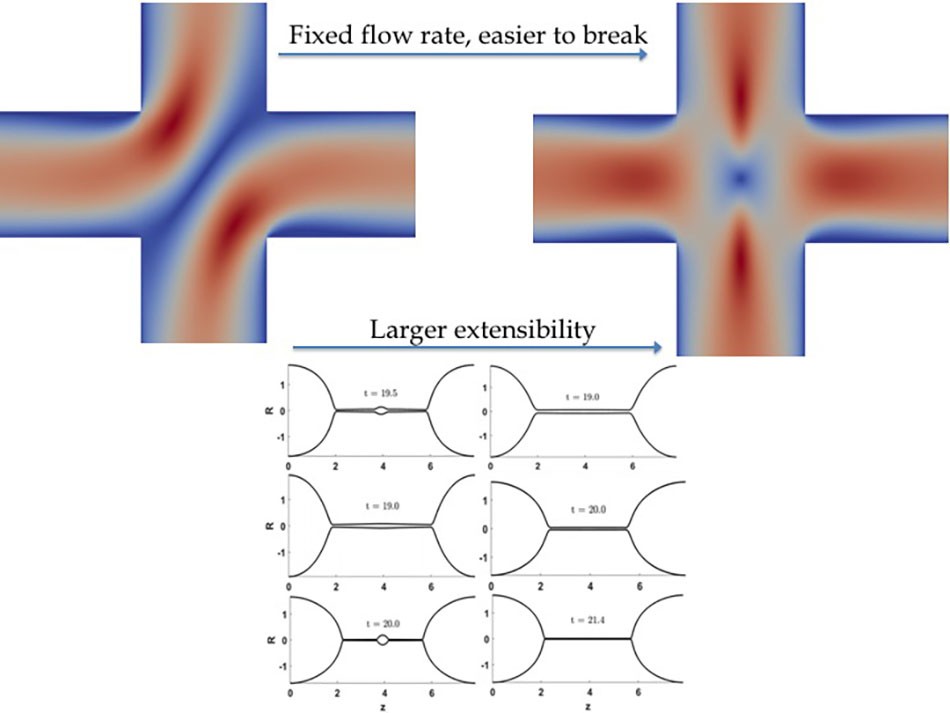
Role of polymer physics in the development of elastic flow instabilitiesDr. Michael CromerAssistant ProfessorSchool of Mathematical Sciences, RITAbstract:Polymer processing and manufacturing operations including molding of elastomeric materials, spinning synthetic fibers, production of paints, agrochemical spraying, inkjet printing and enhanced oil recovery, impose a flow profile that is a combination of shear and extensional flows. Historically, the study of polymeric materials has been characterized by the prevalence of shear flow over elongational flow experiments. In recent years, there have been intense experimental investigations into the development of extension-driven instabilities in the flow of complex fluids. This talk will focus on two of these instabilities. Near the hyperbolic stagnation point in a cross-slot device, polymer chains orient and stretch resulting in extensional thickening that feeds back on the flow, and may cause the symmetric flow to become asymmetric. The question we seek to address here is how additional mesoscopic physics, for example entanglement, branching and breaking/reforming, affect the onset of this instability, and whether we can use such information to control flow behavior. Using the open-source CFD library OpenFOAM, we show how varying model parameters, hence the physics, affect the onset of the instability, and, specifically, how the instability can be completely eliminated within certain regimes. When a viscoelastic material is stretched between two surfaces, the interaction between elastic and capillary stresses leads to the formation of a “beads-on-a-string" structure where between drops, thin and stable filaments form. Under certain conditions, small “satellite” drops can form between the main droplets. In applications, such as in inkjet printing, the emergence of these satellite drops is cause for concern, thus it becomes important to understand what properties lead to their formation. Using a thin film approximation, we numerically solve the capillary thinning of polymer solutions. We investigate the effects that certain mesoscopic properties have on drop formation, in particular polymer stretch and anisotropic drag, ultimately revealing phase diagrams showing under which conditions these satellite drops can form.Speaker Bio:Michael Cromer is an Assistant Professor in the School of Mathematical Sciences at the Rochester Institute of Technology. He received a B.S. in Mathematics at York College of Pennsylvania, and a Ph.D. in Applied Mathematics from the University of Delaware. During his time at UD, he spent several months at the Institute for Mathematics and its Applications at the University of Minnesota during a special semester on complex fluids, and was also awarded the University Dissertation Fellowship. Prior to joining RIT, Michael was a postdoctoral scholar in Chemical Engineering and the Materials Research Lab at the University of California, Santa Barbara, and then was awarded a National Research Council Research Associateship at the National Institute of Standards and Technology. Michael’s research focuses on the modeling, analysis and simulation of complex fluids. His work encompasses a wide range of materials (e.g., wormlike micellar solutions, polymer solutions, and colloidal dispersions), which have a vast range of applications (e.g., oil recovery, soft body armor, materials processing).Intended Audience:No background knowledge required. All are welcome.
Event Snapshot
When and Where
Who
Open to the Public