RIT Offering Nation’s First Light-Sport Aircraft Inspection Course
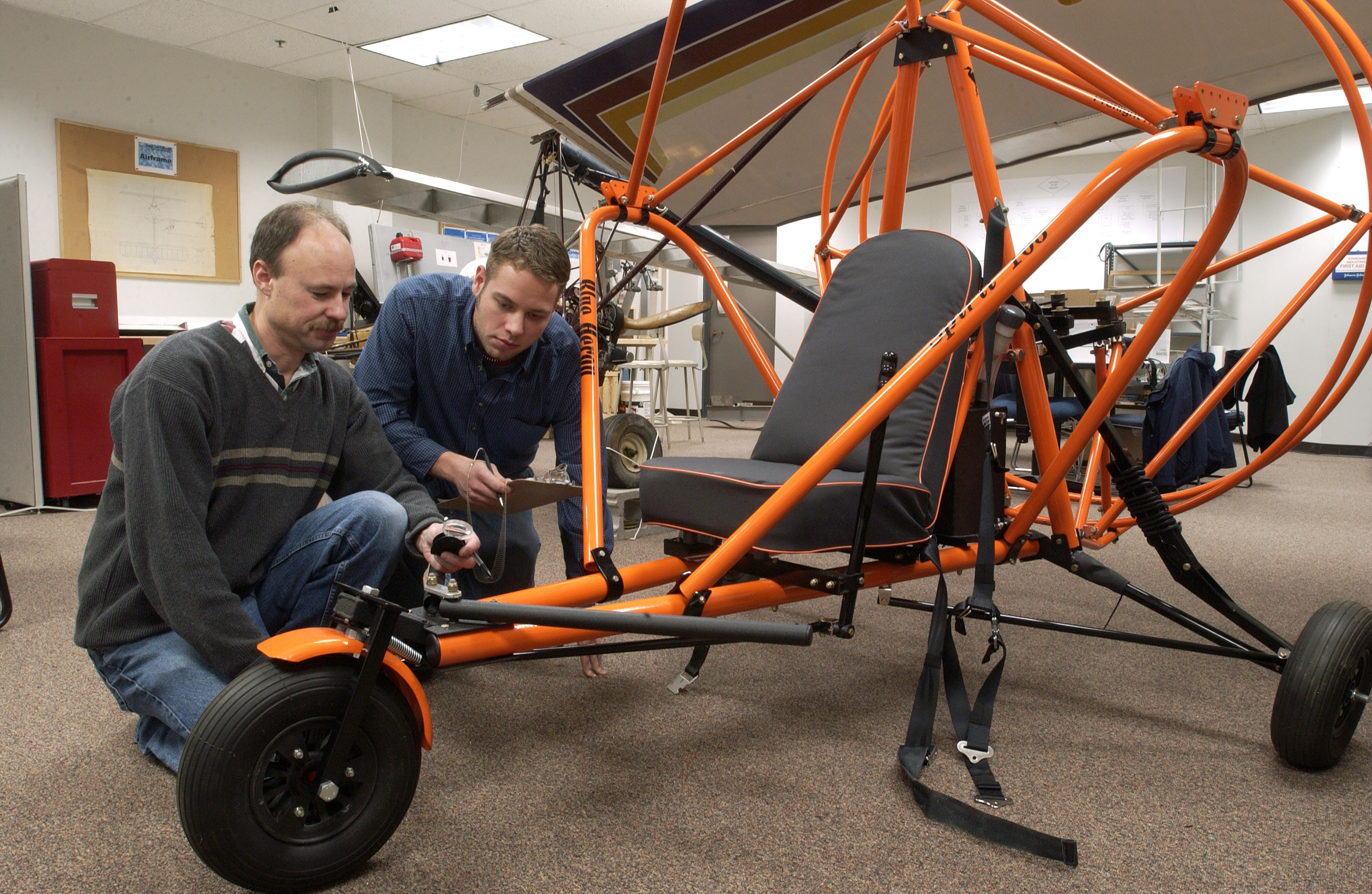
Pilots of light-sport aircraft—such as powered parachutes—can inspect and maintain their personal crafts with expertise after completing a new, federally approved, 16-hour inspection course offered by Rochester Institute of Technology.
The Federal Aviation Administration has granted RIT approval to issue the Light-Sport Aircraft Repairman’s Certificate with Inspection Rating. RIT’s Light-Sport Aircraft/Powered-Parachute Inspection Course, the first of its kind in the nation, is offered 8 a.m. to 6 p.m. Saturdays and Sundays once a month. The first session was held on Dec. 17—the 102nd anniversary of the Wright brothers’ first powered flight. The next classes are scheduled for Feb. 18-19.
Successful completion of the course gives the owners of experimental light-sport aircraft the ability to perform annual inspections that would otherwise need to be conducted by an airport mechanic at considerable cost, according to Kevin Kochersberger, RIT associate professor of mechanical engineering and course instructor. The course covers airframe assembly, disassembly and inspection; inspection of propulsion systems, landing gear, materials, engines and electrical systems; corrosion and degradation; safety, rules and regulations; and theory of flight. Students must be at least 18 years old, fluent in English and U.S. citizens or permanent residents. Registration is limited to 16 students per class. Cost of $350 covers all course materials, including a CD-ROM. Certification is valid for the lifetime of the holder.
“I was pleased to learn that we had received the first powered-parachute inspection course approval in the country,” Kochersberger says. “The FAA accepted the course without a single revision.”
Kochersberger, a licensed pilot and glider flight instructor who specializes in aerospace engineering, has taught flight dynamics, aerostructures and aerodynamics, experimental aerodynamics and wind tunnel balance design. His book, Light Sport Aircraft Inspection Guide, will be published next month.
The course will also be offered to RIT students this spring, Kochersberger adds, and a fixed-wing inspection course is under development and expected to be approved and offered Feb. 4-5.
Note: For further information on RIT’s Light-Sport Aircraft/Powered-Parachute Inspection Course, visit http://lsa.rit.edu.
Photo caption: Kevin Kochersberger, associate professor of mechanical engineering, left, and John Chambers, a fifth-year mechanical engineering B.S./M.S. student and lab assistant, inspect a powered-parachute airframe. Kochersberger instructs the only light-sport aircraft/powered-parachute inspection course in the nation. (Digital photo available at http://www.rit.edu/news/pics/rit_lsa_course.jpg)