RIT Tiger creates career caring for carnivores
Biology alumna Brenna De Angelis is a zookeeper at the Seneca Park Zoo
Carlos Ortiz
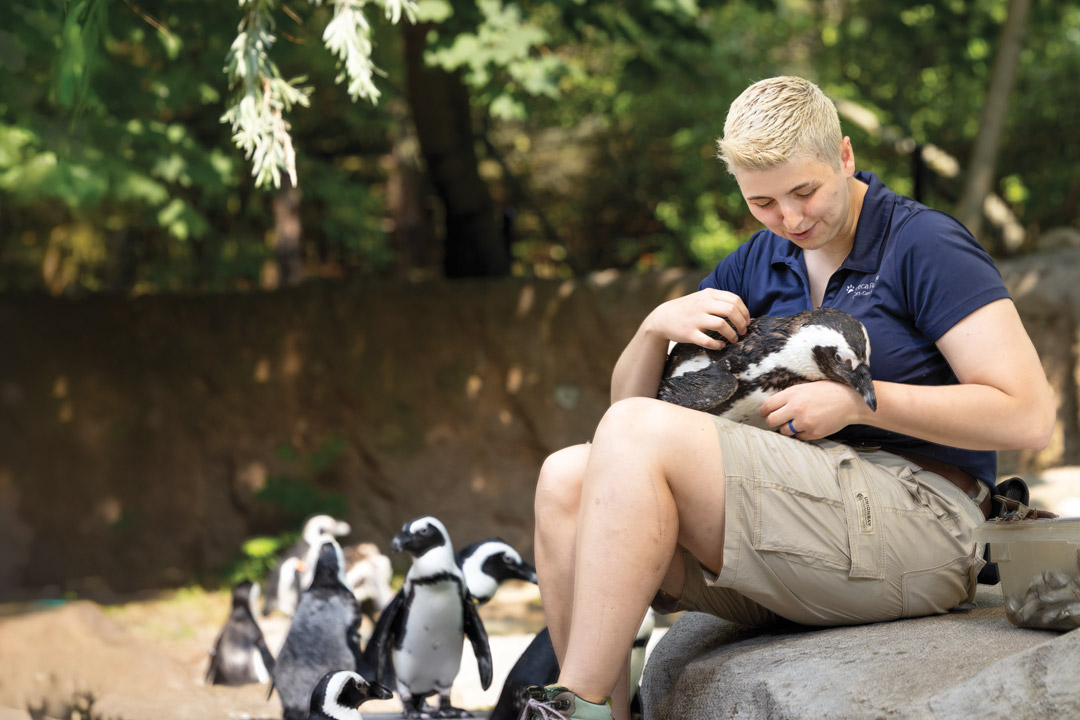
Brenna De Angelis ’16 (biology) was led to zookeeping after experiences she had as a student. She now works at the Seneca Park Zoo. These penguins are African, so they enjoy warm summer temperatures, unlike the arctic members of their species. All animals have distinct personalities, like Gizmo, who De Angelis says likes to be held like a house cat.
Lions, tigers, and bears—that’s the everyday reality for Seneca Park Zookeeper Brenna De Angelis ’16 (biology), a Rochester native who now works with the animals she grew up visiting.
De Angelis didn’t really know what she wanted to do for her future career until the experiences she had while at RIT led her to zookeeping.
“I knew I was good at biology and good at science, so I said, ‘Let me go to RIT and get my undergrad,’” said De Angelis.
During that time, she took an internship at the Seneca Park Zoo in Rochester. She remembers one of the first days she got to touch a rhino—and that’s the moment she could foresee her future career. After the internship, De Angelis continued to volunteer at the zoo once a week, and once a position opened a few months after she graduated from RIT, it was a natural fit.
As part of the carnivore team, De Angelis is the lead penguin keeper and the lead trainer for one of the California sea lions. Any given day she can be called on to assist with any animal in her department, whether that be the snow leopard, the red panda, the lions, the tiger, or the polar bear. Training sessions with the animals are the biggest part of her job. She makes sure the animals are active and engaged while balancing all their individual personalities and needs. The job also includes cleaning, food preparation, and continuing education.
Experiences while a student at RIT set De Angelis up for success. She had the chance to travel to the Galapagos Islands for a study abroad class with Emeritus Professor Robert Rothman—one of hundreds of students who had the opportunity to do so.
Carlos Ortiz/RIT
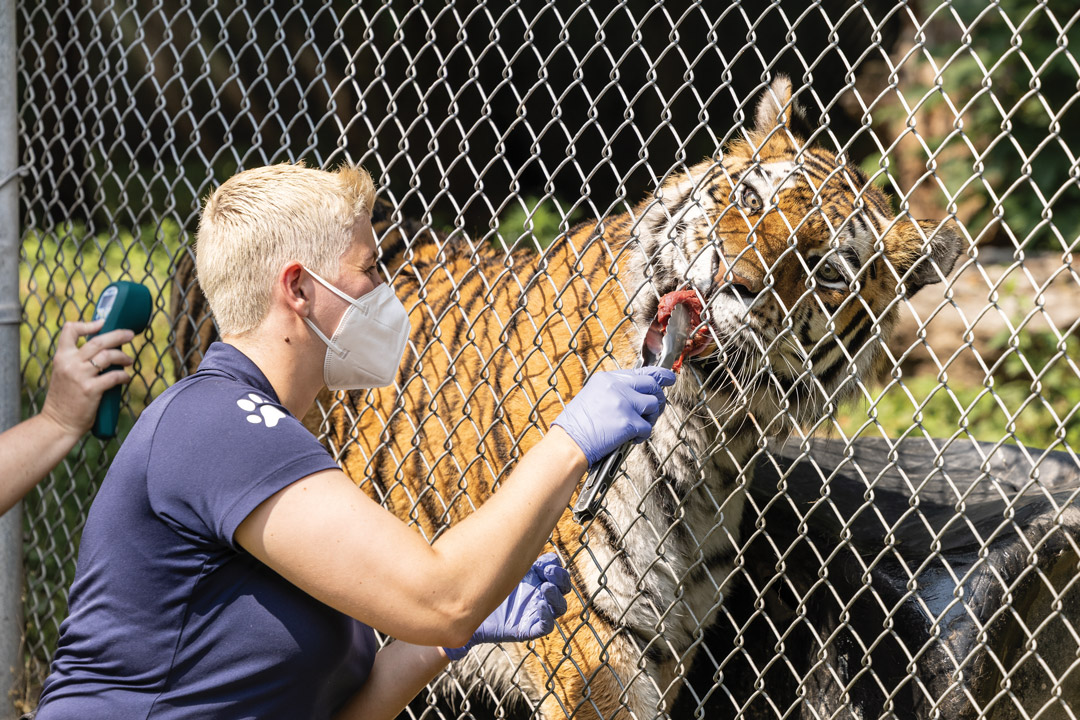
Big cats, like Katya the Amur tiger, are susceptible to COVID, just like humans. To keep them safe, caretakers wear masks to avoid spreading illness.
“Falling in love with the sea lions down in the Galapagos really made me want to pursue this path even more than I already had decided at that point,” said De Angelis.
Getting outside to the High Acres Nature Area with Professor Christy Tyler showed De Angelis that she didn’t want to be in a lab but wanted to spend hands-on time out in the field. Her specialized classes, like those learning about ornithology and invertebrates, helped provide familiarity with different species.
Outside of the classroom, De Angelis was involved in RIT’s student-run radio station WITR. De Angelis deejayed for WITR, became the programming director her senior year, and even continued to DJ after she graduated.
“It really helped develop my public speaking, which is a huge thing in the zoo world,” said De Angelis. “More and more, you’re finding you have to do public education and telling people about conservation and trying to get people to care. You have to make it meaningful.”
Her work with RIT has continued while in her role as zookeeper. Two years ago, she went to Madagascar with coworker Tom Snyder, director of programming and conservation action, and RIT Professor Tony Vodacek to conduct research that was then replicated at the zoo during the April 2024 solar eclipse.
Zookeeping is a competitive career with a lot of applicants for very few roles. For those interested in following De Angelis’s career path, her advice is simple.
“The biggest thing is to get your foot in the door, however you can.”