Student finds co-op success in the transportation industry
Jacob Brodeur secures a co-op by opening himself up to new, unexpected opportunities
Provided
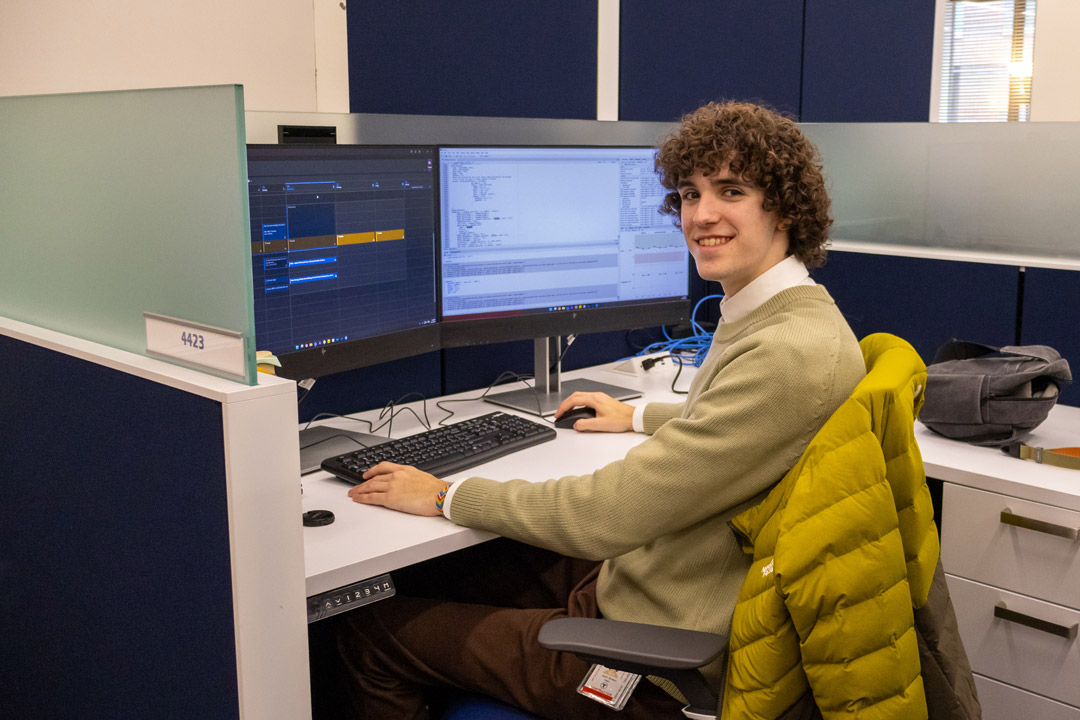
Jacob Brodeur said working for the Massachusetts Bay Transportation Authority was a dream opportunity. Since starting his co-op in January, some of his top co-op highlights include learning the programming language R and having his designed data visualizations published on the mass.gov website.
Jacob Brodeur has always been fascinated by the inner workings of public transportation and urban planning, but a career as a civil engineer or complex mathematician didn’t appeal to his interests. Before coming to RIT, Brodeur didn’t know what other opportunities were available to him in the urbanism industry.
To his surprise, the skills and experiential learning opportunities he gained by studying humanities, computing, and design offered a new path. By widening his search and taking a chance, the third-year student even landed his dream co-op with the Massachusetts Bay Transportation Authority (MBTA).
In January, Brodeur was hired by the MBTA as a graphic design, editorial, and communications intern for the Office of Performance Management and Innovation (OPMI), where he regularly collaborates with colleagues at both the MBTA and Massachusetts Department of Transportation (MassDOT). While his work is focused on data visualization, design, and communication, his projects have expanded beyond what his employers anticipated thanks to his varied, interdisciplinary skillset.
In what ways did your experiences at RIT prepare you for co-op success?
I would say the biggest one is learning how to work with people with completely different skill sets. In this role I'm working on teams with data analysts and statisticians, and I come from a design and computing background. Listening to what someone is saying, realizing you don’t fully understand it, and asking the right questions to get a better understanding is a skill that needs practice. Working with people from different backgrounds through my capstone project has helped a lot with that.
Beyond academics, my on-campus job has really allowed me to understand how the design process in a professional setting works. Having that experience before I broke out of an educational environment was definitely helpful.
How do the skills you gained through the humanities, computing, and design program set you apart as an employee?
Massachusetts Bay Transportation Authority
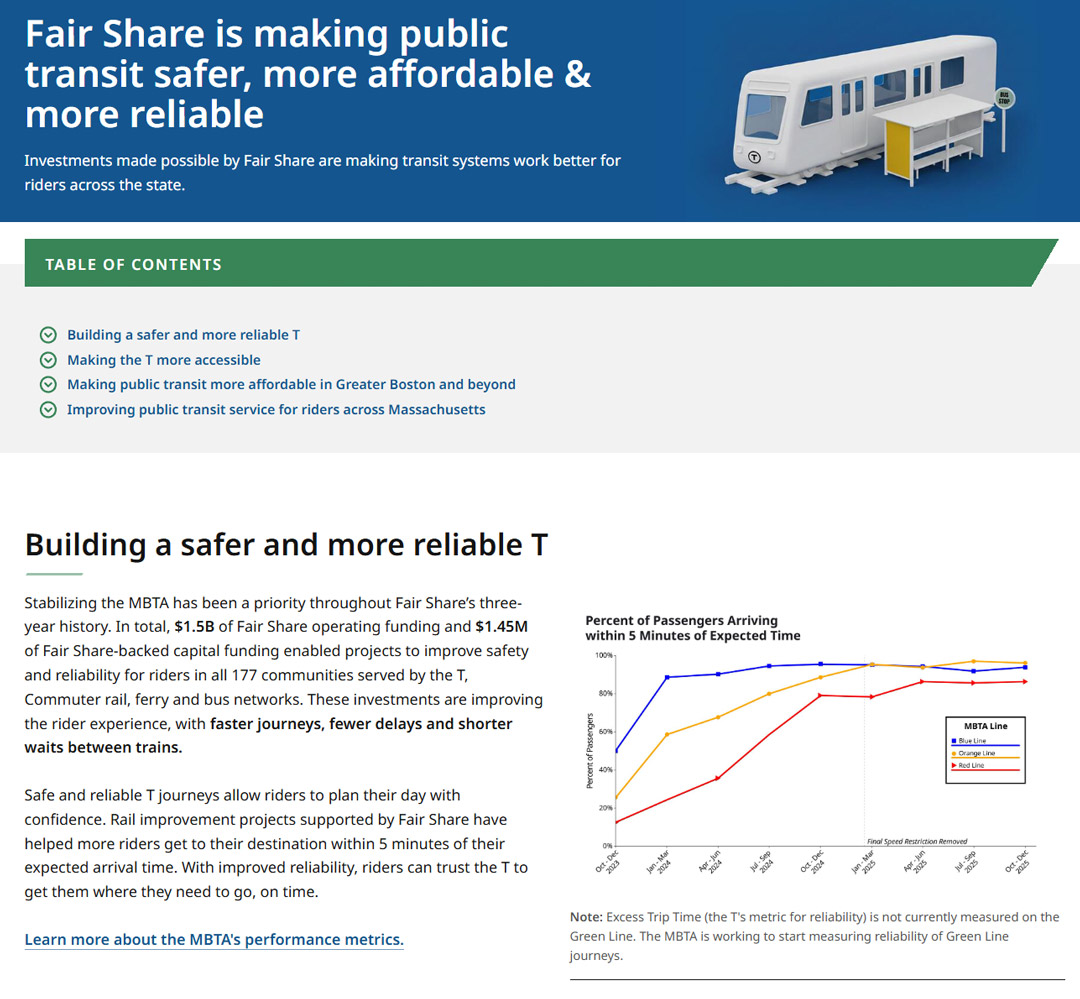
Above is one of Brodeur’s visualizations that was published on mass.gov. The graph intends to illustrate how additional funding gained through the Fair Share Amendment has made a positive impact on the MBTA’s services, such as faster travel times and less delays.
The office I work in is specifically focused on data and analytics for anything related to MBTA and MassDOT. I, of course, don't come from a data analyst or statistical background. They hired me as a graphic designer. But since I've started, they've slowly realized that, because of the background of my program, they can really throw me into many projects outside of what they would normally give someone in my position.
One of the things that surprised my supervisors the most was that I picked up R, which is a programming language for statistical visualizations, in like two or three days. So, on a couple of occasions, I’ve coded data visualization charts and graphs much more effectively than they ever expected.
For one project, my boss wanted me to make edits to a dataset in Illustrator after they exported it. Instead, I figured out how to do the edits they needed directly in the code. Now, when they run this script again next year, they won’t have to do all the manual styling in Illustrator again. I was able to do that because of my expertise in coding and computing, whereas a typical graphic design intern may not have those skills.
Were there any resources or mentors who helped prepare you for your co-op?
I go to my boss on campus, Lisa Monette, for career counseling and advice so much because she used to work in career services. My biggest hurdle when it came to applying for this position was the timing. When I saw it was for the spring semester I didn’t think I could do it because I had to do my capstone project and had on-campus employment commitments. When I was ready to give up on applying, she told me to go for it anyway because it was the exact type of position I always hoped to get. If I got an interview, that’s great and I could plan from there. But if I didn’t, at least I tried.
My program directors, Jessica Lieberman and Michael Frank, have also been super accommodating in helping me continue my education so I stay on track to graduate while also getting this amazing experience.
Outside of RIT, Professors Bettina Werner and Regitze Marianne Hess, who were my instructors during a study abroad semester at DIS in Copenhagen, Denmark, helped me understand the different support roles in urban planning, and greatly strengthened my understanding of and interest in urbanism principles that have helped me immensely in this professional setting.
What advice do you have for other students searching for a co-op or internship?
The best advice I received, and what ended up helping me get my first co-op, was applying through Career Connect. My boss on campus explained that I’d have a better chance applying through that because the companies posting there already know they want an RIT student. For those postings, you’re only competing with a handful of other RIT students for a position, rather than thousands of people that see a public posting on LinkedIn.
I’ve heard a lot of people say, ‘oh, well I can’t find anything for me,’ but I think sometimes people aren’t looking in the right way. The biggest thing I had to learn was not to limit myself by only using the keyword search. You should use the search filters for job types, like internships or co-op in my case, and then for desired major, select any major that’s related to your program, especially other majors that have overlap with your coursework and specialties. A lot of times, employers don’t know exactly what they want and you might surprise them.