NTID AlumniNews
Engineering alum develops problem-solving expertise to contribute to a sustainable future
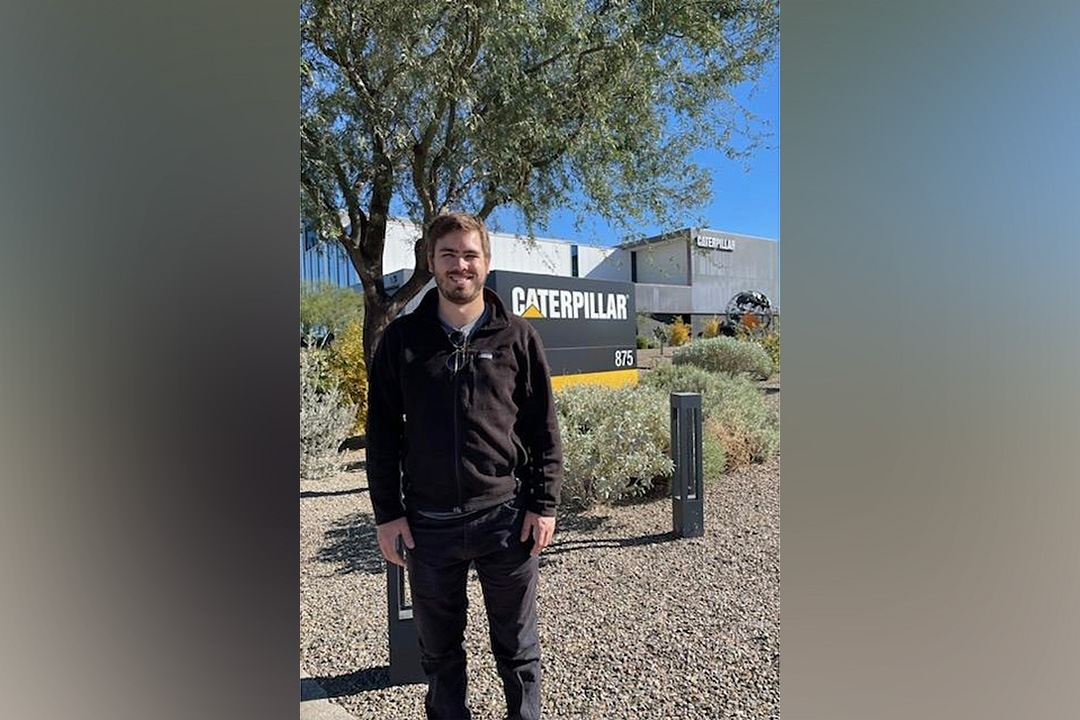
RIT/NTID alum Louis Demer ’22 (mechanical engineering technology) is an engineer with a passion for developing solutions for a sustainable future.
He discovered his interest in engineering through fixing cars, home electrical projects, woodshop works, and building robots. His ambition led him to enroll in RIT’s Electrical Mechanical Engineering Technology program, which focuses on applied design, control systems, and manufacturing of electrical, mechanical and mechatronic systems.
During his time as a student at RIT, he developed technical skills through practical coursework, including engineering communication, electrical engineering technology, and public speaking, to prepare him for a successful role in a competitive industry. In addition to his academic achievements, he completed two cooperative education (co-op) assignments with companies, including TIMET and Silk Road Medical.
After graduating from RIT in 2022, Demer began his career as a design engineer at Caterpillar, Inc. in Tucson, Arizona, where his responsibilities include designing and maintaining electrical systems that support the global mining industry and help customers build a better, more sustainable world. One of the most exciting parts of his role is traveling to different states and countries to see the impact of his works firsthand.
He attributes much of his success to his involvement with the RIT Baja SAE and his participation in the Pumpkin Chunkin Challenge to help him develop effective solutions to real-world challenges. Demer also actively participates in ADEPT (Abled and Disabled Employees Partnering Together) as part of Caterpillar’s Employment Resource Group that supports an inclusive workplace for employees with and without disabilities.
Can you tell me about your current role as a design engineer at Caterpillar, Inc.?
As a Design Engineer at Caterpillar, Inc., I design and maintain electrical systems for our 7495 Electric Rope Shovels (ERS)—some of the largest machines in the world—as well as our Hydraulic Mining Shovels (HMS). I lead schematic updates for newly sold machines and manage all quality events (AQEs) and design deviations. I also review and implement design changes based on feedback from suppliers, our manufacturing facilities, and customers in the field. Through this work, I collaborate across teams to continuously improve our electrical designs, support the manufacturing process, and help ensure our machines operate reliably in demanding environments.
Beyond my engineering responsibilities, I am also involved in Caterpillar's employee resource group ADEPT (Abled and Disabled Employees Partnering Together), where I lead the Workforce pillar. In this role, I partner with Disability: IN and our Human Resources department to identify and facilitate ways to improve recruiting, hiring, and employee support for people with and without disabilities. Through this work, I have also had the opportunity to attend the Disability: IN Global Conference and Expo in Las Vegas, Nevada, where I connected with other companies and disability advocates and learned about best practices from organizations across the country and around the world. I enjoy being able to contribute not only to the engineering work behind Caterpillar's machines, but also to building a more inclusive and supportive workplace.
Why did you want to become an engineer?
I’ve always been interested in machines. Working on cars, doing electrical projects around the house, spending time in our home garage and woodshop, and being part of my high school FIRST Robotics team - helping design, build, and troubleshoot the robot - all helped drive my interest in engineering. Since I enjoyed both mechanical and electrical engineering, I was really excited when I learned that RIT offered a program that incorporated both. That led me to pursue the Electrical Mechanical Engineering Technology program in the College of Engineering Technology.
How did your education or experience at RIT prepare you for a career in engineering?
My GD&T class, Engineering Communication and Tolerancing, taught me how to create engineering drawings, proofread them, identify potential errors, and become comfortable with the review and revision process. My public speaking class, along with the presentations I gave throughout my time at RIT, helped me more comfortable speaking in front of colleagues during meetings and presenting my work in design reviews. My electrical engineering and circuits classes (EEET), along with the associated labs, taught me about circuits, wiring, power, electrical drawings, and electrical safety. All of these concepts apply directly to my daily work as an electrical design engineer working on some of the biggest machines in the world.
The Pumpkin Chucking Challenge from the Introductory Mechanical Engineering course was instrumental to my success at Caterpillar. It taught me a lot about teamwork, project management, and adapting a design to solve real-world engineering problems.
RIT also required me to complete two co-ops, which gave me valuable professional experience before graduating. My first was an electrical-mechanical engineering co-op with TIMET, a titanium production company in Vallejo, California. The following year, I completed a Research and Development Engineering co-op with Silk Road Medical in Sunnyvale, California. Both co-ops gave me real-world engineering experience to add to my resume and, just as importantly, firsthand experience working in professional engineering environments.
Can you share any of the design engineering projects you have worked on that helped solve the company’s significant challenges or improve customers’ lives?
I served as the electrical design lead on a new air system for our Electric Rope Shovel. The system supports the machine's pneumatic functions, which play an important role in the operation of other machine systems, including the brakes. As part of the project, I optimized the electrical wiring harness design, helping reduce costs while supporting the overall machine design.
In addition to larger projects, a significant part of my day-to-day work involves processing AQEs and design deviations related to electrical components on Electric Rope Shovels. This work involves collaborating with suppliers and cross-functional teams, reviewing feedback from across the product lifecycle, and updating electrical drawings and product designs to support continuous improvement. Through these efforts, I help refine our designs, improve product quality, and support customers who depend on this equipment to operate reliably in demanding environments.
What has been your exciting part of your role?
Travel has been one of the most exciting parts of my role. Whether visiting our demonstration, testing, and proving grounds in Green Valley, Arizona, to see and work on our machines, traveling to our manufacturing facility in South Milwaukee, Wisconsin, to see my designs come together in person, or traveling to the field to witness complete Electric Rope Shovel builds, I get to see the real-world impact of my work.
One memorable experience was traveling to Nacozari de García, Sonora, Mexico, to see our machines come together in the field. Caterpillar's machines operate all over the world, from the oil sands of Canada and the Australian Outback to the mountains of Chile and Peru, the Sonoran Desert of Mexico, and the subarctic of Sweden.
What is a typical workday like at Caterpillar, Inc.?
My typical workday at Caterpillar starts with an early morning meeting at home, usually between 6:30 and 7:30 a.m., with our international team members. After my morning meeting, I bike into the office or take advantage of the fare-free public transit options in Tucson, depending on the day.
In the office, I check emails and review electrical drawings for issues related to production, manufacturing, or obsolete parts. I mark up electrical schematic drawings for new machine builds. Throughout the day, I attend project and team meetings and collaborate with colleagues at our manufacturing facilities to support the assembly process and ensure drawings accurately reflect the intended design. Frequently, I attend lunch-and-learn sessions on Caterpillar business practices or presentations from other design teams to learn more about different areas of the business.
Toward the end of the day, I typically finish reviewing and approving drawings, responding to emails, addressing any outstanding design issues, or attending a final team meeting. No two days are the same, which is one of the things I enjoy about the role. There's a mix of independent design work, problem-solving, and collaboration with people across different teams and locations.
What accomplishments are you most proud of?
I am proud of helping reduce wiring harness costs through the electrical design of a new air system for our Electric Rope Shovel. This project allowed me to take on an electrical design lead role and identify opportunities to optimize the design while meeting the machine's requirements.
I am also proud of my work on a Continuous Process Improvement (CPI) project developing electrical design solutions to improve machine reliability and support customers in the field. This work has involved identifying root causes, developing and designing new electrical systems, selecting appropriate components, and preparing installation documentation to support field validation testing. I find it rewarding to work through the engineering process from understanding a challenge to developing and validating a practical solution.
Were you involved in any clubs or organizations that helped shape your career path and develop your engineering skills?
My time with the RIT Baja SAE team helped shape my engineering skills by giving me hands-on experience outside the classroom. I helped manufacture parts for our car using mills and lathes, built and tested electrical circuits to monitor the car's systems during the design and testing phases, and helped maintain our test track and make course changes. These experiences allowed me to work on both the mechanical and electrical sides of engineering while collaborating with teammates to build, test, and improve our vehicle. Getting hands-on experience troubleshooting systems and seeing how our designs performed in real-world testing helped prepare me for my career as a design engineer.
What advice would you give current or prospective students who aspire to become an engineer?
Don’t be afraid to ask questions. Engineering is a collaborative field, and asking questions is one of the best ways to learn, improve, and become a better engineer. There's always something new to learn, and you'll work with colleagues who have decades of experience and are excited to help you learn and grow.
Lastly, what is your favorite memory of college experience when you were a student at RIT?
Going to hockey games with friends, sitting with the Corner Crew, and chanting and cheering on the team was always a great time and a welcome break from the stress and grind of my studies. Despite being in the middle of the desert, Tucson also has a hockey team, the Tucson Roadrunners! Caterpillar often gives tickets to games.