NTID AlumniNews
RIT/NTID alum credits interpreting education for opportunities in management and leadership
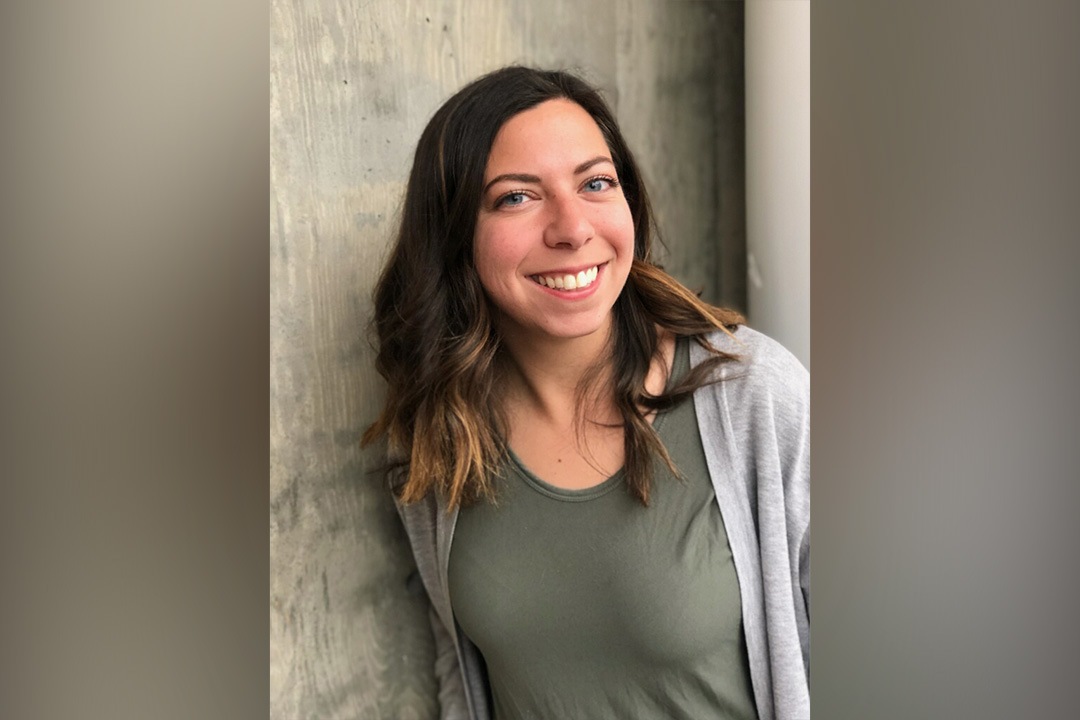
RIT/NTID alum Rebecca DeSantis ’10 credits NTID’s American Sign Language and Interpretating Education program for helping her build the confidence, foundation, and skills that prepared her for a career in interpreting.
While taking ASL classes to develop her interpreting skills, she also discovered a passion for management and leadership. Upon graduating, DeSantis relocated to Albuquerque, New Mexico, where she serves as an associate director for RGC Access and coordinators for the Bridge-to-Work program to assist new interpreters with training and mentoring programs.
DeSantis earned a Qualified Mental Health Interpreter (QMHI) certificate and is a nationally certified community interpreter with a focus in mental health interpreting. She visits RIT/NTID to represent her company at the annual ASLIE Career Fair to recruit interpreting students for internship and employment opportunities.
Why did you choose RIT/NTID to pursue your interpreting degree?
Once I made up my mind to become an interpreter, there was very little question about which program to attend. I visited some other colleges, but nothing compared to the rich and unique experience that RIT/NTID could offer in terms of interacting with the Deaf community.
How did the interpreting program at RIT/NTID help prepare you for your career as an interpreter?
The quality of the interpreting program speaks for itself. Graduates of RIT are equipped with the tools and resources they need to be successful in the field. I truly value my education and the emphasis they placed on reflective practice to ensure our skills wouldn’t simply plateau after graduation. They gave me the foundation I needed not only to start a career in interpreting, but also to feel confident moving out of state to a brand-new community and begin my journey in unfamiliar territory.
One meaningful experience jumps out to me. Toward the end of my time at RIT, I became concerned that interpreting might not be the right profession for me. I had a passion for leadership and organizational management, and I was afraid the field of interpreting would be too narrow to encompass all of my interests. My professor at the time, Kevin Williams, who has since retired, invited me into his office for a casual conversation about my future career goals. He reassured me that the field of interpreting could provide opportunities in leadership, mentoring, business management, research, and more. He gave me the confidence to continue in the direction of interpreting.
After graduating, I worked quickly to become nationally certified. From there, I earned my QMHI credential, and when an opportunity arose to work with a local New Mexico nonprofit interpreting agency, RGC Access, providing mentoring, I eagerly accepted. All of my passions were beginning to come together. The missing piece was organizational leadership, but after remaining with RGC Access, I eventually became the Associate Director, which is my current role. Looking back, I can say without a doubt that the support I received from faculty and mentors at RIT/NTID was a catalyst for my career.
What does a typical work day like for you?
Life as an associate director of a non-profit agency is never slow! I help a lot with the day-to-day operation: onboarding and screening new interpreters, scheduling interpreters on assignments, working with businesses to help them understand their obligation to provide access services, and interfacing with the public about what interpreters do. One thing about RGC Access that makes it stand out among other companies is that all of our staff are connected to the field in some capacity. Both our executive director and I are certified interpreters, we have full time-staff, and a billing specialist who is Deaf. We all come to the table knowing the interpreting profession from the inside out.
Through my day, my administrative responsibilities get interrupted with texts from interpreters, and I enjoy being able to help them navigate their assignments. Sometimes the texts are simple: client didn’t show, do you need me somewhere else? Sometimes they are more complicated, and they are asking about an ethical issue that came up.
I also spend a good portion of my time on the phone debriefing with interpreters. They may call me because their assignment was less than successful, they have information that will be helpful to the next interpreter we send, or they felt a job went amazingly well, and they want to share their success. I love that as the associate director, I’m able to have an authentic relationship with our interpreters and the Deaf community to ensure access! I never want to seem too far removed from the community. Again, that’s something that RIT modeled for me. The professors weren’t just people on a pedestal that couldn’t be accessed outside the classroom; they were all truly in touch with their students. I value that and try to apply it in my work as the associate director.
Tell us more about the Bridge to Work program and your role in it.
The Bridge-to-Work program is designed to help new interpreting graduates establish themselves as community interpreters in New Mexico. We provide workshops, group mentoring, case conferencing, and one-on-one mentorship to help individuals continue developing their interpreting skills. It's a great blend of working in the field, collaborating with colleagues through case conferencing, and completing the "homework" necessary to keep growing professionally.
It's an interesting challenge in New Mexico, and I suspect other communities experience it as well. We desperately need more interpreters, but not just any interpreters. We need qualified interpreters who can work successfully and independently. That doesn't happen overnight. New interpreters who don't have guidance often struggle to gain a foothold in the field. Unfortunately, that can lead to working in isolation and missing opportunities for growth, and I believe that contributes to a retention problem in our profession. The Bridge-to-Work program helps mitigate that issue by providing safe job placement, mentorship, and an environment where interpreters can grow. Though most of our interns come from within New Mexico, last year we were excited to welcome a graduate from RIT!
What do you enjoy most about your work as an interpreter?
Although my job titles have shifted over time, I’m still an interpreter, and my heart is the community! I haven’t tried other types of work to give it a fair comparison, but I just know community interpreting is for me. Interpreting is a people's profession. It’s a service profession, too. What I enjoy most is being able to serve the community and create accessible communication.
What accomplishments are you most proud of?
I’m proud of many things throughout my professional journey: helping to build a company with heart in a time when people worry about AI taking over, setting up a mentoring program to help our next generation of interpreters, continuing to gain new credentials and work in highly specialized areas, but at the end of the day, what I am most proud of is seeing past Bridge-to-Work interns find their way in this field! Whether it’s as simple as seeing them develop their sills to the point of working in more complex settings, or passing the CASLI performance exam, every one of those achievements fills me with happiness for them!
What advice would you give current or prospective students who aspire to become an ASL interpreter?
This field will take you to remarkable places if you let it. If you're feeling lost on where to start, find a community and begin establishing yourself there. If there isn't a formal mentoring program available, I strongly encourage new interpreters to build informal mentorship relationships with experienced colleagues and members of the Deaf community.
Grit and integrity will take you far in this profession. And if, like me, you ever worry that interpreting is "too narrow" to fit all of your passions, think outside the box. Perhaps you'll end up running an agency, developing a mentorship program, conducting research, or pursuing leadership opportunities. There are so many possibilities in this field beyond "just" interpreting.
Is there anything you’d like to add?
I remain incredibly grateful for the foundation RIT/NTID provided me. The technical skills are important, but what has stayed with me most is the sense of community and the relationships I built there. Those experiences continue to influence how I approach interpreting, mentoring, and leadership today.