Electrode Materials Design Strategies for Sustainable Electrochemical Technologies in Water Applications and Energy Storage
This project develops a unified materials strategy for two electrochemical technologies that share the same operating principle: ion storage and transport at engineered interfaces.
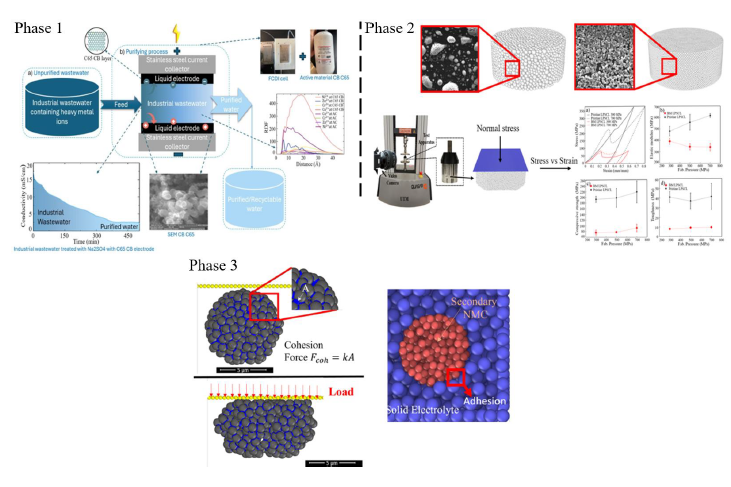
This project develops a unified materials strategy for two electrochemical technologies that share the same operating principle: ion storage and transport at engineered interfaces. These technologies are all-solid-state batteries (ASSBs) and flow-electrode capacitive deionization (FCDI) for water purification. This project focuses on characterizing the mechanical properties of the cathode components: conductive carbon, solid electrolyte, and active material. Phase 1 evaluates a battery-grade conductive carbon, Super C65, typically used to build electronic pathways in lithium-ion cathodes. We test whether its key attributes, high electrical conductivity, nanometric particle size, high specific surface area, and high purity, also enhance ion removal in FCDI. Benchmarking Super C65 against activated carbon under identical conditions establishes how carbon selection influences transport, charge storage, and adsorption behavior in FCDI. Phase 2 focuses on the sulfide solid-electrolyte Lithium Phosphorus Sulfur Chloride (LPSCl). Without altering chemistry, we control particle-size distribution to adjust effective elasticity and packing using milling. Mechanical measurements and cell tests link microstructure and contact loss to electrochemical metrics, defining a processing window that improves ASSB durability. Phase 3 addresses fracture stresses and interfacial bonding between particles in the active material in ASSBs. We quantify fracture stresses at the active material interfaces using nanoindentation operated in a dry, inert atmosphere, and relate measured bond energies and failure modes to cycling performance. Together, these studies provide transferable design rules that connect structure and processing tomechanics and performance, showing how battery-qualified materials can strengthen both energy-storage and water-purification technologies.
More Featured Profiles and Work
Kareem Tawil

Krzysztof K. Jarosz