Environmental Sustainability, Health and Safety Bachelor of Science Degree

Lead sustainability initiatives and promote safer, healthier, and more resilient workplaces and communities with RIT’s ESHS degree.
$72.5K
Median First-Year Salary of RIT Graduates from this Environmental Sustainability, Health and Safety BS degree
#4
Best Engineering Job: “Environmental Engineer”
Overview for Environmental Sustainability, Health and Safety BS
Why Study Environmental Sustainability, Health and Safety at RIT
One Degree, Double the Impact: Unlike most programs that separate these critical fields, RIT’s ESHS degree uniquely combines environmental sustainability with environmental and occupational health and safety, preparing you to lead comprehensive initiatives that address today's most pressing challenges and make a positive difference for people and the planet.
Gain Real-World Experience: Four semesters of cooperative education provide you with hands-on, full-time, paid work experience in the field of environmental sustainability, health and safety, with opportunities for undergraduate research and Study Abroad.
Pursue an Accelerated Degree: Earn two degrees in less time with an accelerated bachelor’s/master's option, where you can earn a BS in environmental sustainability, health and safety and an MS in environmental health and safety management. Or, add an MBA to your bachelor’s degree after your first year of study.
Strong Career Paths: Recent graduates are employed at The EPA, Wegmans, Cornell University, Corning Incorporated, John Deere, Tesla, Pratt & Whitney, The Walt Disney Company, and more.
STEM-OPT Visa Eligible: The STEM Optional Practical Training (OPT) program allows full-time, on-campus international students on an F-1 student visa to stay and work in the U.S. for up to three years after graduation.
What is Environmental Sustainability, Health and Safety?
The sustainability challenges we face as a society are multi-dimensional and complex, and solutions require a multidisciplinary approach. Environmental sustainability, health, and safety is an interdisciplinary field designed to address these complex challenges, considering environmental as well as social and economic dimensions of sustainability. It involves sustainable development that protects people and the planet - now, and for future generations.
RIT’s Environmental Sustainability, Health and Safety Bachelor’s Degree
RIT’s environmental sustainability, health and safety degree (ESHS) prepares you to tackle some of the most pressing challenges of our time—climate change, public health and environmental protection. This interdisciplinary program combines a strong foundation in applied science and math with hands-on learning in sustainability, environmental and occupational health and safety, systems thinking and regulatory policy.
You’ll explore how human activities affect both the environment and public health—and learn how to design real-world solutions that make workplaces safer, communities healthier and industries more sustainable. Whether you're interested in working in industry, government, consulting, or research, this degree opens the door to in-demand careers where you’ll play a critical role in shaping a safer, more sustainable future.
Graduates of the ESHS program are highly sought after by employers who value their technical expertise and commitment to responsible innovation. Join a growing network of professionals helping organizations become more sustainable and socially responsible stewards of the products they make and the services they deliver.
Environmental Sustainability, Health and Safety Courses
The bachelor's degree in environmental sustainability, health and safety offers a comprehensive curriculum that pairs courses in environmental sustainability and environmental and occupational health and safety to provide you with a solid foundation in environmental and social dimensions of sustainability. With professional electives built into the program, you can tailor your course work around the topics and career paths that interest you most.
Furthering Your Education in Environmental Health and Safety
RIT’s Combined Accelerated Bachelor’s/Master’s Degrees enable you to earn both a bachelor’s and a master’s degree in five years of study, giving you a competitive advantage.
- Environmental Sustainability, Health and Safety BS/Environmental Health and Safety Management MS: In this combined accelerated dual degree, the BS degree in environmental sustainability, health and safety provides you with knowledge and experience to make organizations more sustainable, more environmentally friendly, and safer. Then, in the environmental health and safety management master’s degree, you learn how to develop and implement an environmental, health, and safety management system, which enables companies to continually move towards sustainability and safety goals while conforming to national and international standards. You’ll learn to identify and manage risk, and to formulate effective strategies for integrating EHS into the business government agency or organization to drive EHS and sustainability performance.
- +1 MBA: Students who enroll in a qualifying undergraduate degree have the opportunity to enroll in the +1 MBA program by adding an MBA to their bachelor’s degree after their first year of study.
In addition, many students have completed the environmental sustainability, health and safety BS degree have advanced their education with a graduate degree from other top-tier universities including Massachusetts Institute of Technology, University of Pennsylvania, and Yale University.
-

Meet Us on Campus
Learn about academics, co-op and internships, financial aid, and more at one of our on-campus open houses.
October 12 | October 24 | November 14
-

Apply for Fall 2027
Early Decision I and Early Action deadlines are November 1.
Careers and Cooperative Education
Typical Job Titles
| Associate Environmental Engineer | Chemistry Lab Supervisor | Environmental Health and Safety Specialist |
| Environmental Health and Safety Coordinator | Environmental Health Specialist | Environmental Scientist |
| Hazmat Specialist | Industrial Hygienist | Lecturer |
| Risk Control Specialist | Senior HSE Representative | Safety Engineer |
| Senior Safety Officer |
Industries
Cooperative Education
Hands-On Experience = Real-World Skills
In our environmental health and safety degree you will complete four semesters of cooperative education. This will allow you to gain full-time, paid, hands-on experience in industry, government agencies, or environmental consulting companies as you work alongside professionals to learn how environmental sustainability practices and occupational health and safety policies directly affect the way organizations produce products, manage their facilities, balance resources, reduce illness and injury, and create safer work environments.
With the skills you gain both in and out of the classroom, you’ll be in demand as a defender of environmentally sustainable processes and a champion of occupational health and safety policies.
Featured Work and Profiles
-

Zoe Gray finds confidence, connection, and purpose across disciplines at RIT
Zoe Gray is reflecting on a college experience defined by ambition, curiosity, and a willingness to embrace every opportunity that came her way.
Read More about Zoe Gray finds confidence, connection, and purpose across disciplines at RIT -
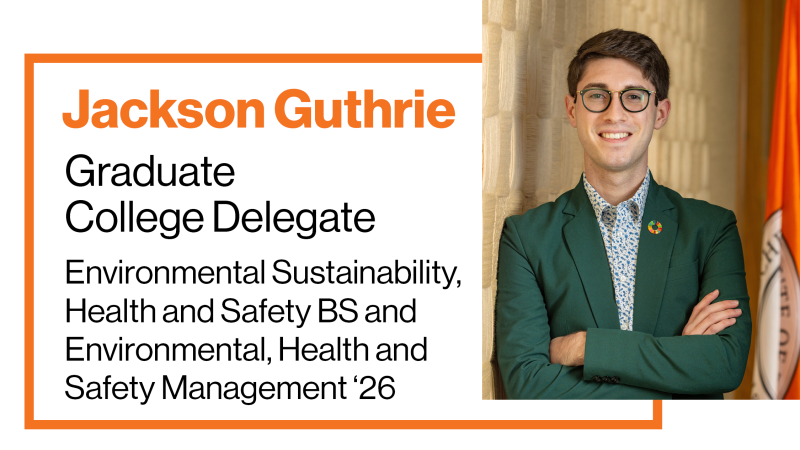
'26 Graduate College Delegate and Convocation Speaker: Jackson Guthrie
Jackson Guthrie ’26 After graduation, Jackson will continue in his current, full-time role as a Project Manager for GreenSpark Solar.
Read More about '26 Graduate College Delegate and Convocation Speaker: Jackson Guthrie -
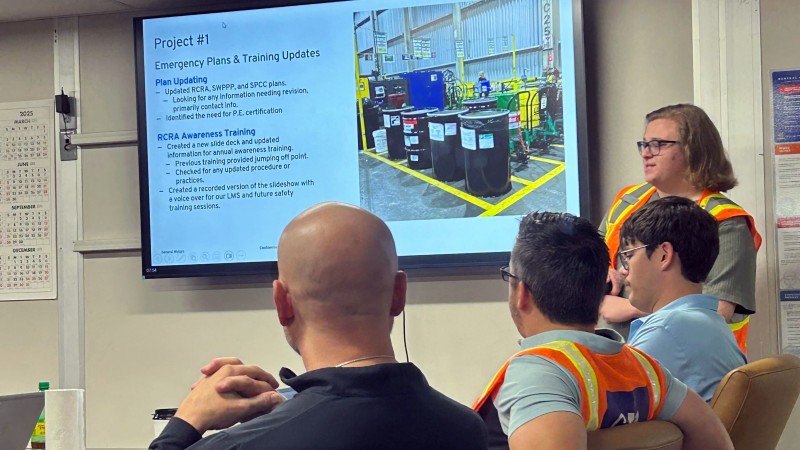
Protecting People and Planet: ESHS Student Drives Real-World Change at General Motors (GM) on Environmental Engineering Co-op
Matthew Huth Motivated by living through environmental tragedies like Hurricane Katrina, Matthew translated RIT's practical skills into a high-impact co-op, implementing a lasting recycling program at General...
Read More about Protecting People and Planet: ESHS Student Drives Real-World Change at General Motors (GM) on Environmental Engineering Co-op -

Full-Time Before Graduation: How RIT’s ESHS BS/MS Launched a Safety Specialist Career
Emersen Bartsch Learn how graduating student Emersen secured a full-time Safety Specialist role with a major electrical contractor in Colorado before completing their degree.
Read More about Full-Time Before Graduation: How RIT’s ESHS BS/MS Launched a Safety Specialist Career -

ESHS Student finds surprising fit with Electric Vehicle Team
Janet, a third-year environmental sustainability, health and safety and economics major from Rockville, MD., is the team manager of the RIT Electric Vehicle Team, a collegiate electric motorcycle...
Read More about ESHS Student finds surprising fit with Electric Vehicle Team -

First-Gen to Fortune 100: Alum's Journey to Tesla and New Balance
Discover how first-gen student Leah's journey from a dairy farm to roles as Regional Safety Manager for Tesla’s Energy division and EHS Engineer for New Balance was made possible by her passion, RIT's...
Read More about First-Gen to Fortune 100: Alum's Journey to Tesla and New Balance
Curriculum for 2026-2027 for Environmental Sustainability, Health and Safety BS
Current Students: See Curriculum Requirements
Admissions and Financial Aid
This program is STEM-OPT Visa Eligible when studying on campus and full time.
First-Year Admission
First-year applicants are expected to demonstrate a strong academic background that includes:
- 4 years of English
- 3 years of social studies and/or history
- 3 years of math is required and must include algebra, geometry, and algebra 2/trigonometry. Pre-calculus is preferred.
- 2-3 years of science. Chemistry or physics is required and biology is recommended.
- Technology electives are preferred.
Transfer Admission
Transfer applicants should meet these minimum degree-specific requirements:
- A minimum of college algebra is required. Pre-calculus or calculus is preferred.
- Chemistry or physics is required.
Financial Aid and Scholarships
100% of all incoming first-year and transfer students receive aid.
RIT’s personalized and comprehensive financial aid program includes scholarships, grants, loans, and campus employment programs. When all these are put to work, your actual cost may be much lower than the published estimated cost of attendance.
Learn more about financial aid and scholarships


Resources
Access Resources for students including academic advisors, student clubs and organizations, documents, technical information and support, and software help.
Related News
-
February 17, 2025

Engineering technology faculty addressing green skills shortage in engineering education through new grant
Integrating the development of eco-friendly practices with social and economic facets of sustainability, could further transform engineering education by equipping future engineers with the skill set required for the profession today.
-
December 2, 2024

RIT student finds surprising fit with Electric Vehicle Team
Janet Hackman, a third-year economics and environmental sustainability, health and safety major from Rockville, Md., is the team manager of the RIT Electric Vehicle Team, a collegiate electric motorcycle racing team founded in 2012.
-
February 13, 2024

RIT eco-friendly initiative reimplements packaged water policy starting April 1
RIT is reimplementing its policy against the use of packaged water, beginning April 1, when university funds may no longer be used to purchase still, unflavored, or packaged water. The policy applies to all single-serve water regardless of container material, size, event type, and method of purchase.