Business simulation helps students find their footing
Saunders College team finishes second in global business simulation
Provided
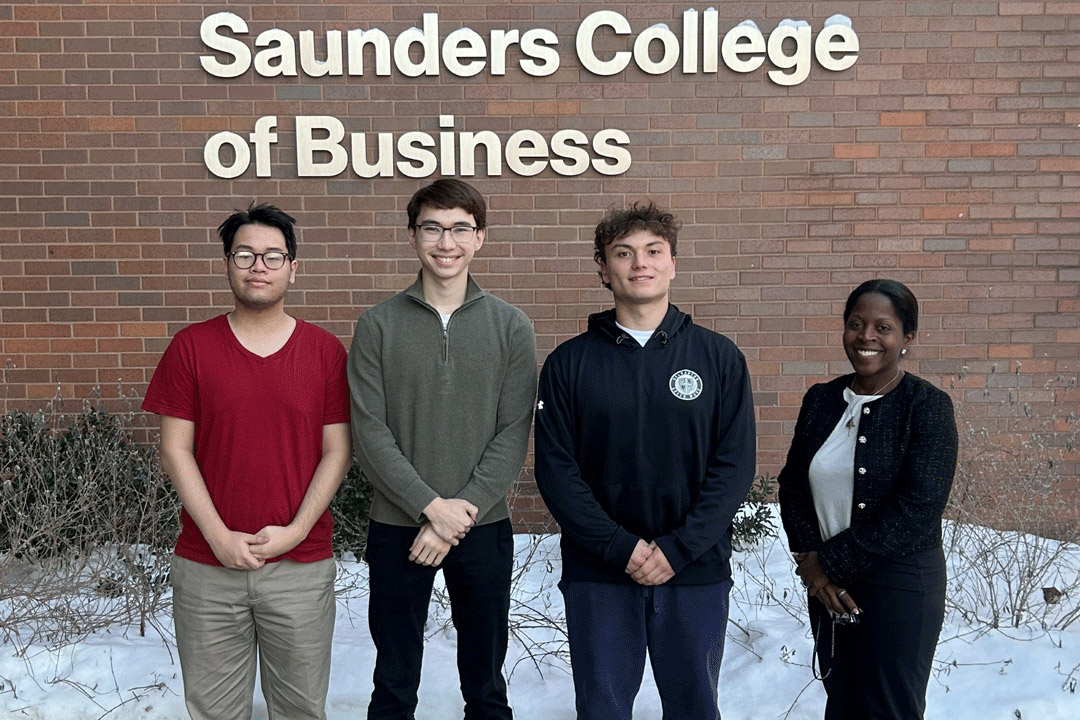
From left, Alex Muneath, Trey Reedy, and Phillip Minardo with professor Nikisha Alcindor after their team, which also included Mika Millard, not pictured, earned second place in the Smartsims MikesBikes World Championships business simulation.
When first-year student Phillip Minardo came to RIT, business wasn't part of his original plan—until a single class at Saunders College of Business changed his mindset by mimicking a real-world workplace experience.
“I joined a business course that included a simulation just to see how I liked it,” Minardo said. “And I actually would say that the simulation was a huge part in me switching to finance.”
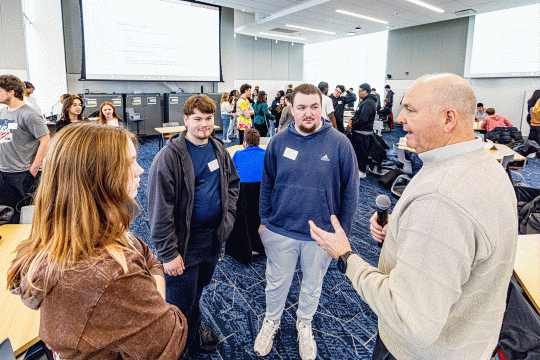
Business 1T: An Introduction to Business is designed to teach students of all majors the fundamentals of running a business. Nikisha Alcindor, a lecturer in the business management department, included a business simulation called MikesBikes into her curriculum with a specific goal of merging classroom theory into real-world practice.
“It bridges the gap between our lectures and the theory that students are learning,” Alcindor said. “It makes them put running a business into practice, by learning about things like team dynamics, all the way down to selecting how to allocate your funds to create value.”
Beyond the business concepts, Alcindor designed the course to put students in situations they couldn't fully prepare for, which included working closely with people they'd never met before.
“I wanted them to have the experience of being in an atmosphere where you don't know anyone, you have to get along,” Alcindor said. "How do you deal with that?"
Third-year student Alex Muneath, fourth-year student Trey Reedy, and second-year student Mika Millard joined Minardo in the class and teamed up to finish second in Smartsims’ MikesBikes World Champs simulation, using their business knowledge to compete against 86 teams from 20 universities across the world.
Alcindor grouped students randomly, deliberately separating anyone she noticed had already become friends. Millard joined midway through the semester, stepping into a group that had already begun to find its footing.
“None of us knew each other,” Muneath said. “But over time we just kind of grew closer over all the meetings and the MikesBikes simulations.”
That chemistry, Minardo said, became one of their biggest advantages.
“When we had differing ideas, it made it really easy to settle them and come to a conclusion without being hostile,” Minardo said.
The global competition ran over several weeks in late December and January, with the team spending much of their winter break on Zoom calls, making decisions for a virtual bike company. They held first place for most of the tournament before being edged out in the final rounds.
“They did something we didn't,” Muneath said of the result. “But out of 86 teams, we'll take it.”
Millard, who is a game design and development student, said confidence was the biggest benefit from this class. Reedy and Muneath switched majors to management information systems and supply chain management, respectively, before the class. They noted that this experience solidified their choices.
“You're able to make decisions that actually affect something,” Reedy said. “It's really nice to see what you enjoy doing and whether you enjoy managing this type of thing or not.”
For Alcindor, watching her students compete on a world stage was exactly the point.
“It makes me feel super happy, and it’s why I do what I do,” she said. “Seeing that they not only learned, but that they’re able to apply what I taught them into real-life situations is super encouraging.”