James Watters to retire from RIT June 30

James Watters, senior vice president for Finance and Administration and RIT treasurer, will retire June 30.
Since 1994, James Watters has served RIT as a member of the Finance and Administration team, including over 20 years as senior vice president for Finance and Administration and treasurer.
Watters, who will retire on June 30, has been an adviser to four RIT presidents and the Board of Trustees, and has managed the university’s $1.2 billion annual operating budget, $1.5 billion endowment, and $337 million capital budget. His vision was instrumental in RIT’s global expansion, guiding the development and business operations of campuses in Dubai, Croatia, and Kosovo. His dedication to the university’s mission has earned him honors, including the Four Presidents Distinguished Public Service Award and the Isaac L. Jordan Sr. Faculty and Staff Award for contributions to enhance access, engagement, and success.
You started your higher education career as a commissioned police officer in public safety. Talk about your pivot to finance.
James H. Watters Professorship
In recognition of Watters’ impact on RIT throughout his 30-plus year career, the James H. Watters Professorship in the Saunders College of Business has been endowed, led by a fundraising effort by RIT Trustee Ron Ricotta. The Watters Professorship will attract and retain exceptional faculty, advance innovative research, and prepare students to lead with integrity in a rapidly evolving economy.
That job as an officer enabled me to earn my master’s degree and my Ph.D., and it instilled the ability to deliver rational decision making in the face of high impact and stressful situations. The path I was following in graduate school to enter the business side of higher education was influenced by my mentor at the University of Pittsburgh who was the senior vice president of finance and business. He convinced me that I could fulfill my passion for finance in a major university environment. Working in investments, public debt financing, real estate development, business operating platforms, and insurance company operations were all part of the opportunities I was given. The day after I defended my dissertation, I was offered a job working in university finance.
What piqued your interest in RIT and what has kept you here for more than 30 years?
I was representing the University of Pittsburgh at a board meeting in Bermuda where several universities were gathered. A conversation with Albert Simone, who was RIT president at the time, laid out a growth plan for the university that promised me the ability to use my experience to help RIT grow and prosper.

Watters, right, talks with college namesake B. Thomas Golisano at the unveiling of the B. Thomas Golisano Collection in the RIT Archives in 2017.
The trustees were very supportive when I proposed a new model for financing to support student enrollment growth. The trustees supported the ideas I had to build University Commons and Institute Hall and develop chemical engineering and biomedical engineering degrees, which had been modeled for financial performance. This was all occurring at the height of the 2008-2009 recession. Just about every other university halted their construction projects and were conservative in their spending. I had the idea that the cost savings on labor and building materials would more than offset the marginal interest rate, yielding success in these crucial areas of need.
Being able to execute ideas, have the support of the board and the president, and work with high-performing Finance and Administration colleagues was a situation of rare opportunity that I have recognized and have greatly appreciated. I am privileged to have been given this chance to make my small contributions to the university.
In your opinion, what are some of the most notable ways that RIT has changed?
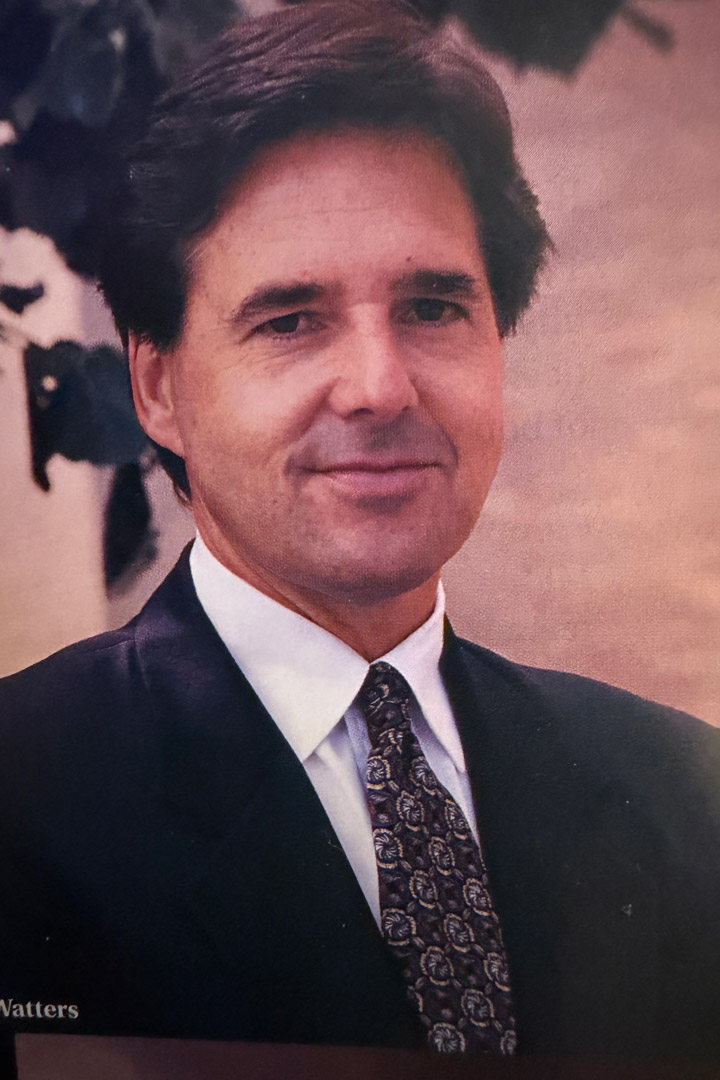
In 1997, Watters was announced as RIT’s vice president for finance and administration and treasurer.
Increasing the research profile of the university has been a major pillar in each strategic plan. Last year, awards to the university exceeded $100 million for the first time in our history. It is remarkable growth. The university is now in the top 100 of prestigious universities and colleges in the United States. This is a remarkable ascension for RIT. We now have campuses throughout Europe and in the Middle East. This global footprint is certainly something I would never have imagined when I was first recruited to RIT. We designed, constructed, and financed 3,000,000 square feet of academic research, athletic, and residential facilities while softening, but still honoring, the original design of the campus. This is almost half of the existing square footage we now enjoy.
Higher education continues to change with the times, and it isn't without its strengths and challenges. From a financial perspective, what can RIT do to remain fiscally strong, especially as the economy fluctuates?

In May, Watters, right, met Dubai Global Scholars. Watters has been instrumental in helping to expand RIT’s international portfolio with campuses in Kosovo, Croatia, and Dubai.
Universities have a remarkable resilience. This is not to say that the higher education sector will not undergo significant challenges and change in the future; all enterprises do. Its mission of educating future leaders, scientists, and humanitarians is a noble enterprise that must be sustained. There will be consolidation in the industry, and I suspect it will accelerate over the coming years. RIT, as it has always done, must similarly adapt to the challenges and maintain fiscal responsibility to carry out its mission. The entrepreneurial history of RIT will play a great role in adapting programs, creating leaner administrative structures, and finding new markets.


