Kate Gleason College of Engineering Welcomes New Faculty
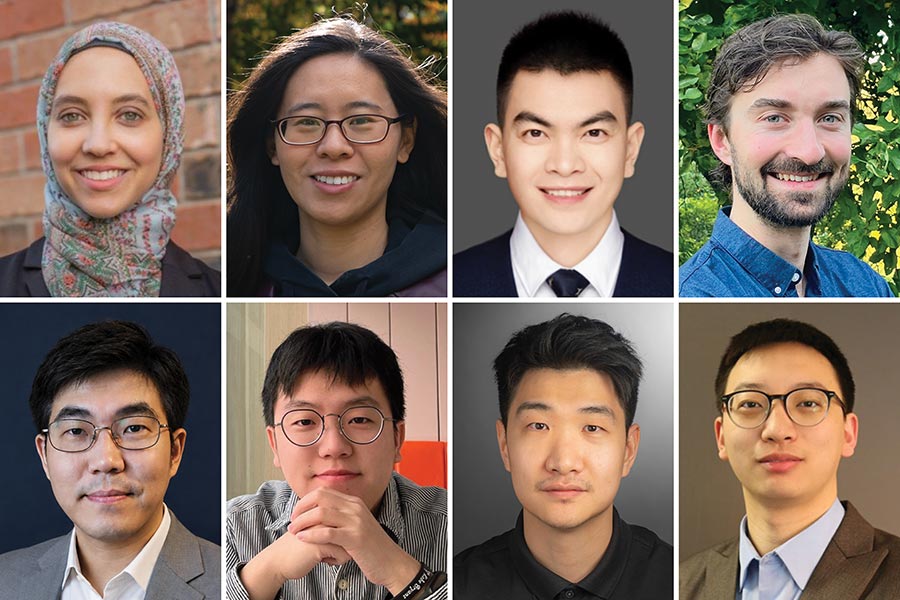
Left to right, top row: Aliaa Alnaggar, Qianying Cao, Daicong Da, Thomas Keller; Left to right, bottom row: Gibum Kwon, Anyi Li, Hewenxuan Li, Jinming Zhuang
AI generated; written and edited by Deanna S. Carlin
The Kate Gleason College of Engineering at Rochester Institute of Technology (RIT) is pleased to welcome eight new faculty members this fall, joining the departments of computer engineering, industrial and systems engineering, and mechanical engineering. The new hires bring expertise spanning stochastic operations research, scientific machine learning, advanced manufacturing, structural health monitoring, and heterogeneous computing, further strengthening the College's research and teaching missions.
“With significant growth in research and record-breaking enrollment in many of our majors, it’s an exciting time for the Kate Gleason College of Engineering. I am thrilled that these eight individuals are joining the RIT family and look forward to learning more about the unique contributions and perspectives that they will bring to the College,” said Doreen Edwards, dean of the Kate Gleason College of Engineering.
New Faculty and Their Research
Aliaa Alnaggar, assistant professor, department of industrial and systems engineering, works in stochastic operations research. Her expertise lies within stochastic programming, dynamic programming, Markov decision processes, robust optimization, distributionally robust optimization, reinforcement learning, and machine learning. She applies these methodologies to applications in crowdsourced delivery, transportation, sharing-economy, healthcare operations management, supply chain management, and sustainability.
Qianying Cao, assistant professor, department of mechanical engineering, focuses on scientific machine learning methods to address complex engineering problems, including structural behavior prediction and the intelligent design of metamaterials. Her current work aims to develop agentic AI frameworks for automated material–structure co-design and for the prediction and control of structural dynamics.
Daicong Da, assistant professor, department of mechanical engineering, investigates problems at the intersection of mechanics of materials, design optimization, advanced manufacturing, and data science. His work integrates a comprehensive understanding of material and structural behavior across multiple scales, loading conditions, and operating environments to enable the co-design of materials, structures, and manufacturing processes with tailored properties and functionalities. He leads the Structural Integrity and Functionality (DASIF) Lab at RIT, which aims to transform how materials and structures are engineered by enabling programmable, multifunctional, and high-performance systems that advance technology and strengthen economic competitiveness.
Thomas Keller, assistant professor, department of mechanical engineering, researches the materials science and additive manufacturing of structural and functional materials, including rare-earth-free permanent magnets for electric motors and hybrid multi-technique additive manufacturing approaches. His research combines fundamental experiments, numerical modeling, and sensor-feedback to control manufacturing from the nano to the macro scale, from feedstock to finished part.
Gibum Kwon, associate professor, department of mechanical engineering, focuses on surface and interface engineering of functional polymers, establishing a fundamental understanding of interactions between solid, liquid, and vapor phases. His team leverages these insights to develop advanced materials, including tailored wettability surfaces, selective absorption gels, and self-healing or anti-dust coatings.
Anyi Li, assistant professor, department of industrial and systems engineering, focuses on advanced manufacturing. His areas of interest include statistical modeling, machine learning, and optimization for additive manufacturing processes; federated learning, graph learning, and multimodal modeling for scalable manufacturing intelligence; and physics-informed quality inspection, defect analysis, and multiaxial fatigue life prediction.
Hewenxuan Li, assistant professor, department of mechanical engineering, integrates data-driven modeling, intelligent sensing and control, structural health monitoring, and bio-inspired robotics to enable resilient autonomy in complex systems, manufacturing processes, and experimental testing across mechanical and aerospace engineering. His research vision centers on intelligent, anomaly-aware engineering systems that can autonomously monitor and adapt while enhancing the safety and longevity of other engineered systems and infrastructure.
Jinming Zhuang, assistant professor, department of computer engineering, works on heterogeneous computing, compiler design and programming abstractions for accelerators, hardware/software co-design, and domain-specific accelerator architectures. He develops novel hardware architectures and compiler optimizations that unlock the full potential of heterogeneous systems, enabling researchers in AI, scientific computing, robotics, and other application domains to efficiently leverage these platforms while abstracting away low-level hardware complexity.
The Kate Gleason College of Engineering looks forward to the contributions these researchers will bring to RIT's academic and research communities.