RIT AI grad student's space defense startup acquired by CesiumAstro
Ryan Kenward leverages machine learning to reduce satellite collision risk. 1Aardvark, the space and missile defense software company he founded, was recently acquired by CesiumAstro.
Ryan Kenward
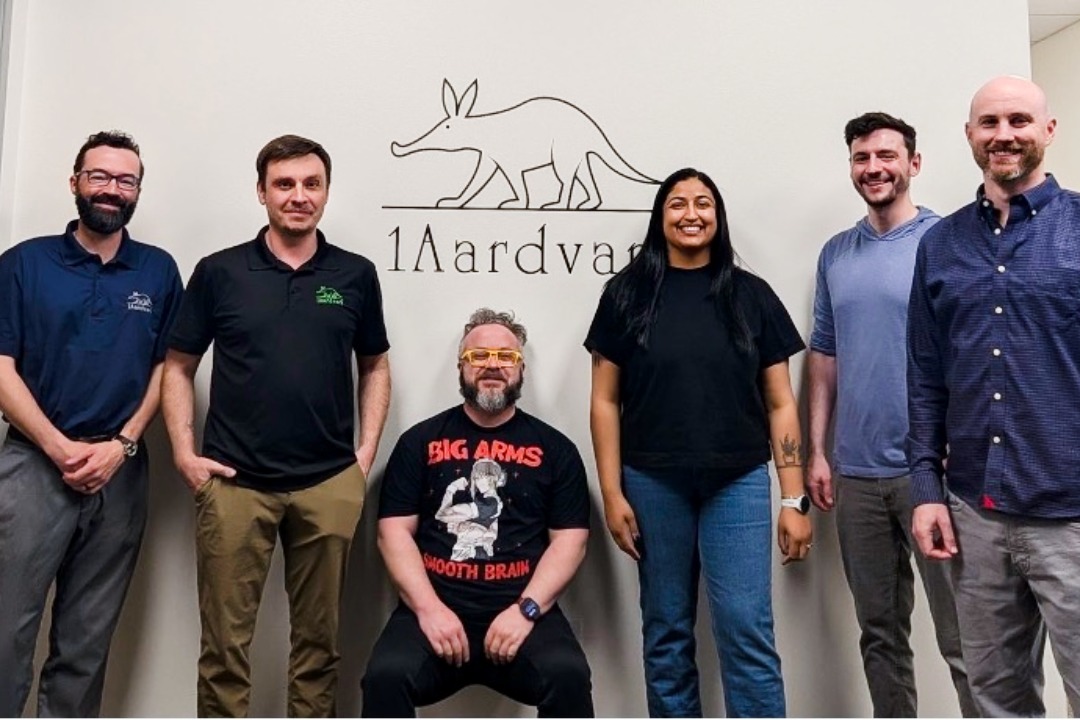
Ryan Kenward, 2nd from left, currently works with Dr. Zhiqiang Tao on problems involving satellite collision risk. 1Aardvark, the space and missile defense software company he founded, was recently acquired by CesiumAstro.
Ryan Kenward is a student in RIT's MS in artificial intelligence online program, based in Austin, TX. He is an Air Force veteran and founder of 1Aardvark, a software development firm focused on missile defense and space operations, that was recently acquired by CesiumAstro.
1. Can you tell us a bit about your background and how it led you to study AI?
I started my career in the Air Force as an intelligence analyst and mission planner supporting the U-2 program. From there, I moved into the defense industry, working my way from field engineer to program manager at companies like Northrop Grumman, including several years living and working in South Korea.
Eventually, I transitioned into business development because I wanted to bridge the gap between technology and the people who actually need it. I learned that even the most impressive technology has little value if it doesn't solve a real problem. That experience ultimately led me to start my own company, 1Aardvark, focused on rapidly developing software to tackle difficult challenges in missile defense and space operations.
Throughout my career, I've seen plenty of examples where AI models performed incredibly well in controlled demonstrations but struggled when exposed to the complexity and unpredictability of the real world.
That's really what motivated me to go back to school. I wasn't interested in studying AI simply because it's the latest technology trend. I wanted to understand it at a fundamental level: how these models work, why they sometimes fail, and how to determine when AI is genuinely the right tool for the job.
RIT's master's program has given me the opportunity to challenge some of my own assumptions, deepen my technical understanding, and apply what I'm learning to problems I've spent much of my career trying to solve. Ultimately, I'm interested in building AI systems that don't just look impressive in a demonstration but actually deliver value when they're put to work in the real world.
2. What projects are you working on in AI at RIT?
For my capstone with Dr. Zhiqiang Tao, I'm working on a problem involving satellite collision risk. Low Earth orbit is getting increasingly crowded, and figuring out whether two objects may collide is a surprisingly difficult challenge. When two objects are predicted to pass close to one another, satellite operators receive a series of updated warnings over several days. Eventually, they have to make a decision about whether to maneuver the satellite, which comes with its own costs and risks. I'm using about 160,000 real-world collision warning messages released by the European Space Agency to see whether an AI model can analyze how those warnings change over time and predict the eventual collision risk roughly two days in advance.
One of the things I find particularly interesting is that ESA previously ran a public competition around this problem, and most of the models struggled to beat a really simple baseline: just assuming the latest risk estimate was the best prediction. That's actually what makes this such a great research problem. I get to experiment with different AI approaches using real operational data and see what actually works. And if I ultimately find that a simpler statistical method performs just as well as a sophisticated neural network, that's a valuable result too.
3. Can you briefly describe the acquisition of 1Aardvark and the role AI will play in your new role?
I founded 1Aardvark in 2023 with a simple goal: bring together talented people who could tackle difficult technical problems and develop solutions quickly. And yes, the name is a little unusual, but it does have the benefit of putting us first on just about every alphabetical list! We built a business developing mission software for missile defense and space programs, and in August 2026, we were acquired by CesiumAstro, a company that develops satellites, advanced communications payloads, and space systems. I'm now the Vice President of Mission Solutions, where I get to work on bringing a lot of those capabilities together.
AI is going to play an increasingly important role in what we're building, particularly as we move toward spacecraft and mission systems that can make decisions autonomously, adapt to changing conditions, and continue operating even when they lose communication with the ground. But I have a strong philosophy about how we get there. Just because we can apply AI to something doesn't necessarily mean we should. I also think one of the biggest near-term opportunities for AI is simply reducing the noise. We have systems producing enormous amounts of data, and in many cases, we have years of real-world examples we can use to train models to recognize patterns, filter out irrelevant information, and help operators focus on what actually matters.
For me, the goal isn't to replace people or traditional systems with AI. It's to figure out how to combine all three in a way that makes the overall system smarter, more reliable, and ultimately safer.