RIT research in Ghana shapes global e-waste policies
Akomeah Darko
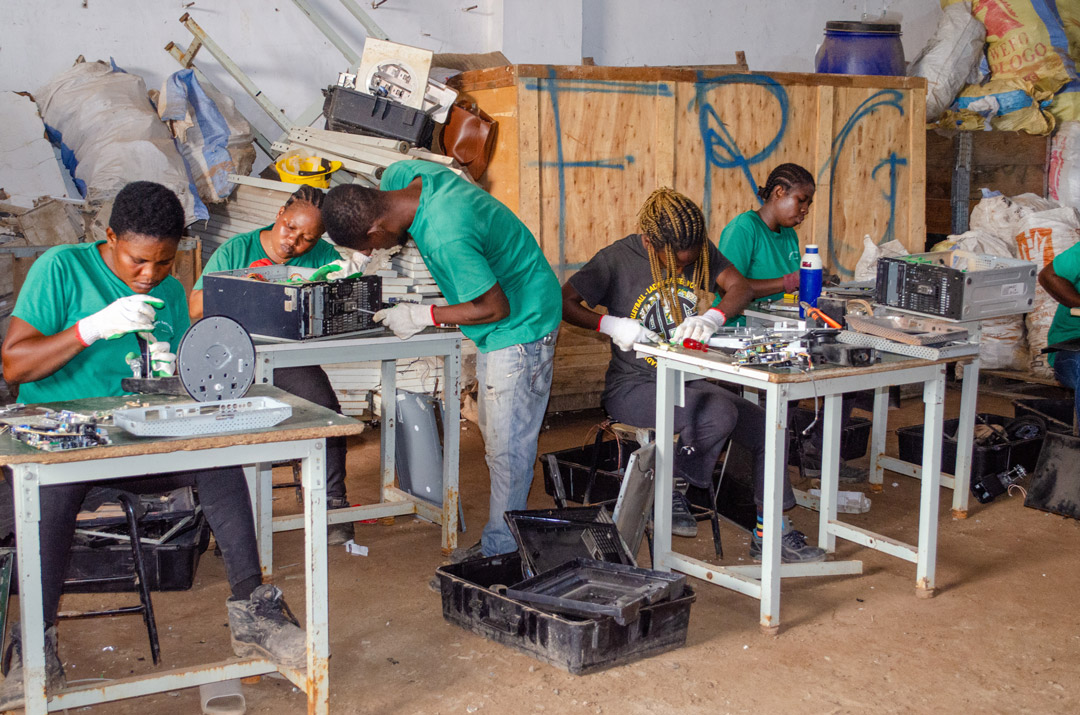
During a trip to Ghana, representatives from RIT’s Golisano Institute for Sustainability toured an electronic recycling center, like this one in Accra, where a local team works on computer refurbishing. A recent study shows that the country views old electronics not as waste, but as a source of economic opportunity.
Ghana has tightened its grip on electronic waste imports in recent years, aiming to curb the environmental toll of decades of discarded technology flowing from wealthier nations. But during a 2024 visit to West Africa, faculty from RIT’s Golisano Institute for Sustainability discovered a complex reality—one where old electronics are often seen not as waste, but as a source of economic opportunity.
A study written by GIS Director Nabil Nasr and GIS Technical Director Michael Thurston is challenging a one-size-fits-all approach to e-waste regulation by comparing how discarded consumer electronics move through markets in the Global North and Global South.
While on the ground in Ghana, Nasr, Thurston, and former economic and policy analyst Chelsea Gulliver went door-to-door speaking with local electronics remanufacturing, refurbishment, and repair businesses, and hosting workshops with government representatives, repair-sector operators, and recycling professionals. The discussions provided researchers with direct insight into how used electronics move through Ghana’s economy, as well as the challenges associated with regulatory oversight.
“A lot of the discarded electronic products that end up in places like Ghana are actually still functional,” said Thurston. “There are multiple options before recycling where much more value can be extracted through repair, refurbishment, and reuse.”
Devices often considered obsolete in higher-income markets – like the Apple iPhone 6, a phone released nearly a decade ago – were routinely repaired, refurbished, and resold in informal secondary markets. In many cases, products discarded elsewhere were still fully functional or required only minor repairs to return to use.
For the GIS team, the scale of reuse was striking.
Beyond repair and refurbishment components that could not be reused were often dismantled for parts or processed for material recovery, supporting secondary markets for metals and other resources. According to Nasr, this is an often-overlooked dimension in global waste discussions.
“The biggest stockpile of critical minerals and rare earth elements is in old electronic equipment,” Nasr said. “If those materials are recovered effectively, it can be a very profitable and lucrative business for many countries.”
Chelsea Gulliver
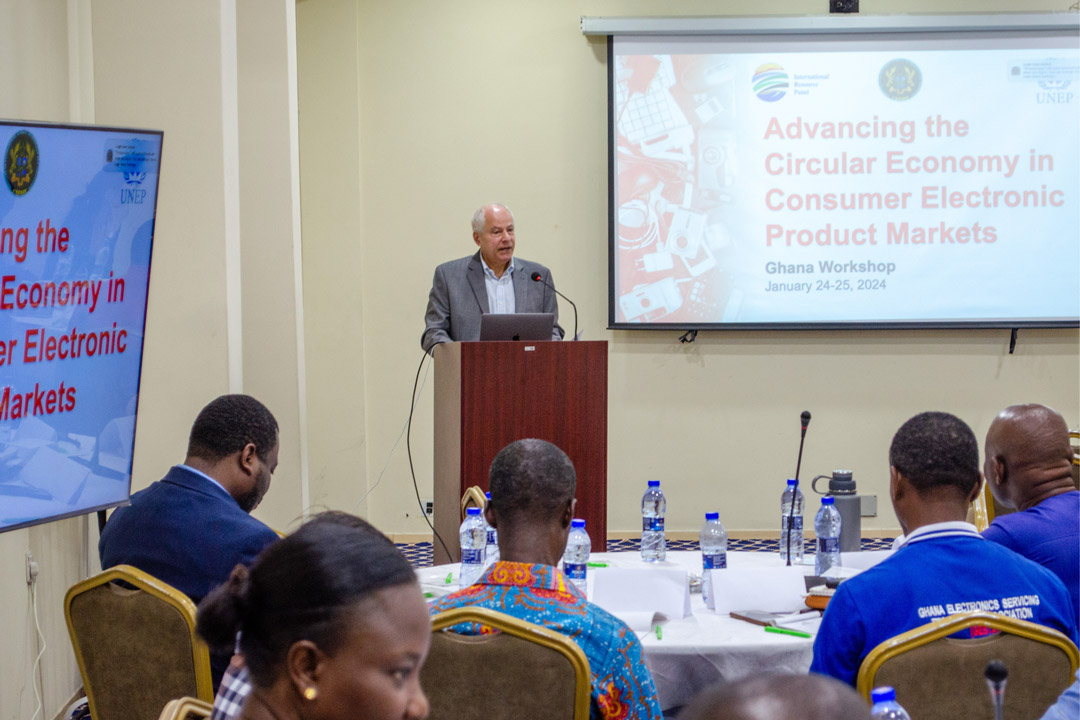
Nabil Nasr, at lectern, led a 2024 UNEP-IRP circular economy workshop in Ghana.
Nasr said the experience challenged a common assumption embedded in global e-waste narratives.
“We tend to think of these products primarily as waste once they leave higher-income markets,” Nasr said. “But many of them retain substantial functional value.”
Their effort in Ghana presents a challenge for policymakers as they define waste and its value within global electronics flows.
Efforts to restrict electronic waste export by nations in the Global North to the Global South are designed to reduce environmental and public health risks. Yet, GIS researchers observed how blanket regulatory approaches can also hinder markets that provide affordable access to technology and sustain local livelihoods.
In addition, without consistent policies to assess product condition prior to export, regulators face an imperfect choice: fully restrict or fully allow.
“Policies that treat all used electronics as waste risk overlooking a critical distinction,” Nasr said. “There are products that are clearly non-functional and should not be shipped. But many devices still have significant remaining value through reuse, repair, or material recovery.”
“There is no universally adopted system for qualifying what is reusable versus what is truly non-functional,” Thurston added. “That uncertainty complicates enforcement and can create unintended consequences on both sides of the equation.”
Akomeah Darko
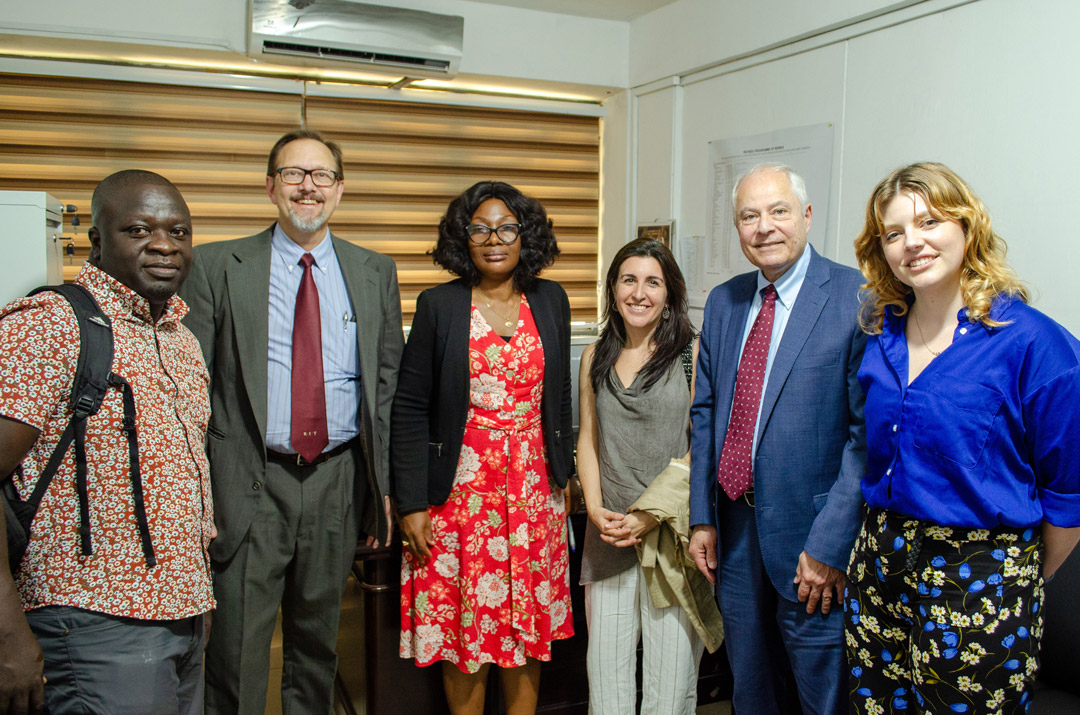
Members of RIT’s Golisano Institute for Sustainability include Michael Thurston, second from left; Nabil Nasr, second from right; and Chelsea Gulliver, right, who met with members of Ghana’s Ministry of Environment, Science Technology, and Innovation during a visit to Accra in 2024.
In an upcoming United Nations report that is expected to be released later this year, Nasr and Thurston point toward greater precision in policy, emphasizing quality standards and design strategies that preserve product value, while limiting environmental harm.
The findings are supported by ongoing research at GIS examining product lifecycles, value retention processes, and circular economy strategies, including work done by Kyle Parnell, who earned his Ph.D. in sustainability from RIT in 2025 and whose research contributes to the UNEP study.
“In many higher-income markets, products are retired based on perceived obsolescence rather than technical failure,” Parnell said. “But functionality doesn’t disappear simply because a newer model exists.”