RIT, URochester to receive $2 million to advance quantum communication network
New federal funding is the result of support from congressional leaders
Carlos Ortiz/RIT
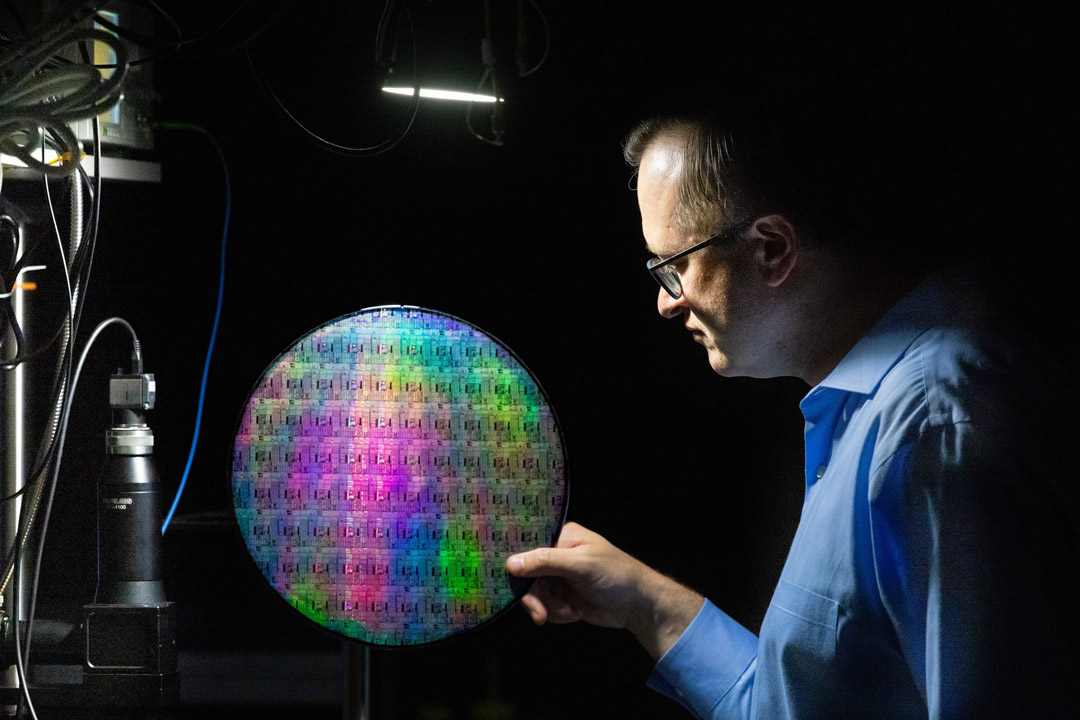
Professor Stefan Preble holds a quantum photonic wafer, which was first developed on RIT’s campus and is a key technological advancement in quantum photonic research.
RIT and the University of Rochester will receive $2 million in federal funding to further develop the Rochester Quantum Network (RoQNET). The National Institute of Standards and Technology (NIST) is providing the funding to advance the future of secure quantum communications and to build new capabilities for RoQNET.
The new funding is a direct result of congressional support from Sen. Charles Schumer, Sen. Kirsten Gillibrand, and Rep. Joseph Morelle as part of the Fiscal Year 2026 Appropriations Bill.

Scott Hamilton/RIT
RIT President Bill Sanders
“This federal investment underscores the power of collaboration and the growing strength of the Greater Rochester region as a hub for quantum innovation,” said RIT President Bill Sanders. “Our partnership with the University of Rochester through the Rochester Quantum Network brings together complementary expertise that positions us at the forefront of secure quantum communications research. We are grateful to Senator Schumer, Senator Gillibrand, and Congressman Morelle for their leadership and support in helping secure this critical funding, which will accelerate discovery, expand educational opportunities for students, and advance technologies with far-reaching national impact.”
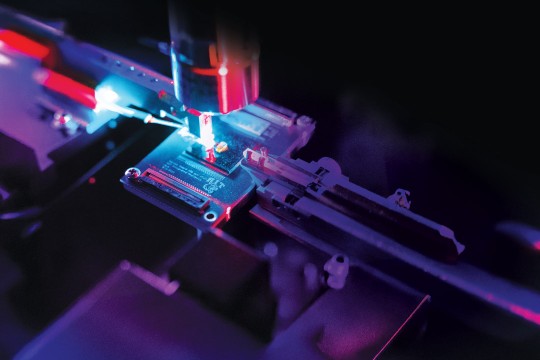
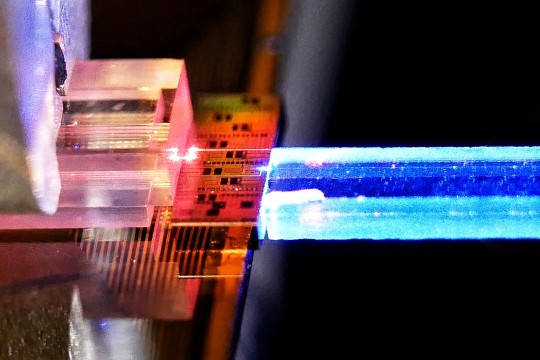
RoQNET was successfully installed in 2024 when researchers demonstrated they can securely transmit single photons from one campus to another over 11 miles of fiber-optic telecommunications lines. Sending communications using individual particles of light offers unprecedented levels of security, making them impregnable from being cloned or intercepted without detection and preventing bad actors from accessing sensitive data.
There are numerous quantum communications networks around the world, but RoQNET was the first to center on quantum photonic chips, building on technology first developed at RIT by a team that included Bausch and Lomb Professor Stefan Preble from the Department of Electrical and Microelectronic Engineering. He is RIT’s lead researcher for RoQNET.
“Our focus with RoQNET has been on the realization of heterogeneous entanglement between different types of qubits,” said Preble. “This funding supports further research to reach the next generation in quantum networking technologies.”
Now that RoQNET is established, researchers are preparing for experiments to share entangled photons across the network. Entanglement is when two or more quantum particles are inextricably linked. It can happen at very large distances and is key in figuring out how to scale up secure quantum computing and communication. One entangled photon pair will be hosted at RIT while the other will be at URochester.
Another goal is to create a statewide quantum network, connecting multiple networks that currently exist. A quantum network was recently established between Brookhaven National Laboratory and Stony Brook University. Other facilities, including the Air Force Research Laboratory and New York University, are developing their own networks.
To connect the various networks across the state, researchers will need to further advance quantum repeater technology to bridge across such large distances. The NIST funding provides important resources to try to reach that goal.
The funding will also enable hardware that will provide high school, undergraduate, and graduate students some of their first opportunities to work with quantum optics and quantum networks.
Elected officials and leaders share support for RoQNET
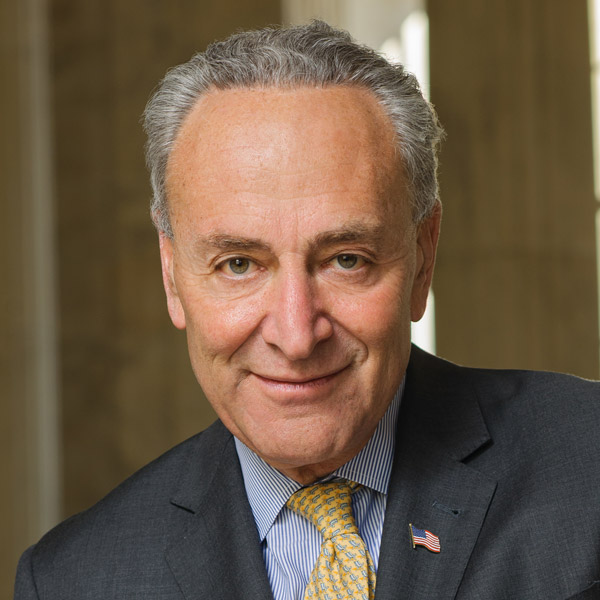
U.S. Senator Charles Schumer: “I was proud to secure this funding for URochester and RIT to help develop a cutting-edge Upstate quantum network. This win-win benefits national security and boosts economic development and innovation by enabling the Rochester region to connect into similar New York-based quantum communications networks positioning New York to be a global leader in quantum communication and networking. RoQNET will stimulate quantum workforce development for K-12 and college-age students and offer learning opportunities for students enrolled in the Monroe Community College Optical Technology program. Rochester is home to world-class research institutions, and this federal investment will help URochester and RIT continue advancing cutting-edge quantum networking work. I was proud to deliver this funding so Rochester’s innovators can keep pushing the boundaries of secure communications and strengthen the region’s role as a hub for advanced technology.”

U.S. Senator Kirsten Gillibrand: “I am proud to help deliver $2 million in funding for this quantum network expansion. Through the development of RoQNET, the University of Rochester and Rochester Institute of Technology are at the forefront of quantum research. Quantum has the ability to fundamentally change how we engage in secure communications. The Rochester region remains a preeminent leader in advanced technologies and high-impact research activities, and I look forward to seeing the results of this partnership.”
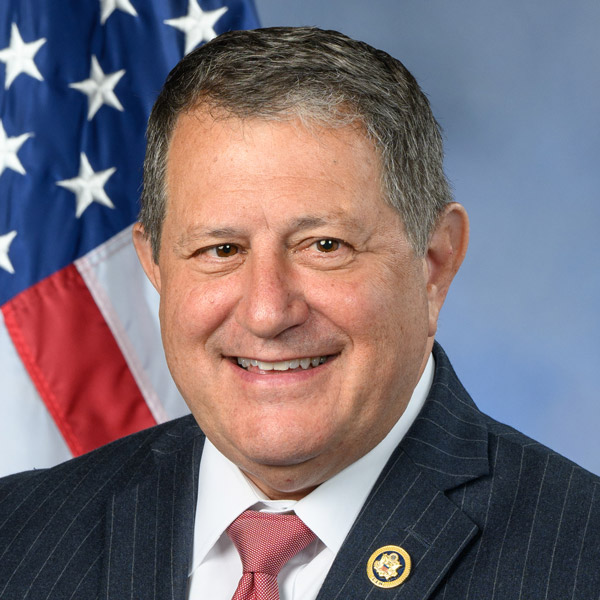
U.S. Congressman Joseph Morelle: “Quantum technology is the next frontier of innovation, and thanks to world-class research universities like URochester and RIT, Rochester will continue to lead the way in these critical technologies. I was proud to secure funding in Washington to support RoQNET, and I cannot wait to see what they discover next.”

University of Rochester President Sarah Mangelsdorf: “We are proud to be at the vanguard of the quantum revolution and thank Senator Schumer, Senator Gillibrand, and Representative Morelle for their support securing crucial federal funding to make new advances in quantum communication. Our university is committing significant time, talent, and resources into advancing quantum technologies, as evidenced by our recent investment in the transdisciplinary Center for Coherence and Quantum Science. We are fortunate to have terrific local collaborators at RIT with whom we can combine our strengths to advance the Rochester region as a hub for advanced technologies.”
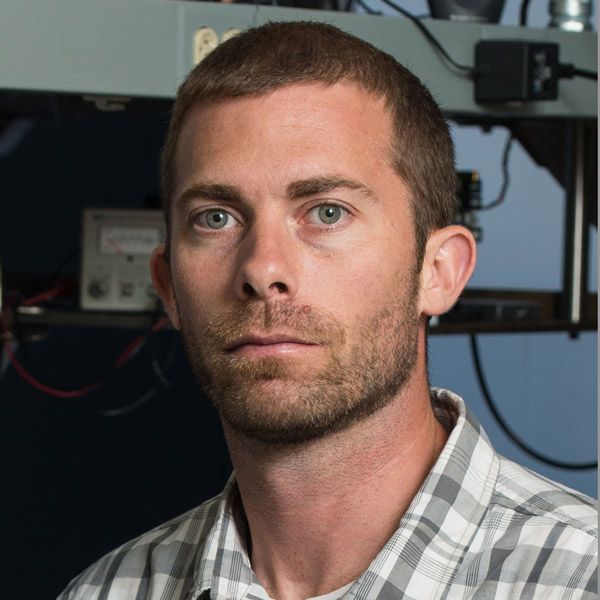
Marie C. Wilson and Joseph C. Wilson Professor of Optical Physics, University of Rochester, Nickolas Vamivakas: “We want to exploit some of the more unique features of quantum mechanics and quantum optics, specifically the idea of quantum entanglement, where two particles of light can share properties no matter how far apart they are. Harnessing quantum entanglement could eventually lead to sophisticated networks of quantum computers or advanced new methods to improve the resolution of space telescopes.”