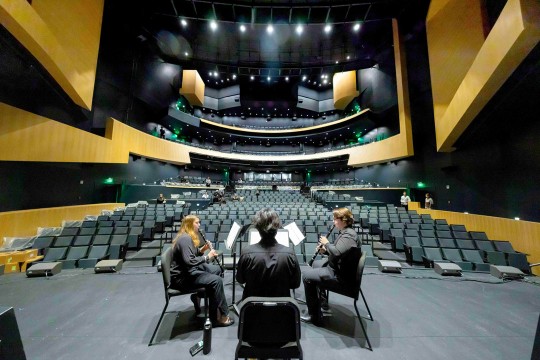
RIT Performing Arts Center already educating students
Students learn how to ready a theater in advance of its opening
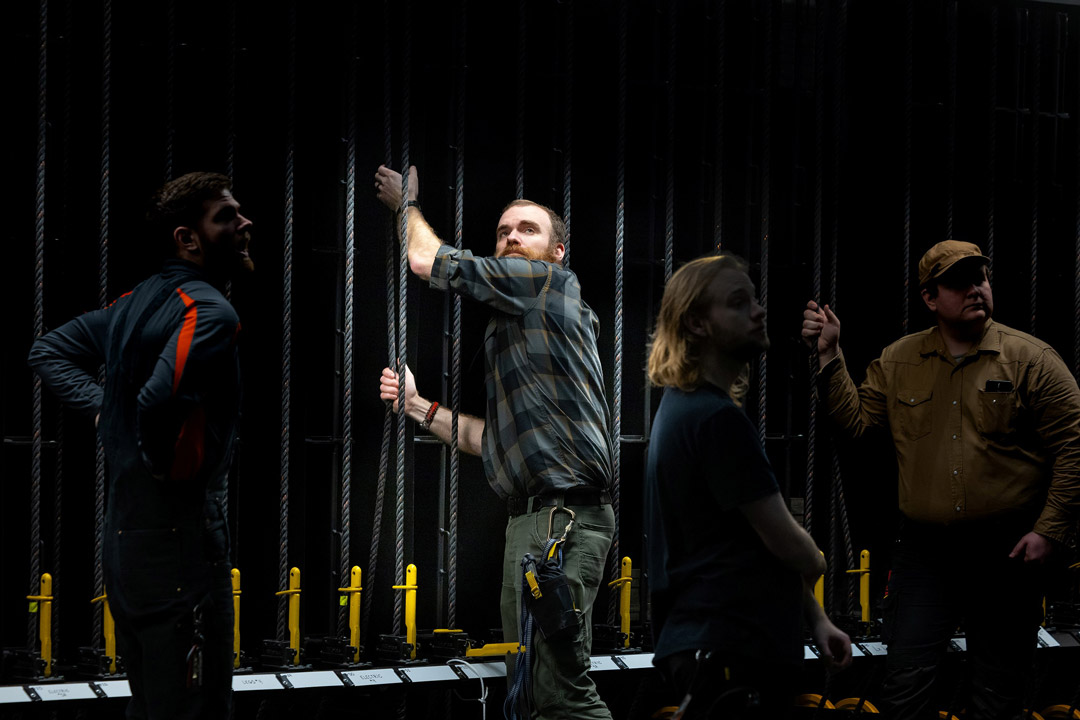
Carlos Ortiz/RIT
Rob Lewis, who is teaching a technical production and venue operations course in the RIT Performing Arts Center, explains how curtains, scenery, and lights are raised and lowered.
Before audiences take their seats in RIT’s new Performing Arts Center, students are using the space as a living classroom.
The 15 students in a three-credit technical production and venue operations course are learning about stage directions, sound, lighting, and how rigging moves curtains and scenery. The coursework centers on preparing a brand-new, 40,000-square-foot theater for operation ahead of its April 10 opening.
“My goal is that the students will have hands-on experience with as many elements as possible in this theater,” said Rob Lewis, technical director for RIT’s School of Performing Arts, who is teaching the class. “This is a unique opportunity for students to be involved and engaged with a brand-new venue and learn about the new technologies that make it all work.”
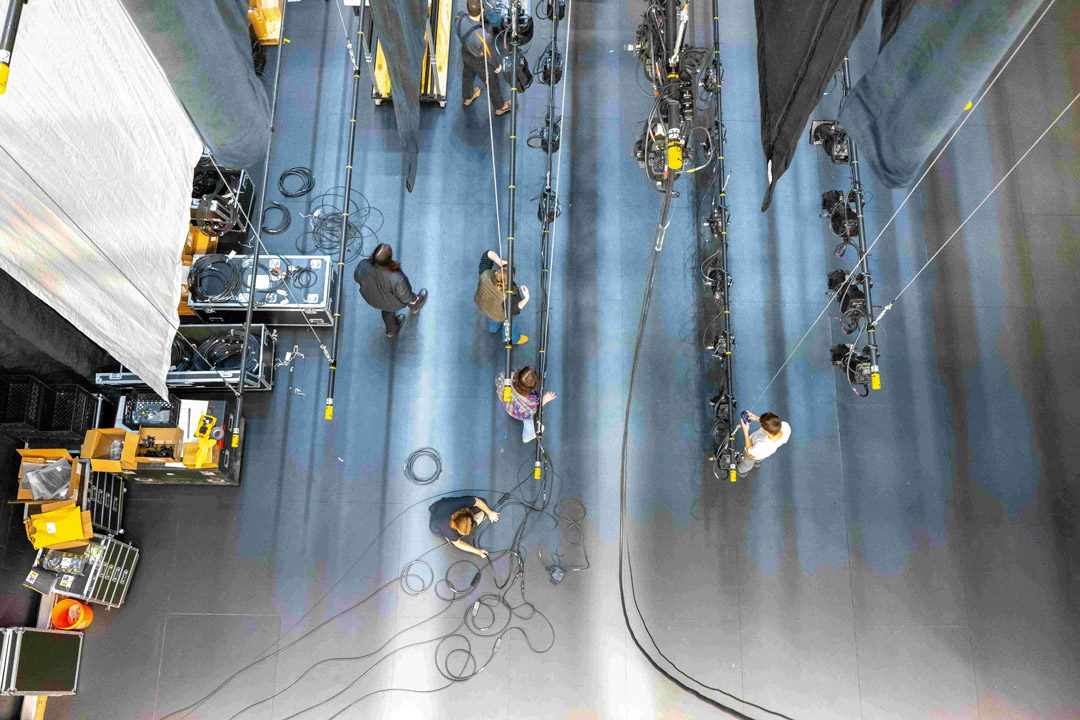
Carlos Ortiz/RIT
Fifteen students are gaining hands-on experience in a technical production and venue operations course in the RIT Performing Arts Center. They are learning how curtains, scenery, and lights are positioned, raised and lowered, and how technology in the theater works.
Wally Adamy, a fifth-year mechanical engineering major from Mechanicsburg, Pa., enrolled in the class because he wanted to be involved with the new space and learn more about it before it officially opens.
Adamy originally received a Performing Arts Scholarship for his saxophone talent, but in his first week on campus joined RIT Tech Crew, which also fulfills his scholarship requirement. As a student supervisor, he supports the audio for many events on campus including broadcasts of hockey games.
“I just thought it would be cool to work with this stuff and get class credit for it,” Adamy said. “The concepts we are learning in class can be applied to production work in theaters on and off campus.”
Adamy served as lighting designer for a recent show on campus, and enjoys all RIT has to offer to build his knowledge and career potential.
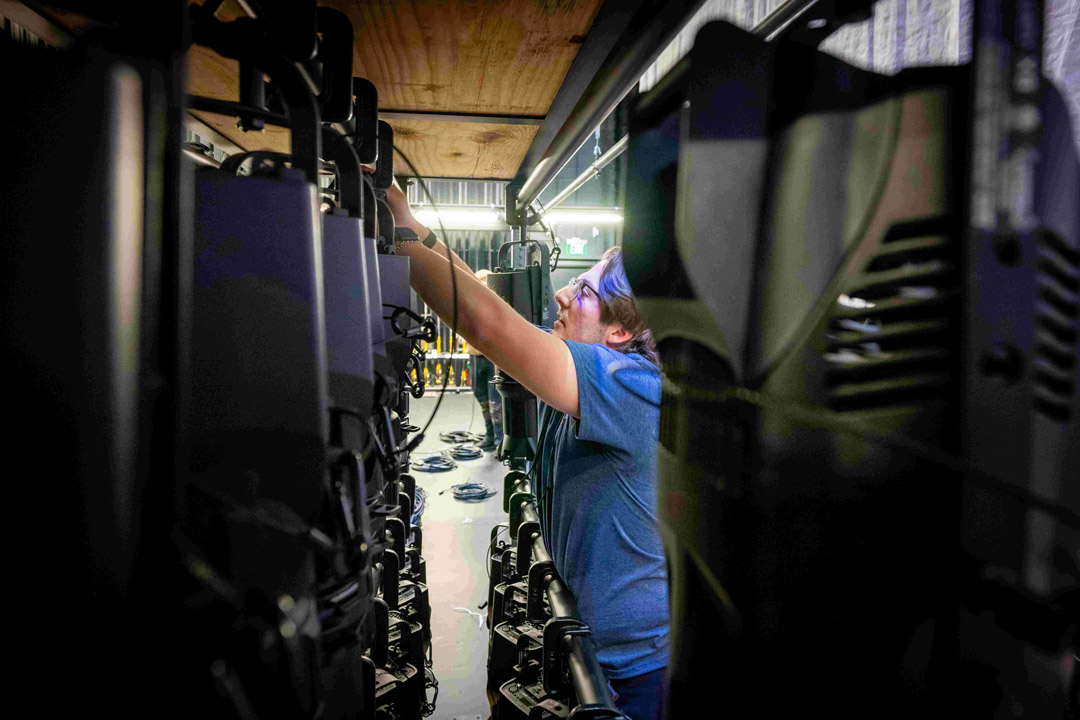
Carlos Ortiz/RIT
Wally Adamy mounts and adjusts lights on stage of the RIT Performing Arts Center. The theater is set to open on April 10.
“I love doing all of this stuff,” he said. “And it’s widely different from anything else I’m doing. I’m taking a digital controls class in the mechanical engineering department, I’m in a leadership class in the business school, and I’m in multidisciplinary design, also in the college of engineering. They all have good things to offer.”
One distinctive feature of the theater is an immersive audio system that is similar to surround sound, the only one of its kind in western New York. “There are 75 speaker boxes around the venue, in the front, side, back, and overhead,” Lewis said.
The theater also comes with a visual intercom system, a concept borrowed from upgrades made to the Robert F. Panara Theatre to allow better accessibility for deaf and hard-of hearing production workers to see sign language cues in a rehearsal or performance.
Ethan Parillo, a fourth-year computing and information technologies major from Sudbury, Mass., likes working behind the scenes. The Performing Arts Scholar in technical production served as lead electrician for last semester’s production of Macbeth, in charge of hanging, wiring, and focusing the lights in the Sklarsky Glass Box Theater.
“I had a pretty good foundation of technical production coming in, but I wanted to work on it in an academic setting,” he said. “It was always a hobby, but I wanted to take it that one step farther to strengthen my academic career in production. That’s something I wanted to get out this class, especially in this beautiful venue.”
Parillo enjoys learning about new technologies in the theater, including LED lighting, acoustics, and the immersive sound system.
“These are technologies I’ve never worked with before, and the fact that I get to work with them at a tech school with such a strong performing arts program is just amazing,” he said.
Carlos Ortiz/RIT
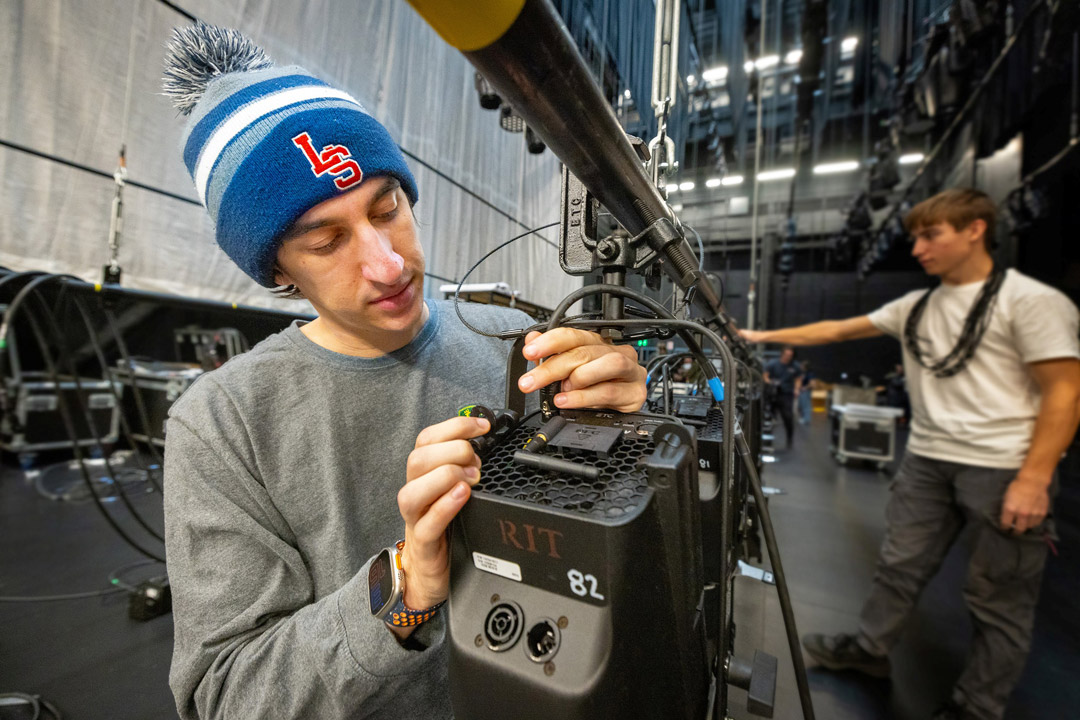
Ethan Parillo installs lights to a 48-foot batten on stage of the RIT Performing Arts Center during a class to teach students about technical production and the features of the state-of-the-art theater.