Deaf Education Master of Science Degree

Learn to teach deaf students and earn dual New York State (NYS) certifications in deaf education and in a secondary subject area.
Overview for Deaf Education MS
The master of science degree in deaf education is designed for students with a passion for teaching Pre-K through 12th grade deaf and hard-of-hearing learners. The curriculum is taught by renowned faculty at RIT, one of the most innovative campuses in the world, and prepares teachers and leaders to be effective and ethical practitioners in deaf education. A carefully designed system of faculty advisement is a prominent feature of the program. On-campus facilities, state-of-the-art technology, and a well-established system of educational access services combine within a rich and inclusive communication environment to make this a vital program for both deaf and hearing students who desire careers as professional educators of deaf students.
As a graduate student in the program, you will have small class sizes, one-to-one discussions, and advisement with faculty that allow you to build your strengths and develop your skills.
RIT’s Deaf Education Degree
Course work requires a minimum of five semesters. A cumulative grade point average of at least 3.0 must be maintained. Before graduation, students are expected to be able to communicate in American Sign Language (ASL) at or above the Intermediate Plus level as determined by a Sign Language Proficiency Interview.
New York state requires 70 full days of student teaching to become eligible for your Initial NYS Teaching Certification. This student teaching component is part of the program's course work. Students can participate in traditional or on-the-job placements. The program collaborates with schools and programs of the deaf to establish placements. Student teachers are supported by a cooperating/mentor teacher and at least one program faculty member (university supervisor) through the entirety of student teaching. Placements are arranged by the Program Coordinator and Coordinator of Clinical Experience.
Degree Completion and Teacher Certification
When you complete the program, you will:
- Earn a master of science degree in deaf education
- Be eligible for initial teaching certification from New York State (NYS) in the education of students who are deaf or hard of hearing, grades Pre-K-12
- Be eligible for initial NYS certification to teach in an academic subject area at the secondary (grades 7-12) school level, also referred to as dual certification, alongside the certification to teach Pre-K through 12th grade deaf and hard-of-hearing students. Subject areas include biology, chemistry, earth science, English, math, physics, social studies, or American Sign Language. To qualify, students must have completed a sufficient number of university-level semester credit hours as set by NYS for each subject area. Students who have not earned the required number of hours as part of their previous or current studies must complete the additional credits before applying for the NYS grades 7-12 certification.
- Be eligible for initial certification from Council on Education of the Deaf
To be eligible for initial NYS teaching certification, you must:
- Complete the Educating All Students (EAS) exam.
- Complete the Content Specialty Test (CST), Deaf and Hard of Hearing exam
- Only for students pursuing dual certification: Complete the Content Specialty Test (CST) in the academic subject area for which you wish to become certified to teach.
- Complete the Deaf Education Teacher Performance Assessment (DETPA) during student teaching
- Complete four NYS workshops: School Violence Prevention and Intervention (SAVE), Dignity for All Students Act (DASA), Needs of Children with Autism, and Child Abuse Identification and Reporting
- Complete NYS certification fingerprinting
Is the RIT/NTID’s Deaf Education Degree right for you?
How do you know if the MS degree in secondary education is the right program for you? Use the following questions to assess your interest in the education field and in teaching students who are deaf and hard of hearing:
- Do you want to teach deaf and hard-of-hearing students?
- Do you want to teach in a variety of Pre-K-12 mainstream and residential/center school settings?
- Do you want an option to teach ASL, math, science, social studies, or English and respond to the need for more high school teachers?
- Do you want to teach in a variety of K-12 mainstream and residential/center school settings?
- Are you fascinated by the cognitive, cultural, and language characteristics of deaf and hard-of-hearing students?
- Are you looking for personal attention and advisement from faculty and staff who are leaders in the field?
- Would you like to learn, live and work on a campus designed for collaboration between deaf and hearing students?
- Do you want training in evidence-based instructional approaches?
Why choose RIT/NTID’s Deaf Education Degree
With the pressing need for more deaf education teachers, especially in secondary education, the strong foundation RIT provides in these areas creates an exceptional environment for deaf, hard-of-hearing, and hearing students to pursue a teaching degree. RIT/NTID's deaf education degree offers the following advantages:
- Personal attention from program faculty members with 1-1 faculty mentoring.
- One additional year of 1-1 faculty mentoring after graduation to provide support with your first year of teaching.
- Dual certification in a secondary school content area in grades 7-12 for students who are hearing or deaf as well as in deaf education for grades Pre-K through 12.
- Strong faculty with expertise in pedagogy, language development, teaching and curriculum, speech development, research, educational technology, youth and adolescent development, student advisement and placement, and educational issues.
- Variety of student-teaching placement options.
- Access to a wide array of research materials.
- Extensive library resources on the education of students who are deaf or hard of hearing, Deaf culture, sign language, and curriculum materials.
- Thorough and thoughtful personal advising.
- Close proximity to schools for deaf students and mainstream programs.
- A vibrant Deaf community in Rochester, N.Y.
- Seminars and workshops focused on contemporary educational and cultural topics.
- Immersion in American Sign Language.
- Collaboration with faculty, staff members, and students.
-

Affordable Now. Valuable for Life.
Earn your master’s degree without the full price tag. With Master Up you can receive a 30% tuition scholarship for an RIT master’s degree.
- No announcements are currently running for this program.
Featured Work and Profiles
-
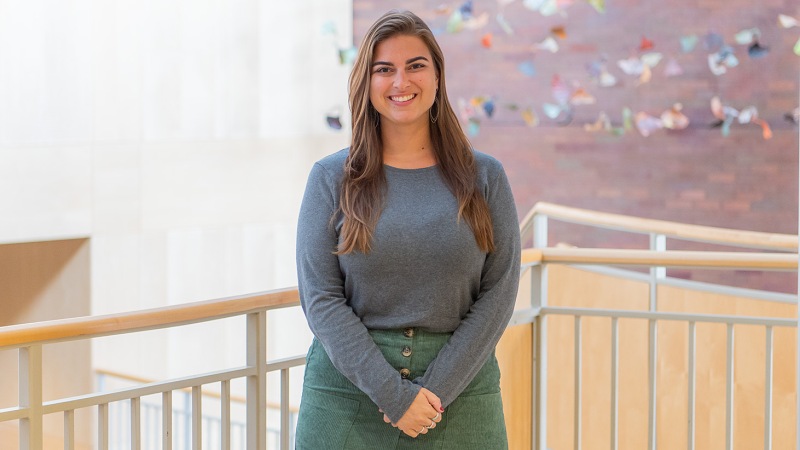
Megan Gonzalez
“My time at RIT allowed me to meet other deaf and hard-of-hearing individuals, which was not an opportunity that I had often when I was growing up. I was able to explore my Deaf identity and learn...
Read More about Megan Gonzalez -

Gina Pennington
“It was the knowledge I received and the experiences I had while in the MSSE program that have truly shaped me into the educator I have become today.”
Read More about Gina Pennington -

Lia Horyczun
“I wanted to become a teacher of the deaf so I could provide a quality education in the most accessible manner for deaf and hard-of-hearing students.”
Read More about Lia Horyczun -
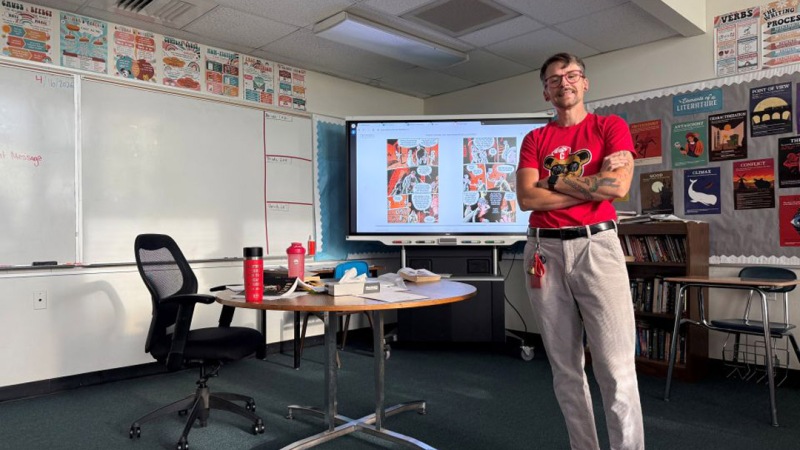
NTID Student Finds Their Calling in Deaf Education
Blake Culley '26 MS (Deaf education) will continue working at California School for the Deaf, Riverside, as a bilingual language arts high school teacher.
Read More about NTID Student Finds Their Calling in Deaf Education
Curriculum for 2026-2027 for Deaf Education MS
Current Students: See Curriculum Requirements
Note for online students
The frequency of required and elective course offerings in the online program will vary, semester by semester, and will not always match the information presented here. Online students are advised to seek guidance from the listed program contact when developing their individual program course schedule.
Admissions and Financial Aid
This program is available on-campus or online.
On Campus
| Offered | Admit Term(s) | Application Deadline | STEM-OPT Visa Eligible |
|---|---|---|---|
| Full-time | Fall | Rolling | Yes |
Online
| Offered | Admit Term(s) | Application Deadline | STEM-OPT Visa Eligible |
|---|---|---|---|
| Full-time | Fall | Rolling | No |
Full-time study is 9+ semester credit hours. International students requiring a visa to study at the RIT Rochester campus must study full‑time.
Application Details
To be considered for admission to the Deaf Education MS program, candidates must fulfill the following requirements:
- Complete an online graduate application.
- Submit copies of official transcript(s) (in English) of all previously completed undergraduate and graduate course work, including any transfer credit earned.
- Hold a baccalaureate degree (or US equivalent) from an accredited university or college. A minimum cumulative GPA of 3.0 (or equivalent) is recommended.
- Satisfy prerequisite requirements and/or complete bridge courses prior to starting program coursework.
- Submit a current resume or curriculum vitae.
- Submit a three-minute YouTube video in American Sign Language explaining your personal educational philosophy. After recording your video, upload it to YouTube and provide the URL using one of the following methods. Password-protected URLs will not be accepted.
◦ Post the YouTube video URL in the appropriate field within the online application.
◦ Email the YouTube video URL to NTIDAdmissions@rit.edu - Submit two letters of recommendation.
- Entrance exam requirements: GRE required for students who have a GPA below 3.0
- Submit English language test scores (TOEFL, IELTS, PTE Academic, etc.), if required. Details are below.
English Language Test Scores
International applicants whose native language is not English must submit one of the following official English language test scores. Some international applicants may be considered for an English test requirement waiver.
Duolingo (DET): 120
IELTS: 6.5
LanguageCert Academic: 70
PTE Academic: 56
TOEFL: 79/4.5 (40/2.5 for deaf/hard-of-hearing)
International students below the minimum requirement may be considered for conditional admission. Deaf and hard-of-hearing test takers with significant hearing loss do not need to take the listening and speaking sections for the TOEFL and IELTS. Each program requires balanced sub-scores when determining an applicant’s need for additional English language courses.
How to Apply Start or Manage Your Application
Cost and Financial Aid
An RIT graduate degree is an investment with lifelong returns. Graduate tuition varies by degree, the number of credits taken per semester, and delivery method. Because RIT receives federal support, students in the MSSE program pay less than RIT's regular tuition rate. View the Deaf and Hard-of-Hearing and Hearing NTID-Supported Students tuition section in cost of attendance
A combination of sources can help fund your graduate degree. Learn how to fund your degree
Additional Information
Online Study Restrictions for Some International Students
Certain countries are subject to comprehensive embargoes under US Export Controls, which prohibit virtually ALL exports, imports, and other transactions without a license or other US Government authorization. Learners from the Crimea region of the Ukraine, Cuba, Iran, North Korea, and Syria may not register for RIT online courses. Nor may individuals on the United States Treasury Department’s list of Specially Designated Nationals or the United States Commerce Department’s table of Deny Orders. By registering for RIT online courses, you represent and warrant that you are not located in, under the control of, or a national or resident of any such country or on any such list.


Related News
-
April 23, 2026
NTID student Blake Culley finds their calling in Deaf education
After graduation in May, Blake Culley will continue their work inspiring students as a bilingual language arts teacher.
-
March 14, 2025

Learning a Shared Love Language — One That Includes Signing
The New York Times features the love story of alumnus Jerald Creer and his husband, Kent Williams.
-
August 20, 2024

Student team from RIT’s National Technical Institute for the Deaf wins 2024 College Bowl championship
This is the seventh time that an RIT/NTID student team has won the national question-and-answer competition, which consists of topics including arts and literature, history and government, geography, science, technology and nature, sports and leisure, Deaf heritage and culture, entertainment, current events, and mathematics.

