Biomedical Engineering Master's Capstone: FloWrap
RIT Master's students designed the FloWrap device, a wearable compressive leg wrap designed to help reduce the risk of deep vein thrombosis (DVT) in post-surgical patients with limited mobility.
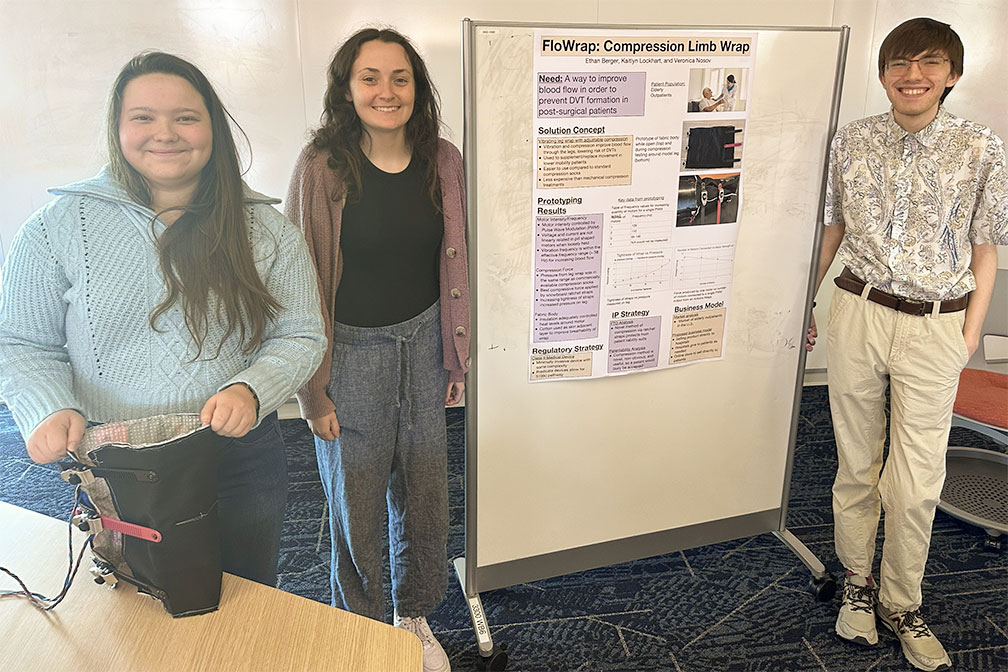
A Biomedical Engineering MS capstone team, consisting of Ethan Berger, Kaitlyn Lockhart, and Veronica Nosov, designed the FloWrap device, a wearable compressive leg wrap designed to help reduce the risk of deep vein thrombosis (DVT) in post-surgical patients with limited mobility. DVT occurs when blood flow slows and blood clots form in deep veins, most commonly in the legs, during periods of prolonged inactivity after surgery. If left untreated, these clots can travel to the lungs and cause life-threatening complications such as pulmonary embolism. Existing prevention methods, including anticoagulant medications, compression stockings, and early ambulation, can be difficult for some patients to tolerate or use consistently. FloWrap was developed as a more comfortable and user-friendly alternative that encourages circulation while remaining portable and reusable.
The device was intended to combine compression, heating elements, and vibrational massage into a single wearable system intended to improve lower-extremity blood flow. Compression helps promote venous return and reduce blood pooling in the legs, while the vibration subsystem is designed to mimic muscle activity and stimulate blood flow during periods of inactivity. Localized heat is used to encourage vasodilation and circulation. By integrating these therapies into one device, the project aims to provide a more effective and accessible solution for patients recovering at home or in clinical settings. FloWrap uses a multilayer fabric structure to balance durability, comfort, and thermal insulation. The outer layer is designed for structural support and durability, while an insulating middle layer helps contain heat within the device. A soft inner cotton layer improves comfort during prolonged skin contact and assists with moisture management. Adjustable straps and structural supports distribute pressure evenly around the leg to maintain consistent compression without relying on pneumatic air chambers.
The massage subsystem uses multiple vibration motors distributed throughout the wrap to provide intermittent stimulation. Pulse-width modulation (PWM) control allows the vibration intensity to be adjusted easily and more consistently. This system is intended to improve comfort and circulation while remaining lightweight and portable. Compared to traditional DVT prevention methods, FloWrap is intended to be easier to apply and remove, especially for elderly or post-operative patients who may struggle with compression stockings. The reusable and portable design also makes the device more suitable for home recovery. Future development of the project includes improving washability through removable electronic components, refining the compression mechanism, adding the heating element, and performing benchtop testing to evaluate circulation improvement and overall device effectiveness.
More Featured Profiles and Work