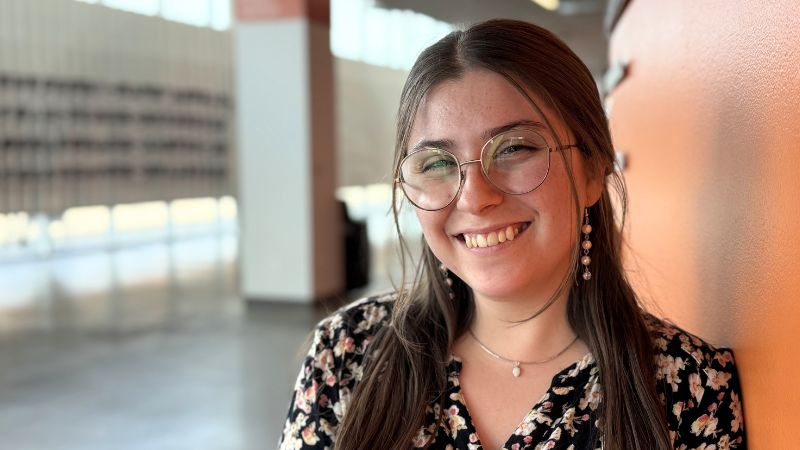
From Code to Curating: How Alice Found Her Voice and Her Future
As a first-generation American and college student, Alice Cauchi arrived at RIT with a "one-track mind" focused solely on grades and independence. However, the unique intersection of her double major in computer science and museum studies transformed her from a quiet, self-reliant student into a "blooming," extroverted leader.
By blending the technical rigor of software engineering with the outreach-driven nature of liberal arts, Alice discovered that her most valuable asset wasn’t just her ability to code, but her confidence to market herself—a skill that landed her a software engineering co-op in Oregon after a bold, spontaneous pitch at a hackathon.
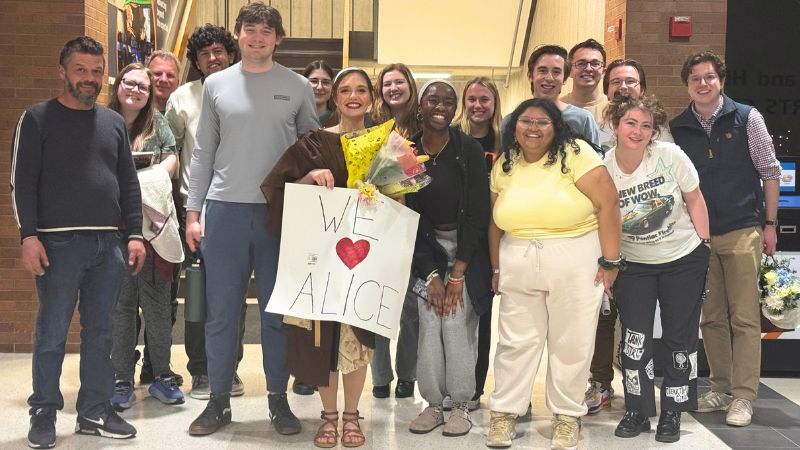
Alice’s journey was defined by stepping out of her comfort zone, whether it was 3D printing tactile art for the Vignelli Center or performing in the RIT Players’ production of “A Midsummer Night’s Dream.” Her favorite memory—seeing a surprise front row of family, co-op supervisors, and friends holding a "We [heart] Alice" sign on opening night—perfectly captures her evolution.
Now, preparing to graduate with RIT’s Class of 2026, she looks forward to her new job with Honeywell, while also remembering celebrating all the ways she’s grown and the people who helped along the way.
Meet Alice Cauchi
How did you combine studies to create an education for your goals and passions?
I started at RIT as a computer science major. There wasn't anything that really drew me to computer science other than I took a class in high school, and I just loved it and I was able to make things work and figure things out. (I have always been good at puzzles and problem solving.) Then I took a museum studies class for my immersion during freshman year. I always loved museums, and so when Dr. Decker mentioned to me that it could be a double major, it was perfect.
Whenever I tell people that I'm a computer science and museum studies double major, they ask “What do they have to do with each other?,” and I tell them they would be so surprised to hear how well they combine. For example, when I did my research for the MISHA team, I worked not only on their imaging side, but also updating their code base. I got to actually use my computer science knowledge and my programming knowledge to update a piece of historical research, which is really awesome!
I'm also super interested in education design. It's what I'm currently writing my thesis on, and I'm hoping to find a space where I can design curriculum for education—using my programming engineering background to create technology to help museums advance in that field.
It's not a very common mix, but I would say it’s getting me noticed in the job market. It is helpful to be able to use what I've learned in COLA, my writing and my public speaking or my ability to network with people. That's set me apart in job interviews; rather than just being able to technically show that I'm capable of engineering and problem solving, it allows me to think and present things in a more creative way. When I gave my elevator pitch at the career fair, it was definitely something that got recruiters going “what?” and wanting to know more. It's my secret little “in” at interviews and career fairs.
Reflecting on your time at RIT, what is your favorite memory?
Last spring, I was a part of the RIT Players’ production of “A Midsummer's Night Dream.” That whole time—rehearsing, getting to know the cast, being a part of something—was special. On opening night, new friends who I had made while on co-op, my best friends who were traveling and not on campus at the time, and my family all came. They all sat in the first few rows and kind of spread out.
Being in the play was something I was feeling really nervous to be doing, especially since I’m a little bit on the quieter side. I wasn't really expecting them to be there, and I couldn't see them because of the lights. But afterwards, when we were doing bows, the lights came on in the house, and then I saw my family and all of my best friends who had traveled to come see and even my supervisor from my co-op.
It was probably the most overwhelming emotional experience to see all the people who I loved come. We have a really funny picture of me holding a sign that they had made that said “We [heart] Alice” and my shocked face of just tears.
Did you have a favorite class, and if so, why?
In the spring of my freshman year, I took my first museum studies class, Visitor Engagement & Museum Technologies, and Dr. Decker was teaching it along with a couple other faculty. It was a class where we were given a big project: curating an exhibit to be held at the Vignelli Center. Using 3D printing, we recreated art pieces that had been clay, ceramics, and glass originally so that people visiting the exhibit could touch and interact with the them. We wrote description labels for each piece, too.
And, it made me think, “Oh, I could do this for work and it could be something that I can enjoy and love.” At the end of the exhibition, we got to take home some of the pieces that we had 3D printed or worked on, and mine was a red 3D printed cup and the label for it. My mom has it sitting on display in our house, so every time I go home, I'm reminded of that project.
What is the one most valuable skill you have learned at RIT?
I've had three co-ops so far, all in the same area (software engineering), but my liberal arts have taught me how to talk to people. We call it “networking,” but it’s really just being confident enough to go up to someone and say, “Hey, I think this job is something that I'm looking for, and I think you could be looking for someone like me. Let's have a conversation.” I think it’s what set me apart in job interviews and job fairs.
It's actually how I got my first co-op at Carrier! I was at a hackathon and overheard chatter that Carrier was looking for a software engineer to go to Oregon. So, I walked up to the hiring manager and said, “I heard you are looking for someone to go to Oregon. I love Oregon.” He asked, “Have you ever been?” I said, no, but I could learn to love it, and so I ended up in Oregon and it was a great experience.
The ability to market myself is something I've learned from my museum studies courses. Museum studies is a lot of outreach, a lot of knowing how to talk to people, to understand not only what the collection needs from you, but also what the institution requires from you. You have to be able to think creatively in the process, especially when you're picking up legacy work and software engineering. Being able to pitch a new idea, something they haven't maybe thought of before or haven't seen any new context is, I think, very valuable. It gets the gears turning, and it’s definitely something I've learned here through the College of Liberal Arts.
How has college shaped who you are today?
I'm a first generation American and a first generation college student, so getting into college was a really big deal for me and for my family. I went through high school doing what I needed to do to get into a good school. I was very, very focused, and I kind of told myself “If I just stay on top of my grades, it will all be great.” I had a one-track mind.
RIT has definitely made me more curious and willing to step out of those comfort zones and into trying something experimental, saying, “if it doesn't work out the way I think it will, that's totally okay.” It's okay because you can look back and say that you tried it, and either you'll loved it and it wasn’t for you.
Giving myself grace has been something that's really been new for me since I’ve been here. Now, I’m still definitely an 18-credit-semester kind of gal (I thrive on being busy), but I’ve grown to give myself that room to try new things and say, “okay, that didn't go so well, but what did you learn? What would I try again differently next time?” and be okay with that.
Another way I’ve changed is that now I am more extroverted. When I started RIT, I was kind of quiet, but when I came home freshman year between fall and spring semesters for winter breaks, my parents said they’d never seen me talk so much before! They said, “You're kind of a blooming person.” And, I definitely can see that in myself.
Advice for younger you—if you go back in time and give your freshman self advice, what would you say?
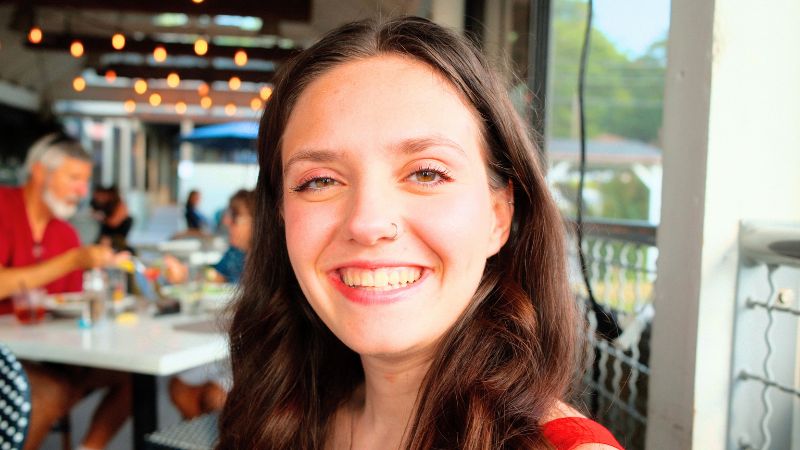
Don’t be afraid to lean on people and allow help. I started college feeling like I could think through all the problems by myself and be totally independent, but then college got hard and I had to lean on people. I wish I would have done it sooner.
My parents, my family, and also my friends have been one of my biggest support systems here on campus, and I cannot be more grateful to them for being a part of my life.
So, just be willing to accept help. Whether that be just simply asking for it or knowing when to seek it out is definitely something I would say do sooner. It makes college a lot easier if you're not trying to do everything by yourself.
Also, don’t be afraid to reach out to home and say things have been hard. I was always afraid to make my parents worry about me, especially because I'm far away. This was definitely a new experience for my parents as well, having one of their children leave home. They'll worry (that's their job as my parents), but they want to help. Asking for help is not a sign that you couldn't do it by yourself. It's just saying, I can do this by myself, but I need support. So, that's definitely the advice that I would give anybody, but specifically my younger self.
For supporting you along your RIT journey, is there anyone you’d like to thank?
I definitely want to thank my mom and my dad. They are why I'm who I am today and have always supported me throughout my entire journey. They check in and ask, “are you happy? Are you doing good? Do you still enjoy this?”
My sister, Roxy. She's my best friend, my baby sister. Now that she's older, we can lean on each other. She's been part of my biggest support system.
And, my best friends who I've made here, they know who they are. I won't list them all by name, but when they read it, they'll say, “oh, that's me.” Thanking them for being my roommates and living with me and putting up with me for so long, but also just being my support system and showing me how to have fun and become who I am through college. I want to thank them for that as well.
Dr. Decker introduced me to the realm of museum studies and has basically been a guiding North Star throughout that journey, introducing me to research opportunities and classes that she thought I would be interested in. She and Dr. Samaya Nasr are my thesis advisors, and I've been so lucky to have them along this whole curriculum journey with me, and I'm very grateful for them as well.
Program of Study
Computer Science BS and Museum Studies BS double major
Co-Ops & Internships
- Liberty Mutual Tech Start Internship Program, Portsmouth, NH
- Carrier Software Engineer, Salem, OR
- Honeywell Software Engineer, Pittsford, NY
Research
Team Member, Multispectral Imaging System for Historical Artifacts
After Graduation
Employed as a Software Engineer for Honeywell in Pittsford, NY.
Campus & Community
- Student Government COLA Senator and Vice President (Feb 2026)
- Computer Science Ambassador Golisano College of Computing and Information Sciences
- Academic Support Supplemental Instructor and Program Assistant
Study Abroad
Florence, Italy: Santa Reparata International School of Art (Summer 2025)
Awards & Honors
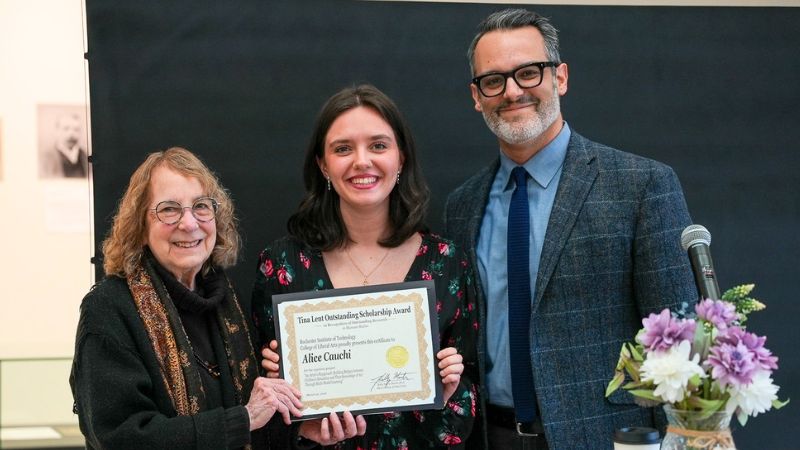
- Tina Lent Outstanding Scholarship Award Museum Studies, 2026
More Featured Profiles and Work
Landyn Hatch