News by Topic: Faculty
-
November 6, 2023
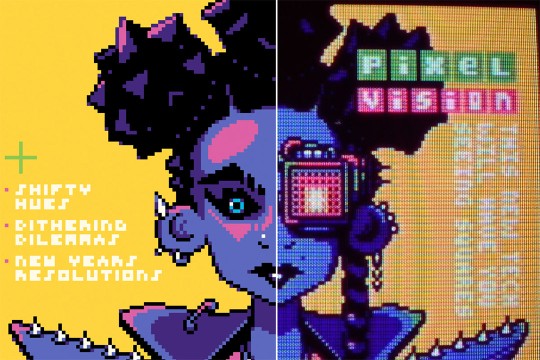
Pixel Art Conjures Nostalgia For A Screen Experience That Didn’t Exist
Science Friday talks to David Long, director of the MAGIC Center, about how CRT televisions display color.
-
November 3, 2023
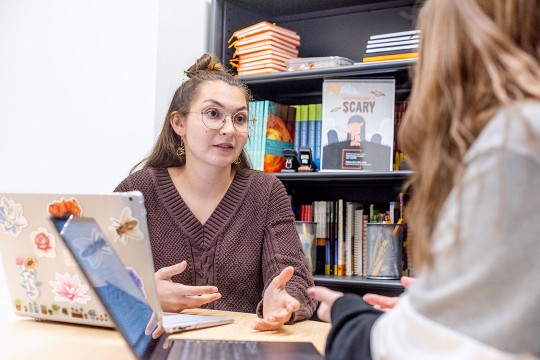
Peer consultants at the Writing Center and Expressive Communication Center boost students’ skills and confidence
The Writing Center and the Expressive Communication Center (ECC) provide peer consultations to help students gain confidence in writing and speaking. The Writing Center is housed in the University Writing Program within the School of Individualized Study, and the ECC is part of the School of Communication in the College of Liberal Arts.
-
November 3, 2023
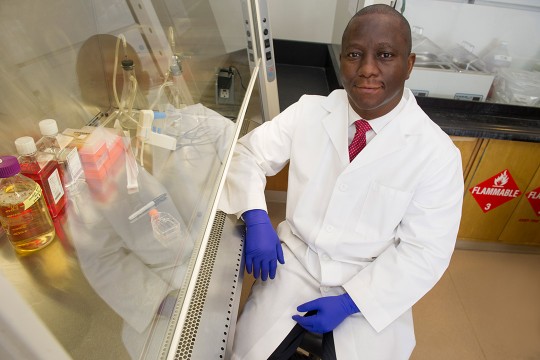
RIT researcher looks for genetic switch to prevent ‘sleeping sickness’ in cattle
RIT researcher Bolaji Thomas is leading a $650,000 study to compare the genetic response in cattle in sub-Saharan Africa to the parasitic disease Trypanosomiasis, or “sleeping sickness,” that attacks their blood and brain. As parasites adapt to a warming world, the biting fly that transmits Trypanosomiasis could someday migrate to northern climates.
-
November 1, 2023

The 'Silent Pandemic' Is Now Screaming at America's Children
Newsweek talks to Andre Hudson, dean of the College of Science, about antimicrobial resistance.
-
November 1, 2023
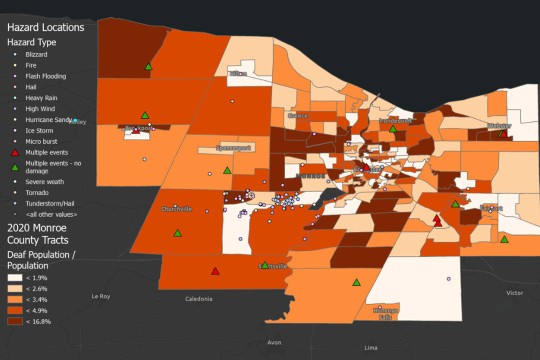
RIT researchers earn $1 million Civic Innovation Challenge grant to empower Deaf community
RIT and NTID researchers have identified a critical gap between emergency services and the needs of the Deaf and hard-of-hearing community. Now with a $1 million grant, they are working to bridge that divide.
-
October 30, 2023

Students deliver multispectral imaging system to The State Archives in Dubrovnik
The low-cost multispectral imaging system MISHA, or the Multispectral Imaging System for Historical Artifacts, was developed by RIT experts to uncover object details that aren’t visible to the naked eye.
-
October 30, 2023
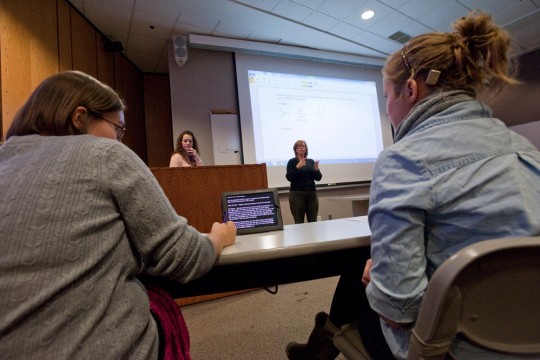
RIT scientists receive grant to expand work on a sign language lexicon for chemistry
A team of scientists at RIT will expand its work after receiving a large grant from the National Science Foundation to make chemistry more accessible for students who rely on American Sign Language interpreters in class. The team has been awarded nearly $380,000 for its proposal to transform chemistry for deaf and hard-of-hearing students via the design, implementation, and evaluation of a descriptive sign language lexicon.
-
October 27, 2023

RIT professor co-authors research on biochar accelerating pathway to global decarbonization
Groundbreaking new research published this month—co-authored by research faculty at RIT’s Golisano Institute for Sustainability—shows that carbon-removal solution biochar can play a significant role in emissions reductions at the global and national levels.
-
October 26, 2023

Engineering faculty-researcher awarded grant to decrease computer chip vulnerabilities
Michael Zuzak, a faculty-researcher at RIT, is one of a growing field of engineers looking to improve computer chip security during manufacturing. Zuzak received a two-year National Science Foundation grant to use the developmental practice of logic obfuscation to enable system-wide security during the manufacturing and testing of integrated circuits.
-
October 26, 2023

Technology takes a prominent role in Rochester’s health care higher ed programs
The Rochester Business Journal features the Human Movement Lab and talks to Jason Rich, lecturer in the exercise science program. (This content may require a subscription to view.)
-
October 25, 2023

Weed dealers in Rochester NY still leaving trail of death and destruction, 'gangs' or not
The Democrat and Chronicle talks to Irshad Altheimer, professor in the Department of Criminal Justice and director of the Center for Public Safety Initiatives, about gang-related violence.
-
October 24, 2023
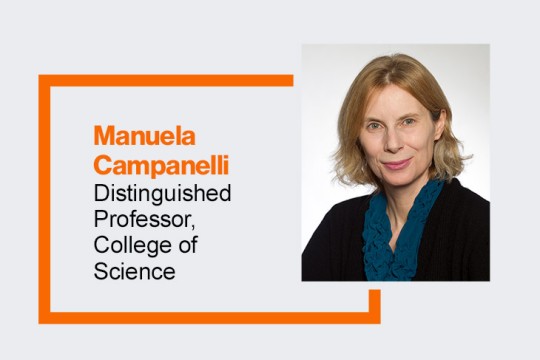
RIT’s Campanelli receives award for work in gravitational wave science
Distinguished Professor Manuela Campanelli has been honored with the American Physical Society’s (APS) 2024 Richard A. Isaacson Award in Gravitational-Wave Science for her extraordinary contributions to and leadership in the understanding and simulation of merging binaries of compact objects in strong-field gravity.